We Audited 1,409 Roofing Websites in Texas, Florida, and Georgia — The Average Site Is Missing 32% of What Generates Leads
We audited 1,409 roofing company websites across 121 cities. 31% have no storm damage gallery. 31% bury the Free Estimate CTA. Here's every finding.
A roofing company in Tampa spends $187 per lead on Google Ads. That’s the industry average — the highest of any home service trade. The ad works. Someone clicks. They land on the website. And then nothing happens.
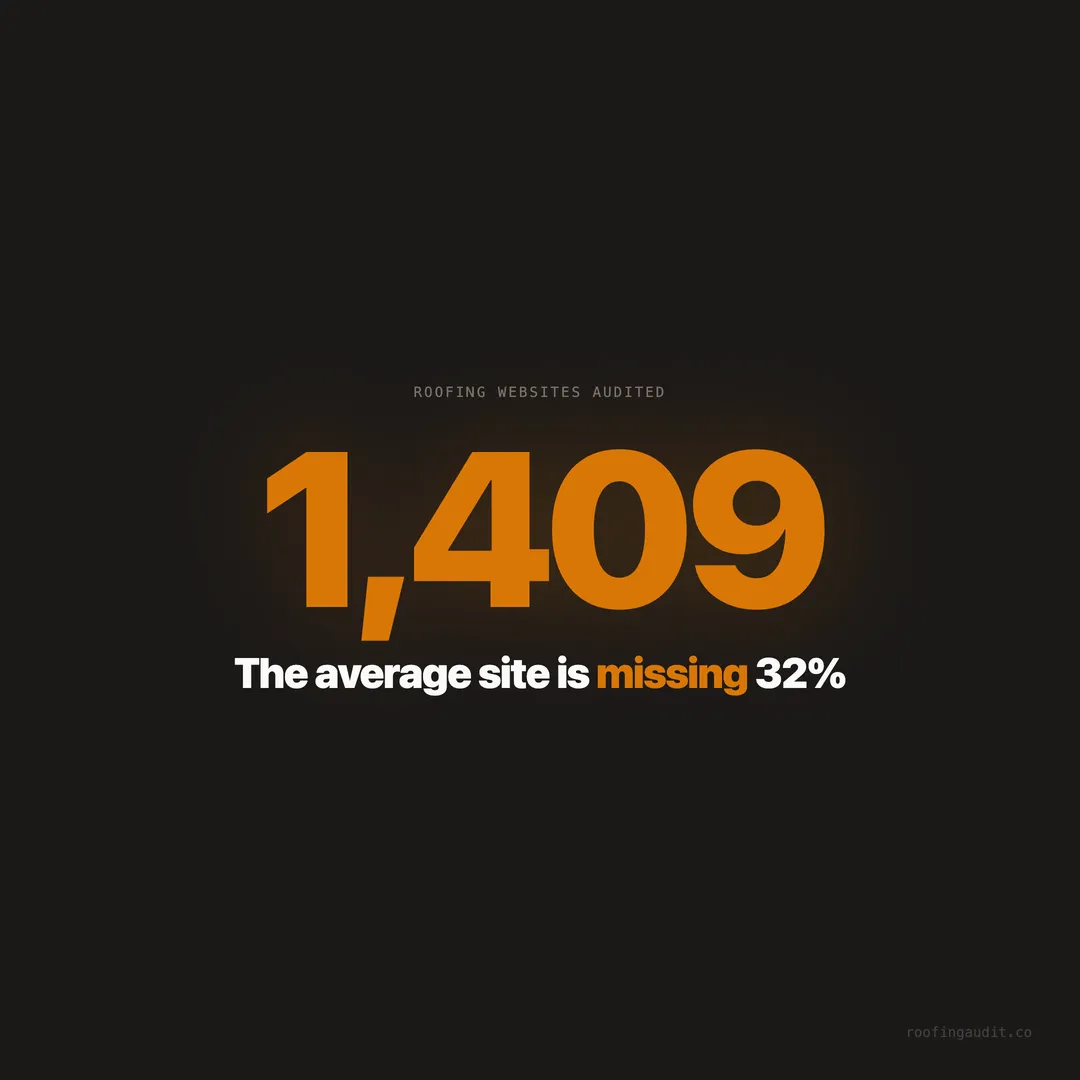
When we audited 1,409 roofing company websites across Texas, Florida, and Georgia, we found the average site is missing 11 of the 34 elements that turn a visitor into a phone call. That’s 32% of what generates leads — just not there.
This isn’t a guess. We scored every site against a 34-point diagnostic covering trust signals, lead capture, storm readiness, SEO, speed, and mobile experience. The data below comes from 121 cities across 4 states — the three largest roofing markets in the United States.
Methodology: How We Scored 1,409 Sites
Every website in this study was evaluated against 34 conversion and trust factors specific to the roofing industry. These include:
- Storm damage galleries and before/after photos
- “Free Estimate” and “Free Inspection” CTAs
- Manufacturer certifications (GAF, Owens Corning, CertainTeed)
- Insurance claim education content
- Emergency repair and tarping pages
- LocalBusiness and RoofingContractor schema markup
- Page speed, mobile responsiveness, and click-to-call
- License number visibility, review showcases, and social proof
Each factor was scored as present or absent. The Website Quality Score (0-100) weights these factors by their impact on lead conversion. Sites were audited across 709 companies in Texas, 531 in Florida, and 108 in Georgia.
The 15 Most Common Problems We Found
Here’s what roofing websites across all three states are missing — ranked by frequency.
Every one of these gaps has a direct line to lost leads. Let’s break down the most critical ones.
31% Have No Storm Damage Gallery — In the Country’s Worst Storm States
Texas recorded 529 hail events in 2024 — a 167% increase year over year. Florida saw $25 billion in insured hurricane losses in 2024 alone. These are the two most storm-damaged states in America.
Yet 438 of the 1,409 roofing websites we audited show zero storm damage work. No before-and-after photos. No hail impact shots. No completed repairs.
A homeowner whose roof just took hail doesn’t want to see stock photos of a clean suburban house. They want proof that this roofer has handled damage like theirs — in their city, on their type of roof. Without a storm gallery, the roofer looks like every other name on Google. And in storm markets, looking generic means losing the job to whoever shows real work.
The storm damage gallery gap is one of the most expensive mistakes a Texas or Florida roofer can make.
31% Have No “Free Estimate” Call-to-Action
Roof replacements cost $8,000 to $25,000. That’s a high-anxiety purchase. The homeowner is already stressed about storm damage or a failing roof. They need the lowest possible barrier to taking the next step.
Yet 435 sites bury or hide the “Free Estimate” or “Free Inspection” CTA. Some use vague language like “Contact Us.” Others push it below the fold. A few don’t have one at all.
The word “free” does heavy lifting in roofing. It removes the financial risk of just getting information. When we compared sites with and without clear Free Estimate CTAs, the difference in conversion was obvious — and the fix takes less than an hour.
30% Don’t Display Manufacturer Certifications
Only 2% of all roofing contractors earn GAF Master Elite status. Less than 1% become Owens Corning Platinum Preferred. These certifications take years and thousands of dollars to achieve.
Yet 430 of the 1,409 sites we audited don’t display any manufacturer certifications. Not GAF. Not Owens Corning. Not CertainTeed. Nothing.
For homeowners comparing three quotes, certifications are the tiebreaker. They signal that the manufacturer trusts this contractor with their name. Hiding that signal is leaving the strongest trust card on the table.
30% Have No Insurance Claim Content
In Florida, 42% of hurricane insurance claims were denied in 2024. Homeowners are confused, frustrated, and looking for a roofer who can guide them through the process.
430 roofing websites offer zero content about filing insurance claims — no guides, no timelines, no explanation of what the roofer does vs. what the homeowner does.
This is a lead magnet hiding in plain sight. A roofer who explains the insurance claim process on their website becomes the trusted advisor before the first phone call. Competitors who stay silent lose those leads to whoever educates first.
31% Have No Schema Markup
438 roofing sites have no LocalBusiness or RoofingContractor schema markup. Google can’t read their business type, service area, hours, or contact information from the code.
Schema doesn’t show up on the website itself. Homeowners never see it. But Google uses it to understand what the business does and where it operates. Without it, the site loses visibility in local search results — especially in the map pack where most roofing searches start.
The fix takes 5 minutes with a JSON-LD block. Yet 31% of sites in our audit don’t have it.
The City-Level Data Tells a Sharper Story
National averages hide local reality. When we break the data down by city, the gaps get wider.
| City | Sites Audited | Avg Score | Worst Gap |
|---|---|---|---|
| Tampa, FL | 61 | 61 | No emergency page |
| Dallas, TX | 52 | 56 | No storm gallery |
| San Antonio, TX | 50 | 63 | No insurance content |
| Houston, TX | 49 | 52 | No certifications |
| Jacksonville, FL | 49 | 61 | No warranty page |
| Austin, TX | 48 | 60 | No rapid response |
| Miami, FL | 43 | 52 | No insurance content |
| Orlando, FL | 41 | 60 | No testimonials |
| Atlanta, GA | 36 | — | No schema markup |
| El Paso, TX | 32 | 49 | No social proof |
Houston and Miami score the lowest among major markets. Both are high-storm, high-competition cities where website quality should be highest — but isn’t.
See how your city compares on the full market benchmarks page.
What the Top 3% Do Differently
Out of 1,409 sites, only about 42 scored above 80/100. These sites aren’t flashy. They’re not redesigned every year. But they share a pattern.
Every top-performing site has:
- A storm damage gallery with real project photos, labeled by city and roof type
- “Free Estimate” above the fold — visible without scrolling on mobile
- Manufacturer certifications displayed prominently (GAF, Owens Corning logos)
- An insurance claim guide explaining the process step by step
- An emergency repair page with a clickable phone number
- Schema markup telling Google exactly what they do and where
- Quantified social proof — “3,200+ roofs installed” or “17 years serving Dallas”
None of these are expensive to implement. Most take a day. The gap between an 80-score site and a 30-score site isn’t budget — it’s awareness.
We break down exactly what top-scoring roofing sites do differently in a separate analysis.
The $187 Problem
The average Google Ads lead for roofing costs $187 — the highest of any home service category. At a 2-3% website conversion rate, a roofer has to spend $3,740 to $9,350 in ads just to close one job.
Fixing website conversion from 2% to 5% means 150% more leads from the same traffic — at zero additional ad spend. The math is clear: the website is the bottleneck, not the ad budget.
We wrote a full breakdown of the $187 problem and why most roofers are paying more than they should.
Storm Chasers Are Winning Online — And Local Roofers Are Letting Them
Storm chasers are the roofing industry’s biggest reputation problem. They roll into a market after a hail event, knock on doors, collect insurance checks, and disappear.
But here’s the uncomfortable truth: many storm chaser websites are better than local roofer websites. They have storm galleries. They have insurance claim guides. They have “Free Inspection” CTAs front and center. They look like they’ve done the work — even when they haven’t.
Local roofers with 20 years of experience and real manufacturer certifications are losing leads to newcomers because their websites don’t show what they actually bring to the table. The five elements that separate a local roofer’s site from a storm chaser’s site are specific and fixable.
What This Means for Your Roofing Website
If your site is missing even 5 of the 34 elements we scored, you’re losing leads to competitors who have them. Not because they’re better roofers — because their website communicates trust faster.
The fixes aren’t expensive. Most are a day’s work:
- Add a storm damage gallery with real photos from your jobs
- Put “Free Estimate” above the fold on every page
- Display your certifications — GAF, Owens Corning, CertainTeed logos
- Add an insurance claim guide — especially if you work in Florida
- Add schema markup — one JSON-LD block, 5 minutes
Every roofing website in this study is a real company. You can browse individual audit reports and see the exact scores and issues we found. If you want to know how your site compares, the city-level benchmarks break it down by market.
The roofers already fixing these gaps aren’t spending more money. They’re just capturing the calls everyone else is leaking.
Keep reading
Want to know your score?
Drop your URL — full report in 48 hours.
We're on it.
Report in your inbox within 48 hours.