The State of Roofing Company Websites in 2026
Annual benchmarks from 1,409 roofing sites: avg score 38/100, 31% missing storm galleries, $187/lead on ads. The full industry report.
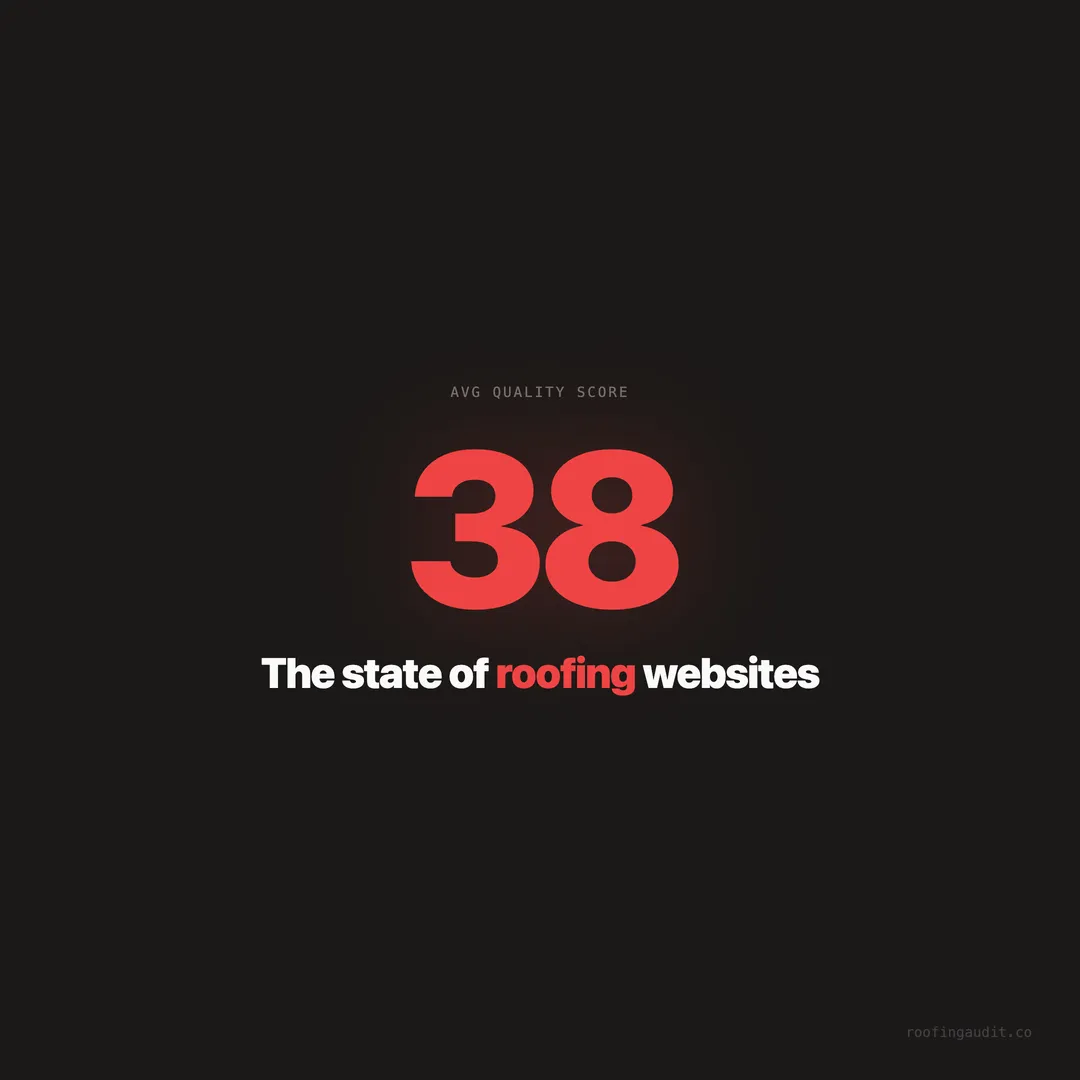
The roofing industry generated $33.29 billion in revenue in 2026. There are 101,679 roofing contractor businesses operating in the United States. And the average roofing company website scores 38 out of 100 on lead-generation readiness.
That gap between industry revenue and digital maturity is the story of this report. We audited 1,409 roofing websites across 121 cities in Texas, Florida, and Georgia — the three largest storm-damage roofing markets in the country — and scored each one against 34 conversion and trust factors.
This is the first annual State of Roofing Websites report. The data below represents what we found in early 2026.
The Big Numbers
| Metric | Value |
|---|---|
| Websites audited | 1,409 |
| Cities covered | 121 |
| States | 4 (TX, FL, GA, NM) |
| Average Website Quality Score | 38/100 |
| Sites scoring below 40 | ~66% |
| Sites scoring above 80 | ~3% (42 sites) |
| Google Ads avg lead cost (roofing) | $187 |
| Average roof replacement | $8,000 — $25,000 |
The average roofing website is missing roughly one-third of the elements that drive leads. For a trade where a single job can exceed $15,000, that’s an expensive gap.
Lead Capture: The Biggest Weakness
The most critical gaps we found are in lead capture — the elements that turn a website visitor into a phone call or form submission.
31% have no “Free Estimate” CTA. On a purchase that costs $8,000-$25,000, the word “free” removes the financial barrier to getting started. Sites without it use vague language like “Contact Us” — or worse, bury the CTA below the fold. Read the full analysis of the missing CTA problem.
31% have no project gallery. Homeowners want proof. Before-and-after photos from real jobs — especially storm damage repairs — build trust faster than any testimonial. The storm damage gallery gap is particularly acute in Texas and Florida.
31% have no testimonial showcase page. Reviews exist on Google, but they’re not displayed on the website. When a homeowner is comparing three roofers, the one showing reviews on their own site converts more visitors.
Trust Signals: The Silent Conversion Killer
Roofing is a trust-intensive purchase. A stranger is going to climb on your roof, tear off the old material, and replace it — often while filing an insurance claim. Trust signals on the website determine whether that first call happens.
30% don’t display manufacturer certifications. Only 2% of all roofers earn GAF Master Elite status. Those who have it — or any manufacturer certification — should be showing it prominently. The 30% who don’t are hiding their strongest trust card.
31% have no quantified social proof. No “3,200 roofs completed.” No “serving Houston since 2005.” No specific numbers at all. Just vague claims like “quality workmanship” that every competitor also makes. We detail why quantified proof outperforms generic claims.
31% don’t display their license number. In states that require contractor licensing, displaying the number on the website is a basic trust signal — and a legal compliance indicator. 431 sites in our audit skip it entirely.
Storm Readiness: Critical in TX and FL
The roofing markets we audited are storm markets. Texas and Florida lead the country in hail damage and hurricane damage respectively. Website storm readiness should be a baseline — but it’s not.
31% have no storm damage gallery. In states where homeowners regularly file storm claims, visual proof of storm repair work is the number one trust builder. The gallery gap costs these roofers the highest-intent leads.
31% have no same-day or rapid response messaging. After a hailstorm or hurricane, homeowners want speed. The roofer whose website says “on-site within 2 hours” beats the one whose website says nothing about response time.
30% have no insurance claim content. In Florida — where 42% of claims are denied — this is a massive missed opportunity. Homeowners searching “how to file roofing insurance claim” are ready to hire the roofer who helps them through it.
30% have no emergency repair page. Storms don’t happen during business hours. A roofer without an emergency page loses every after-hours search to the competitor who has one.
SEO: Invisible to Google
31% have no LocalBusiness or RoofingContractor schema markup. This is invisible to visitors but critical for Google. Schema tells search engines what the business does, where it operates, and how to display it in local results. Without it, the site is harder to find for “roofer near me” searches.
31% have missing or weak meta descriptions. The meta description controls how the site appears in search results. A compelling description with a CTA gets more clicks. A missing one means Google picks random text from the page — usually not the most persuasive snippet.
31% have zero image alt tags. Every image on the site is invisible to Google Image Search and inaccessible to screen readers. Alt tags are one of the easiest SEO fixes available.
Content: Missing Service Pages
Roofing is not one service. It’s roof replacement, repair, inspection, emergency tarping, metal roofing, shingle installation, solar-ready roofing, commercial flat roofs, and more. Each service type deserves its own page — for both SEO and conversion.
30% have no metal roofing page — despite metal roofing being the fastest-growing segment at 15-20% of the market.
31% have no roof replacement process page — the most expensive service a roofer offers, and 31% don’t explain how it works.
30% have no emergency repair page — losing every after-hours and post-storm lead.
31% have no manufacturer warranty information — on a purchase where the warranty is often the deciding factor.
The Competitive Landscape
The roofing industry is at an inflection point. The $187 cost-per-lead on Google Ads — the highest in home services — is pushing contractors to either optimize their websites or keep hemorrhaging ad budget.
At a 2-3% conversion rate, a roofer spends $3,740-$9,350 in ads to close a single job. Fixing conversion from 2% to 5% means 150% more leads at zero additional cost. The math on paid vs. organic makes the case clearly.
Meanwhile, storm chasers — fly-by-night contractors who follow storms — often have better websites than established local roofers. They have storm galleries, insurance guides, and prominent CTAs. Local roofers with 20 years of experience are being outcompeted online by companies that didn’t exist last year.
What Needs to Change
The roofing industry doesn’t have a demand problem. Storm damage is increasing. Roofs are aging. Homeowners are searching online.
The problem is that two-thirds of roofing websites score below 40 on lead-generation readiness. The traffic arrives. The website fails to convert. The lead goes to whoever has the next-best site.
The top 3% of roofing websites prove it’s fixable. The elements that drive conversion are known, specific, and implementable in days. The question for every roofing company is whether they’ll fix the leaks in their website before their competitors do.
The full 34-point checklist is the starting point. The city-by-city benchmarks show where you stand relative to your market. And the individual audit reports let you see exactly what we found on real roofing sites.
The data is here. What you do with it determines whether you keep paying $187 per lead — or start generating them for free.
Keep reading
Want to know your score?
Drop your URL — full report in 48 hours.
We're on it.
Report in your inbox within 48 hours.