Solar-Ready Content: Why 31% of Roofing Sites Are Missing the Next Revenue Stream
438 of 1,409 roofing sites have zero solar content. With solar CAGR at 13.8% and 39% of commercial roofers already offering solar, the gap is costing leads.
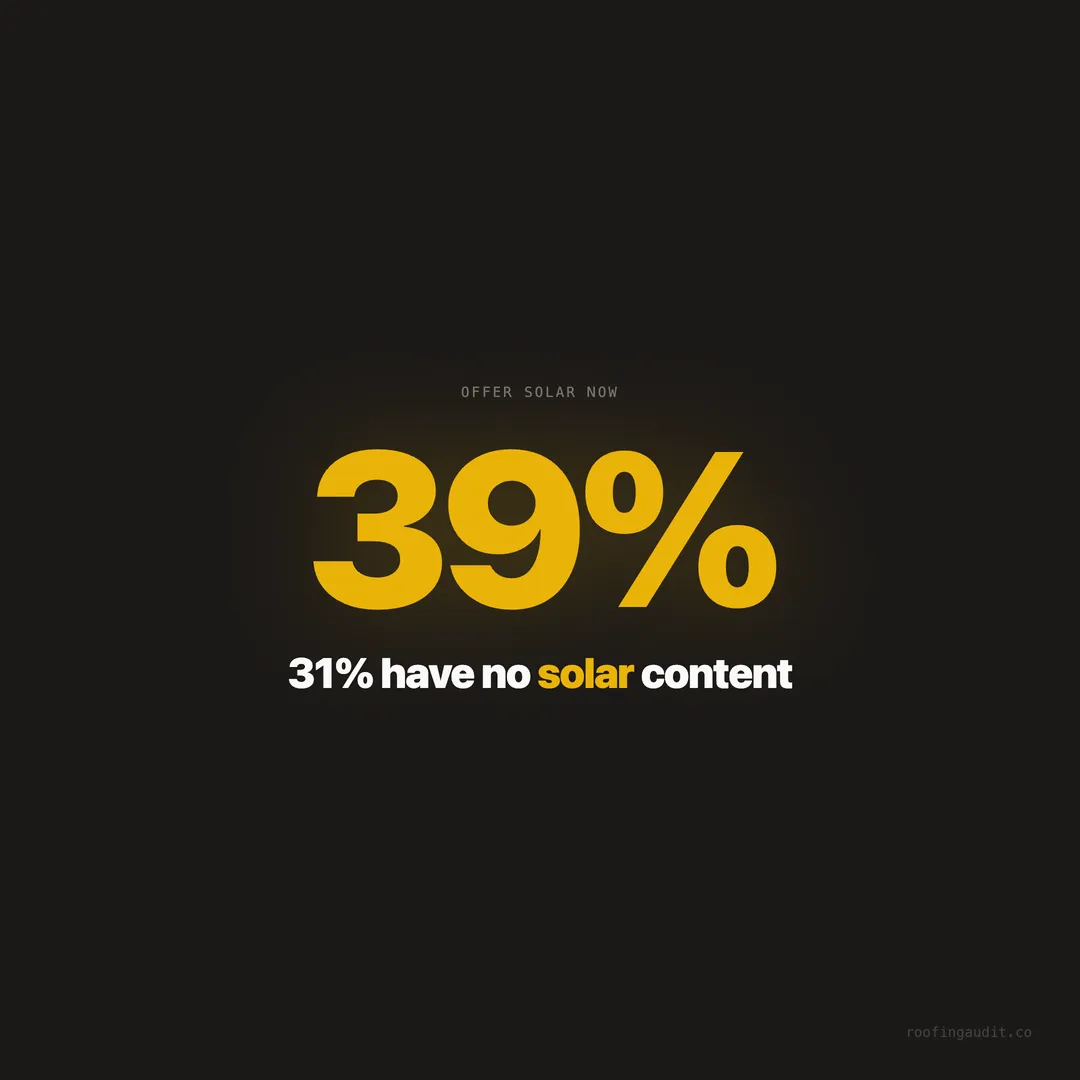
When we audited 1,409 roofing websites across Texas, Florida, and Georgia, 438 — 31% — had no solar content whatsoever. No solar-ready roofing page. No mention of panel-compatible installations. No content addressing the fastest-growing segment in residential construction.
Meanwhile, the U.S. residential solar market hit $6.42 billion in 2025 and is growing at a compound annual growth rate of 13.8%. Homeowners installing new roofs are already asking about solar. If your website doesn’t answer that question, someone else’s will.
The roofing companies that treat solar as “not my problem” are handing revenue to competitors who figured this out two years ago. And the data from our audit proves it.
Roofing and Solar Are Converging Whether You Like It or Not
This isn’t a trend you can wait out. Three forces are pushing roofing and solar together:
Homeowner behavior is changing. When a homeowner needs a roof replacement costing $8,000-$25,000, they’re already spending a significant amount. The incremental cost of making that roof solar-ready — or installing panels at the same time — becomes a natural conversation. 68% of leads start on mobile, and those homeowners are comparing roofers side by side. The one who mentions solar gets the second look.
Building codes are mandating it. California’s Title 24 already requires solar on new residential construction. Other states are following. Even in Texas and Florida, energy code updates are pushing toward solar-ready roofing standards. Roofers who can’t speak to this look behind the curve.
Economics favor bundled installations. Installing solar during a roof replacement saves the homeowner $3,000-$5,000 in labor costs compared to installing panels on an existing roof. The roofer who bundles the service captures a larger job value — often pushing total project revenue from $12,000 to $28,000+.
39% of commercial roofers in our dataset already offer some form of solar service. The residential side is catching up fast.
438 Sites Are Invisible to Solar-Interested Homeowners
Here’s the search behavior that matters. A homeowner who needs both a roof and solar panels types queries like:
- “solar-ready roof replacement [city]”
- “can I add solar panels during roof replacement”
- “roofer who installs solar [city]”
- “best roofing material for solar panels”
- “solar roof installation cost”
438 roofing websites in our audit have zero content addressing any of these queries. They’re invisible to an entire category of high-value homeowners — homeowners who are already planning to spend $8,000-$25,000 on a roof and are willing to spend $15,000-$30,000 more for solar.
That’s not a small missed opportunity. That’s a $20,000+ average project value that these roofers never even get a chance to quote.
The roofers who do have solar content are capturing these leads with minimal extra effort. A single well-built solar page — explaining compatibility, process, and pricing — puts the roofer in front of homeowners that 31% of competitors can’t reach.
The Three Levels of Solar Readiness
Not every roofer needs to become a solar installer. The data shows three distinct approaches that work, depending on the business model:
Level 1 — Solar-Compatible Content (Minimum)
At minimum, every roofing website should address solar compatibility. This means:
- A section on your roof replacement page explaining which materials work best with solar panels (standing seam metal is ideal, architectural shingles work well, tile requires additional mounting)
- A mention of solar-ready underlayment and flashing so homeowners know you understand the requirements
- A note about conduit pathways — pre-running conduit during a roof replacement saves $500-$1,500 later
This costs nothing to add. It’s content, not a new service line. And it captures search traffic from homeowners researching the intersection of roofing and solar.
Level 2 — Solar Partnership Model
Many successful roofers partner with a local solar installer. The roofer handles the roof, the solar company handles the panels, and the homeowner gets one coordinated project. This model works because:
- The roofer captures the full roofing job ($8,000-$25,000)
- The roofer earns a referral fee from the solar partner ($500-$2,000 per referral)
- The homeowner gets a single point of contact
- The solar partner gets pre-qualified leads with brand-new roofs
On the website, this shows up as a “Solar Partnerships” or “Solar-Ready Roofing” page that explains the bundled process. It positions the roofer as a full-service solution without the overhead of becoming a licensed solar contractor.
Level 3 — Full Solar Integration
39% of commercial roofers in our dataset already offer solar installation as a service line. For residential roofers with the capital and licensing, this is the highest-margin approach. A combined roof-and-solar project can exceed $40,000 in total value, with margins on the solar portion running 20-30%.
The website for a full-integration roofer needs:
- A dedicated solar landing page with project photos
- A financing calculator (solar + roof combined)
- Case studies showing combined project savings
- Manufacturer certifications for both roofing and solar products
What the Top-Scoring Sites Do Differently
The top 3% of roofing websites in our audit were 2.4 times more likely to have solar content than the average site. Here’s what they include:
Solar-specific project galleries. Not just roofing photos — but photos of roofs with panels installed, including the mounting system, flashing details, and finished result. Homeowners want to see what it looks like on a house similar to theirs.
Cost comparison content. A clear breakdown of the cost to add solar during a roof replacement vs. retrofitting panels on an existing roof. The savings are significant — $3,000-$5,000 in avoided labor — and this data converts visitors into leads.
Incentive and tax credit information. The federal Investment Tax Credit (ITC) currently covers 30% of solar installation costs. Most homeowners don’t know this applies when solar is installed during a roof replacement. Roofers who explain this on their website add a powerful financial incentive to their pitch.
Material compatibility guides. Which roofing materials work best with different panel mounting systems. Standing seam metal allows clamp-on mounting with no roof penetrations. Asphalt shingles require rail-mounted systems with flashed lag bolts. Tile roofs need specialized tile hooks. This content demonstrates expertise and captures long-tail search traffic.
The Financial Case for Solar Content
Let’s break down the math for a roofer who adds a solar page to their website.
Cost to create the page: $0 if you write it yourself, or $200-$500 if you hire a writer. One-time investment.
Search traffic captured: Solar-related roofing queries in a mid-size Texas or Florida market generate 100-400 searches per month. Even ranking on page two captures some of that traffic.
Lead value: A homeowner searching for solar-ready roofing is planning a project worth $20,000-$40,000+. At the standard roofing industry close rate of 30%, every three qualified leads produces one job.
Referral revenue: If you partner with a solar installer, referral fees of $500-$2,000 per completed installation create a revenue stream that costs nothing beyond the initial introduction.
Lifetime value: A homeowner who trusts you with both their roof and their solar installation will refer you to neighbors. The lifetime customer value of a solar-roofing client is 3-5x that of a roof-only client.
Compare this to buying leads at $187 each through Google Ads. A single solar-roofing page that generates two organic leads per month replaces $4,488 in annual ad spend — from a one-time content investment.
How Solar Changes the Sales Conversation
The roofing sales conversation has traditionally been straightforward: inspect the roof, provide an estimate, close the deal. Solar adds a dimension that many roofers avoid because they’re unfamiliar with it. But the roofers who embrace it report several advantages:
Longer conversations lead to higher close rates. When a roofer can discuss solar compatibility, the sales visit takes longer — but the homeowner feels more informed and more confident. Close rates for bundled roof-solar projects run 35-40%, higher than the 30% industry average for roof-only jobs.
Higher average ticket. A roof replacement alone averages $12,000. Add solar and the ticket jumps to $28,000-$40,000+. Even with a solar partner handling the panel installation, the roofer captures the full roofing revenue plus a referral fee.
Reduced price sensitivity. Homeowners shopping for solar-ready roofing are less price-sensitive than homeowners shopping for a basic roof replacement. They’re already planning a premium investment. They care more about quality, warranty, and long-term performance than shaving $500 off the quote.
Repeat and referral business. Solar-roofing clients become advocates. They show off their panels to neighbors. They mention the roofer who made it all seamless. In neighborhoods where one home gets solar, adjacent homes are 63% more likely to consider it — and they’ll call the same roofer.
State-by-State Solar Readiness
The solar opportunity varies by state, and your content should reflect local market conditions:
Texas leads the nation in new solar capacity installations, with 8.7 GW added in 2024. The combination of high electricity costs, abundant sunshine, and hail-prone weather makes solar-ready roofing particularly relevant. A Texas roofer should emphasize hail-resistant solar mounting systems and impact-rated panels.
Florida has the second-highest solar potential in the country but ranks lower in installations due to utility-friendly regulations. However, homeowner demand is surging. A Florida roofer should focus on hurricane-rated mounting systems, wind uplift testing, and the fact that a new roof is the ideal time to go solar before the next hurricane season.
Georgia is emerging as a solar market with 3.2 GW of installed capacity. The state’s growing population and rising energy costs make it a prime market for bundled roof-solar installations. Georgia roofers should emphasize the federal tax credit and Georgia Power’s net metering policies.
Building Your Solar Page Today
You don’t need to become a solar expert overnight. You need a page that demonstrates awareness and positions your company as solar-ready. Here’s the minimum content:
Opening section: Explain that you install solar-compatible roofing systems. Mention that a roof replacement is the ideal time to prepare for solar — or install panels simultaneously.
Material compatibility: List which roofing materials you install and how each works with solar panels. Standing seam metal is the premium option. Architectural shingles are the most common. Tile requires specialized mounting.
Process overview: Whether you install solar yourself or partner with a solar company, explain the process. How long does it take? What’s the coordination between roof and panel installation? Who handles permitting?
Cost and savings: Mention the 30% federal tax credit. Note the savings of bundling vs. retrofitting. Provide a general cost range for combined projects.
Call to action: “Planning a roof replacement? Ask us about solar-ready options during your free estimate.”
That single page — built once — captures homeowners who are currently choosing your competitors because your site doesn’t mention solar at all.
The 438 Roofers Who Are Already Behind
The solar market isn’t slowing down. At 13.8% CAGR, it will nearly double by 2030. Every month that passes without solar content on your website is a month where homeowners searching for solar-ready roofing can’t find you.
438 roofing sites in our audit have zero solar content. Those roofers are invisible to a growing market segment that’s spending $20,000-$40,000+ per project. They’re losing to competitors who spent an afternoon adding a solar page.
The top-performing roofing websites don’t just have better design or faster load times. They have content that matches what homeowners are actually searching for. And increasingly, homeowners are searching for roofers who understand solar.
The question isn’t whether solar matters to your roofing business. The market has already answered that. The question is whether your website reflects it — or whether you’re one of the 438 roofers whose sites pretend solar doesn’t exist.
Your website checklist should include solar-ready content. Your competitive benchmarks should factor it in. And your lead generation strategy should recognize that the homeowner comparing your site to a competitor’s will notice when only one of you addresses the biggest trend in residential construction.
Fix the gap. Add the page. Capture the leads.
Keep reading
Want to know your score?
Drop your URL — full report in 48 hours.
We're on it.
Report in your inbox within 48 hours.