How a Slow Website Costs Your Roofing Business $8K-$25K Jobs
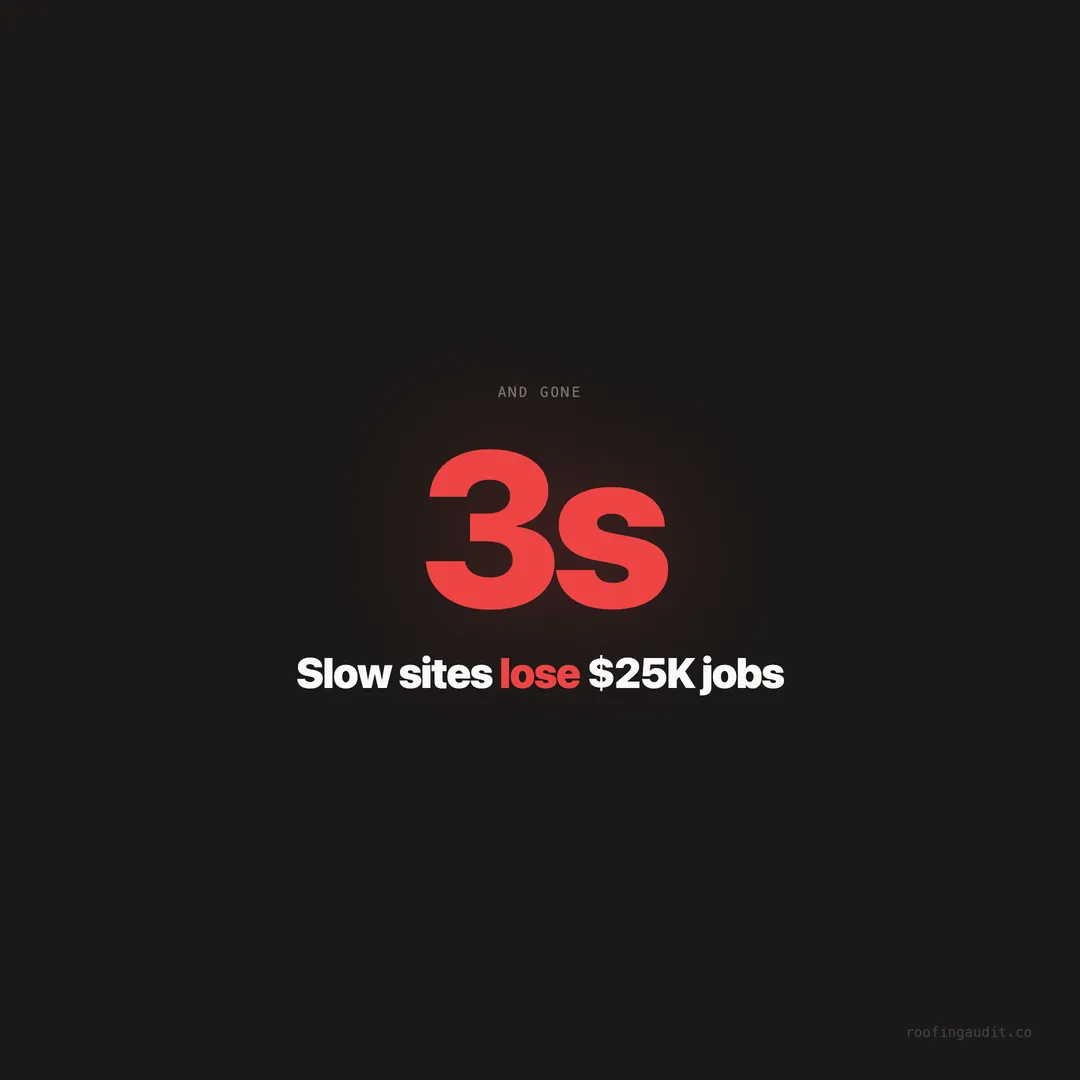
53% of mobile visitors leave after 3 seconds. With roofing jobs worth $8K-$25K and leads at $187 each, a slow website bleeds revenue every day.
A homeowner in Houston watches her ceiling stain grow after last night’s storm. She pulls out her phone, searches “roof repair near me,” and clicks the first result. The page takes five seconds to load. She hits back. Clicks the second result. That site loads in under two seconds. She calls them. That call turns into an $18,000 roof replacement.
The first roofer never knew they lost the job. Their website told the homeowner to leave before they could even see the phone number.
When we audited 1,409 roofing company websites across Texas, Florida, and Georgia, slow load times were one of the most consistent problems we found — and one of the most expensive. In an industry where the average Google Ads lead costs $187 and jobs range from $8,000 to $25,000, every second of load time has a dollar value attached to it.
53% of Mobile Visitors Leave After 3 Seconds
Google’s own research puts the number at 53% abandonment when a mobile page takes longer than 3 seconds to load. That number gets worse with each additional second. At 5 seconds, it climbs to 90%. At 10 seconds, the visitor is long gone.
This matters more for roofers than almost any other trade. 68% of roofing leads start on a mobile device. The homeowner isn’t sitting at a desk with fiber internet. She’s standing in her driveway, looking at damaged shingles, searching on a phone that might be on a congested 4G network. Load time isn’t theoretical for her — it’s the difference between calling your company and calling the next one.
The roofing industry’s $187 average cost per lead from Google Ads is the highest in home services. When more than half of those paid clicks bounce because the page loaded too slowly, the math is brutal. You’re paying $187 to send someone to a page they never see.
The Real Cost of a Slow Roofing Website
Let’s do the math that most roofing companies never run.
Say you get 100 visitors per month from Google Ads. At $187 per click, that’s $18,700 in ad spend. If your site loads in 5+ seconds and 90% bounce, you’ve paid $16,830 for nothing. Even at 3 seconds with a 53% bounce, you’ve lost $9,911 worth of traffic before anyone reads a word on your site.
Now consider what those visitors are worth if they convert. A roofing job averages $8,000 to $25,000. Even at a modest 5% conversion rate on the visitors who stay, one extra second of load time can eliminate several conversions per month. That’s not a $187 loss — that’s an $8,000 to $25,000 loss per missed conversion.
Over a year, a slow website can cost a roofing company $100,000 or more in lost jobs. Not from bad marketing. Not from bad reviews. From a website that took too long to show up.
What Makes Roofing Websites Slow
Roofing websites have a unique speed problem. The product is visual — homeowners want to see completed roofs, before-and-after photos, crew shots, certifications. That means lots of images. And images are the number one speed killer.
When we examined the slowest-loading sites in our audit, the same problems appeared repeatedly.
Uncompressed Project Photos
Roofers upload photos straight from their phone or camera. A single iPhone photo can be 4-8 MB. A gallery page with 20 uncompressed photos loads 80-160 MB of images before anything appears on screen. For context, the entire homepage of a fast website should weigh under 2 MB total.
The fix is straightforward: convert images to WebP or AVIF format, compress them to 50-100 KB each, and serve them at the correct display dimensions. A photo that’s 4000x3000 pixels doesn’t need to be that large if it’s displayed at 800x600 on the page. This single change — covered in depth in our post about roofing website images killing load time — can cut page weight by 90% or more.
No Lazy Loading
Every image on the page loads immediately, whether the visitor can see it or not. This means a gallery page with 30 photos tries to download all 30 before showing anything. Lazy loading tells the browser to only load images as the visitor scrolls to them. The visible images load first. Everything below the fold waits its turn.
Bloated Website Builders
Many roofing sites run on WordPress with 15-30 plugins, a theme with built-in page builders, and tracking scripts stacked on top. Each plugin adds JavaScript. Each script blocks rendering. The site becomes a Frankenstein of code that the homeowner’s browser has to download, parse, and execute before showing the first pixel.
Some of these plugins add genuine value — contact forms, review widgets, analytics. But many are dead weight: unused sliders, animation libraries, social media widgets nobody clicks, and backup plugins that shouldn’t run on the front end.
Third-Party Scripts Without Delay
Google Analytics, Facebook Pixel, Microsoft Clarity, chat widgets, review aggregators — each one adds 50-200 KB of JavaScript and multiple network requests. Loading them all at page load competes directly with showing the visitor your phone number and “Free Estimate” button.
The solution isn’t removing analytics. It’s loading them after the page has fully rendered. A 1-2 second delay on third-party scripts is invisible to the analytics data but makes a measurable difference in load time.
Speed and Google Rankings Are Connected
Google has used page speed as a ranking factor since 2018 and made Core Web Vitals a ranking signal in 2021. The three metrics that matter:
- LCP (Largest Contentful Paint): How long until the biggest visible element loads. Should be under 2.5 seconds.
- FID/INP (Interaction to Next Paint): How long until the page responds to a tap or click. Should be under 200 milliseconds.
- CLS (Cumulative Layout Shift): How much the page layout jumps around during loading. Should be under 0.1.
A slow roofing website doesn’t just lose the visitor — it ranks lower, which means fewer visitors to begin with. The compounding effect is devastating. Slow page = lower rank = fewer clicks = the clicks you do get bounce = even fewer leads.
Among the top-scoring roofing websites in our audit, every one loaded in under 3 seconds. Among the bottom 30%, load times frequently exceeded 6 seconds.
Mobile Speed Is the Real Bottleneck
Desktop speed tests can be misleading. Most roofing company owners check their website on a fast office computer with broadband internet. It loads in 2 seconds. Looks fine. Problem solved.
But 68% of roofing leads start on mobile. The homeowner is outside, on a phone, possibly in a storm-affected area where cell towers are congested. The effective connection speed might be 3G or slow 4G — a fraction of what the office computer gets.
A site that loads in 2 seconds on desktop can take 8-12 seconds on a real mobile connection. That’s the gap that kills leads. And it’s the gap most roofers never see, because they never test their site the way their customers actually use it.
Google’s PageSpeed Insights tool simulates a mid-range mobile device on a throttled connection. This is the closest approximation to what your actual customers experience. If you’ve never run your site through it, the results will probably surprise you.
What Fast Roofing Websites Do Differently
The top-performing roofing websites in our audit share specific speed practices. None of them require a redesign. All of them can be implemented on an existing site.
They Compress Every Image
No raw camera uploads. Every photo goes through compression before hitting the website. WebP format cuts file size by 25-34% compared to JPEG with no visible quality loss. The gallery still looks professional. The page loads in half the time.
They Lazy Load Below-the-Fold Content
The hero section, phone number, and CTA load immediately. The project gallery, testimonials, and footer images load as the visitor scrolls. This means the most important content — the part that generates the call — appears instantly.
They Minimize JavaScript
Fast roofing sites don’t run 20 plugins. They use lightweight themes, minimal scripts, and defer everything non-essential. The contact form loads. The click-to-call button works. The analytics track in the background. Everything else is stripped or deferred.
They Use a CDN
A Content Delivery Network serves the site from servers physically close to the visitor. A homeowner in Miami gets the page from a Florida server, not a data center in Oregon. CDNs cut load time by 40-60% for geographically distributed traffic.
They Test on Real Mobile Connections
The owners or marketers check the site on a phone, on cellular data, in the field. They know exactly what a homeowner sees when she searches from her driveway after a storm. This reality check catches problems that desktop testing misses.
The 3-Second Test for Roofing Websites
We wrote an entire guide on the 3-second test — a quick diagnostic for whether your site passes the basic speed threshold. Here’s the core of it:
- Open your website on your phone (not Wi-Fi — use cellular data)
- Start a stopwatch when you tap the link
- Stop when the page is fully visible and interactive
If it takes more than 3 seconds, you’re losing more than half your mobile visitors. If it takes more than 5 seconds, you’re losing nearly all of them.
This isn’t a vanity metric. It’s the single most predictive number for whether a roofing website will generate leads or hemorrhage them.
Speed Directly Affects Your Cost Per Lead
Most roofers focus on getting more traffic — more ads, more SEO, more social media posts. But traffic doesn’t matter if the website can’t hold the visitor long enough to convert.
A roofing company paying $187 per lead on Google Ads with a 5-second load time is effectively paying $1,870 per lead — because 90% of those clicks bounce. Cutting load time to under 2 seconds doesn’t require more ad spend. It makes the existing spend work 9 times harder.
This is why site speed shows up in our 34-element roofing website checklist. It’s not a design preference. It’s a revenue multiplier.
How to Fix a Slow Roofing Website This Week
You don’t need a new website. You need to eliminate the specific bottlenecks that slow down the existing one.
Day 1: Run a speed test. Use Google PageSpeed Insights. Test the homepage and one gallery page. Write down the scores and note the specific recommendations.
Day 2: Compress images. Every image on the site should be WebP, under 100 KB, and sized to its display dimensions. Free tools like Squoosh handle this in minutes. This single step often cuts load time in half.
Day 3: Add lazy loading. If your platform supports it (WordPress, Wix, Squarespace all do), enable lazy loading for all images below the hero section. If you’re on a custom site, one line of HTML per image (loading="lazy") handles it.
Day 4: Defer third-party scripts. Move Google Analytics, chat widgets, and review embeds to load after the page renders. Most platforms offer a “defer” or “async” option. This frees up the browser to show your content first.
Day 5: Retest. Run PageSpeed Insights again. Compare the before and after. On most roofing sites, these four steps produce a 30-60 point improvement on the mobile score.
Five days. No redesign. No developer needed for most of it. And the payoff — capturing the leads that a slow site was leaking — starts immediately.
Every Second Has a Price Tag
A homeowner searching for a roofer after a storm isn’t patient. She’s stressed, she’s dealing with insurance, and she has three browser tabs open with three different roofers. The site that loads first gets the call. The site that loads second gets the back button.
When we audited 1,409 roofing websites, the speed gap between the best and worst was enormous. The fastest sites loaded in under 2 seconds on mobile. The slowest exceeded 10 seconds. The difference in lead generation between those two groups was not subtle.
A roof replacement costs $8,000 to $25,000. Losing one job because your website loaded too slowly is expensive. Losing one job per week is catastrophic. And at $187 per Google Ads click, you’re paying for the privilege of losing those jobs.
Speed is not a technical detail. It’s the first thing your customer experiences. Make it fast, or make peace with your website not generating leads.
Keep reading
Want to know your score?
Drop your URL — full report in 48 hours.
We're on it.
Report in your inbox within 48 hours.