Why Most Roofing Websites Are Brochures Instead of Lead Machines
The average roofing site scores 38/100 on lead generation. It informs instead of converts. Here's why — and what the top 3% do differently.
Most roofing websites were built to exist — not to generate leads. They have an about page. A list of services. A phone number somewhere. Maybe a stock photo of a clean roof. They look like a digital business card — and that’s exactly what they act like.
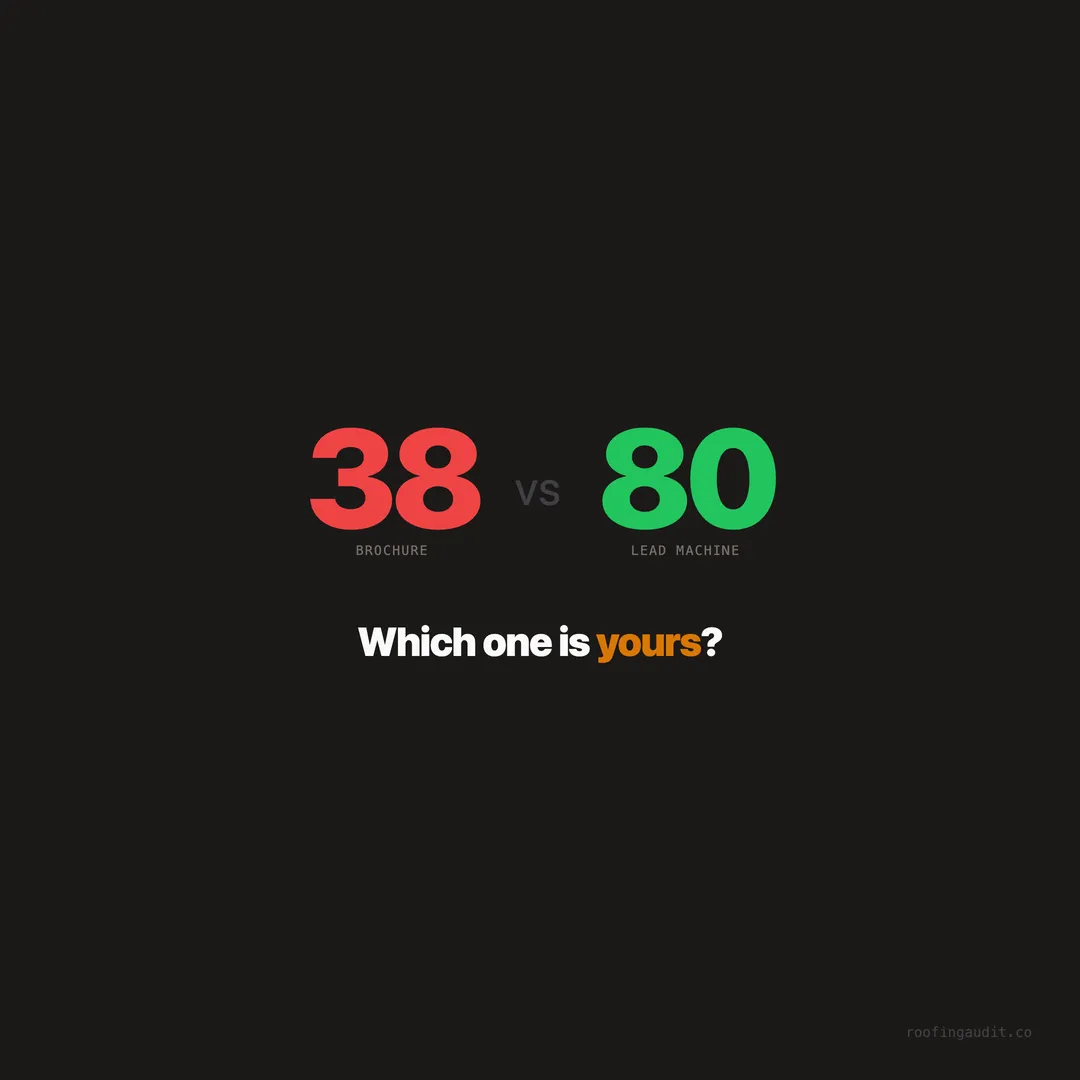
When we audited 1,409 roofing websites across Texas, Florida, and Georgia, the average site scored 38 out of 100 on our lead-generation index. Not because the sites are ugly. Not because they’re broken. Because they’re brochures — built to inform, not to convert.
The difference between a brochure and a lead machine isn’t design. It’s intent. A brochure describes the company. A lead machine guides the homeowner to take action. Every element on the page either moves someone toward requesting an estimate — or it doesn’t.
The Brochure Pattern
Across 1,409 sites, brochure-style sites share the same DNA:
The homepage talks about the company. “Founded in 2005, ABC Roofing is a family-owned business committed to quality craftsmanship…” The homeowner doesn’t care. She cares about whether her roof can be fixed, how fast, and at what cost.
Services are listed, not sold. A page says “We offer roof repair, roof replacement, and storm damage repair.” No photos. No process explanation. No pricing context. No reason to pick this company over the identical page on the competitor’s site.
The CTA is passive. “Contact us for more information.” That’s not a call to action — it’s a suggestion. Compare it to: “Get Your Free Storm Damage Inspection — We’ll Be There in 24 Hours.”
Trust is assumed, not proven. No certifications displayed. No project count. No review stars. No specific numbers. The site says “trusted” without showing why.
31% have no Free Estimate CTA above the fold. The most important conversion element on the page is simply missing.
The Lead Machine Pattern
The top 3% of sites — those scoring above 80 — follow a fundamentally different structure. They don’t talk about themselves. They talk to the homeowner’s problem and make the next step obvious.
Every Page Has a Job
On a lead machine site, every page exists for one purpose: to get the visitor closer to requesting an estimate.
- Homepage: Identify the problem, show proof, present the CTA
- Service pages: Explain the specific service, show relevant photos, repeat CTA
- Gallery page: Visual proof of work done — labeled by city, roof type, damage
- Insurance page: Guide the homeowner through the claims process — then CTA
- About page: Build trust with real photos, real numbers, real certifications — then CTA
- Emergency page: Clickable phone number, response time promise, immediate action
No page exists “just for information.” Every page drives toward the same action: schedule a free estimate or inspection.
The CTA Appears 3+ Times Per Page
Not once. Not just in the header. The Free Estimate CTA appears:
- In the hero section (above the fold)
- After the first content section (mid-page)
- At the bottom of the page (before the footer)
On longer pages, it might appear 4-5 times. This isn’t aggressive — it’s practical. A visitor who isn’t ready after the hero might be ready after seeing the gallery. Give them the button when they’re ready, wherever that is on the page.
Social Proof Is Everywhere
Not just on the about page. The top-performing sites weave social proof into every section:
- Hero: “4.9 ★ — 890 Reviews”
- Services: “3,200+ roofs installed”
- Gallery: “Hail damage repair — Plano, TX — insurance approved”
- Footer: “GAF Master Elite Contractor — Serving DFW Since 2007”
31% of audited sites have no quantified social proof. Lead machines have it on every page.
Why Brochures Persist
If lead machines are better, why do 97% of roofing sites still function as brochures?
The web designer didn’t know roofing. Most roofing websites are built by general web designers or template platforms. They know how to make a site that looks professional. They don’t know the 34 specific elements that convert roofing visitors into leads.
The roofer doesn’t know what’s wrong. A brochure site looks fine. It loads. It has pages. The roofer assumes the problem is traffic — not conversion. So they buy more ads at $187/lead instead of fixing the site.
Nobody measured it. 30% of roofing sites have no analytics tracking at all. They can’t see that 500 visitors came this month and only 5 called. Without data, there’s nothing to fix.
Templates set the default. Most website templates are brochures by design. They have an about page, services page, contact page, and footer. That’s it. The template doesn’t include a storm gallery, insurance guide, or emergency page because the template isn’t built for roofers — it’s built for any business.
The Conversion Cost of Brochure Sites
At a 2% conversion rate (typical for brochure sites), a roofer getting 500 monthly visitors generates 10 leads. At a 30% close rate, that’s 3 jobs/month.
At a 5% conversion rate (typical for lead machine sites), the same 500 visitors generate 25 leads and 7.5 jobs/month.
That’s 4.5 extra jobs per month — worth $54,000 in monthly revenue at a $12,000 average job value. Over a year: $648,000 in revenue the brochure site left on the table.
The cost to convert a brochure into a lead machine? $2,000-$5,000 in one-time work. The ROI pays for itself in the first week.
How to Make the Shift
You don’t need a new website. You need to transform the existing one from brochure to lead machine:
- Add a storm damage gallery — 31% are missing one
- Put “Free Estimate” above the fold — on every page
- Display certifications — logos, not just text
- Add quantified social proof — specific numbers, not adjectives
- Write an insurance claim guide — especially in FL
- Create an emergency page — clickable phone, response time promise
- Repeat the CTA — 3+ times per page
The brochure-to-machine conversion isn’t about making the site look different. It’s about making it work different. The homeowner’s journey — 3-second test, trust evaluation, action — should be frictionless from landing to lead.
The roofers with full schedules aren’t better marketers. They just have websites that do the selling for them while their crews are on the roof.
Keep reading
Want to know your score?
Drop your URL — full report in 48 hours.
We're on it.
Report in your inbox within 48 hours.