Why Your Roofing Business Doesn't Show Up for 'Roofer Near Me'
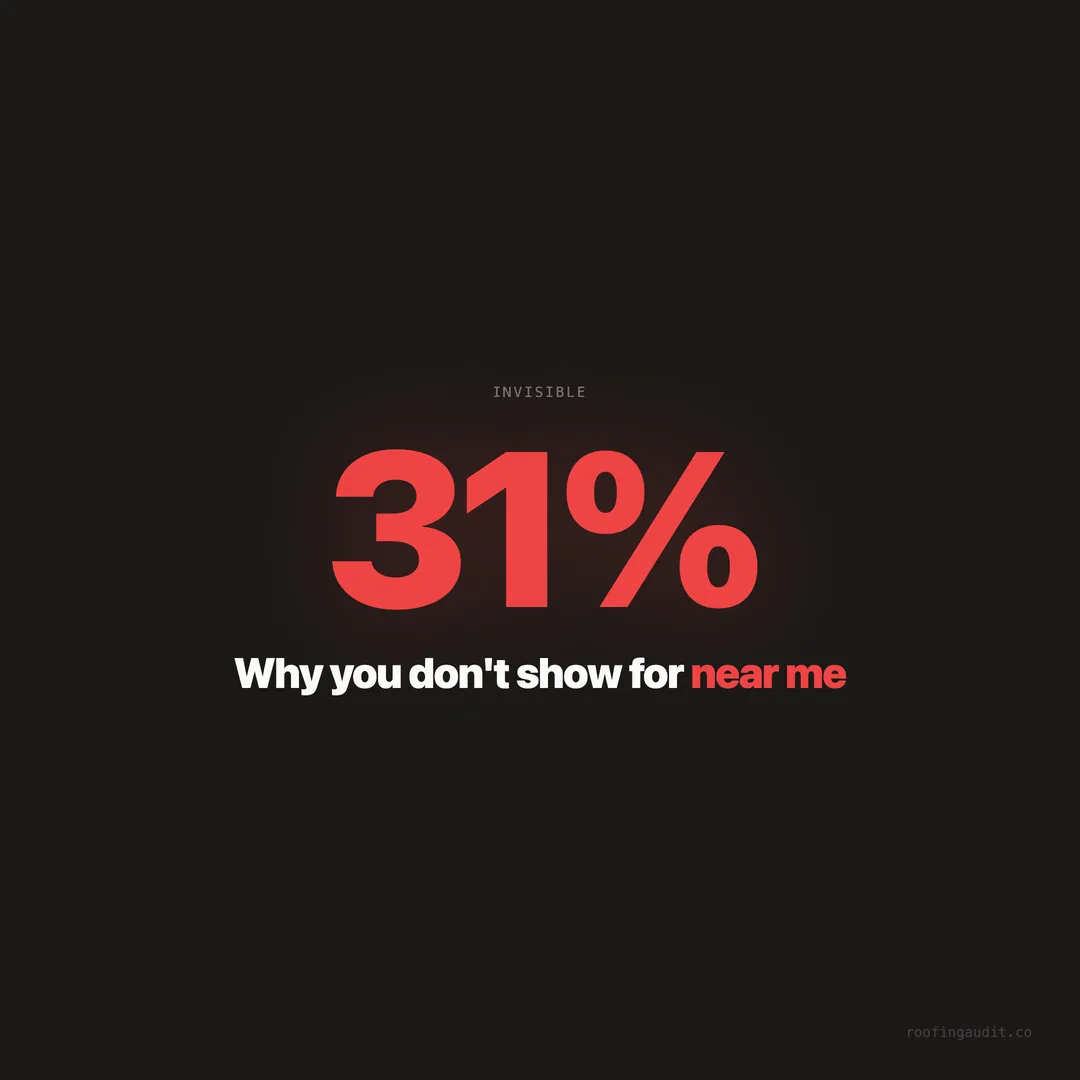
31% of 1,409 roofing sites lack schema markup. Without structured data, Google can't match your business to local searches — and you lose $187 leads.
A homeowner in Jacksonville notices a leak after a rainstorm. She grabs her phone and types “roofer near me.” Google shows three companies in the map pack, two ads, and ten organic results. She calls the top map result. Job booked by lunch.
Your roofing company is six miles from her house. You’ve been in business 14 years. You’ve replaced 200 roofs in her zip code. But you didn’t show up — not in the map pack, not in organic results, not anywhere she looked.
This happens thousands of times per day across Texas, Florida, and Georgia. When we audited 1,409 roofing websites across 121 cities in those three states, we found that 31% — 437 sites — had no structured data markup telling Google what their business does, where they operate, or what services they offer. Another 30% had no emergency page, 31% had no roof replacement process page, and 30% had no metal roofing page. These aren’t cosmetic problems. They’re the reason Google doesn’t show your business when a homeowner searches.
Google Needs More Than a Website to Rank You Locally
Here’s the misconception most roofers have: “I have a website, so Google knows about my business.” That’s like saying “I have a business card, so the phone book listed me.” The phone book had a process. Google has one too — and it starts with structured data.
Structured data (also called schema markup) is code embedded in your website that explicitly tells Google: this is a roofing business, it’s located at this address, it serves these cities, it offers these services, it has these hours, and here’s the phone number to call.
Without it, Google has to guess. And Google’s guesses are worse than you think.
31% of roofing websites in our audit had zero schema markup. No LocalBusiness. No Service. No GeoCoordinates. Nothing. Google was left to scrape the page text and hope it could piece together that this is a roofer in Houston who does storm damage repair. Sometimes it figured it out. Often it didn’t — which is why those companies don’t appear for the highest-value search term in roofing: “roofer near me."
"Near Me” Searches Are the Highest-Value Leads in Roofing
Not all search traffic is equal. A homeowner searching “roofing materials comparison” is researching. A homeowner searching “best roof for hot climate” is planning. A homeowner searching “roofer near me” is buying.
Near-me searches signal immediate intent. The homeowner has a problem — a leak, storm damage, an aging roof — and they want someone local to fix it. They’re not reading blog posts. They’re looking for a phone number.
Here’s what makes this search term so valuable:
High close rate. Near-me searchers convert at a significantly higher rate than general roofing searches. They’ve already decided they need a roofer. They just need to pick one.
Premium job value. The average roofing job in our dataset ranges from $8,000 to $25,000. At $187 per lead in paid advertising, the return on a near-me organic lead is massive — because it costs nothing once you rank for it.
Repeat geography. A homeowner who finds you through “roofer near me” lives in your service area. Their neighbors have roofs too. One visible job in a neighborhood generates word-of-mouth referrals for years.
After-hours urgency. Many near-me searches happen after business hours — during storms, after sudden leaks, on weekends. The roofer who shows up in these results captures leads that 429 competitors without emergency pages will never see.
Five Reasons Your Roofing Site Doesn’t Show Up
We analyzed the 437 roofing sites in our audit that lacked schema markup, then cross-referenced them against broader local SEO factors. Five patterns emerged.
Your Site Has No Structured Data
This is the biggest gap. LocalBusiness schema tells Google your business name, address, phone number, service area, business hours, and what you do. Without it, you’re relying on Google to figure it out from body text.
The top-scoring roofing websites in our audit had structured data on every page — not just the homepage. Service pages had Service schema. Blog posts had Article schema. The about page had Organization schema. Every page reinforced the same message: this is a roofing business in this city.
You Have No Service Area Pages
35% of roofing websites in our audit had no city or service area pages. They had a single homepage that mentioned their primary city — and nothing else.
Google ranks pages, not websites. If you serve Houston, Katy, Sugar Land, Pearland, and The Woodlands, you need a page for each. Not duplicate content — unique pages that mention local landmarks, neighborhoods, storm history, and common roofing problems specific to that area.
A roofer with 15 city pages has 15 chances to appear in near-me searches across those areas. A roofer with zero city pages has one chance — and it’s a weak one.
Your NAP Information Is Inconsistent
NAP stands for Name, Address, Phone number. If your website says “Johnson Roofing LLC” but your Google Business Profile says “Johnson Roofing” and your Yelp listing says “Johnson Roofing Co.” — Google isn’t confident these are the same business.
24% of sites in our audit had NAP inconsistencies between their website and visible directory listings. These discrepancies erode Google’s trust in your business data.
You Don’t Have City-Specific Content
It’s not enough to list cities you serve. The roofers who rank for near-me searches in multiple cities create content specific to each city.
“Hail damage roof repair in Plano” should reference Plano’s storm frequency, the common roofing materials in Plano subdivisions (built in the 1980s and 1990s — they have 30-year-old shingles), and local building codes. Generic content with a city name swapped in doesn’t work. Google detects template content.
Your Site Loads Too Slowly on Mobile
78% of near-me searches happen on mobile. Our audit found that the average roofing website loads in over 6 seconds on mobile — well past the 3-second threshold where most users abandon. If your site doesn’t load fast on a phone, you’re invisible to the person standing in their driveway staring at a damaged roof.
Fast mobile speed isn’t just user experience. It’s a direct ranking factor. Google has confirmed that page speed impacts mobile search rankings, and near-me searches are overwhelmingly mobile.
The Schema Markup Your Site Needs
Structured data sounds technical, but it follows a straightforward pattern. Every roofing site needs three types at minimum:
LocalBusiness schema on the homepage and contact page. This includes your business name, address, phone, hours, service area (list of cities), and business type (RoofingContractor).
Service schema on each service page. Roof replacement, roof repair, emergency tarping, inspections, metal roofing, commercial roofing — each service page should have its own schema telling Google exactly what service you provide and where.
BreadcrumbList schema on every page. This tells Google your site structure: Home > Services > Roof Replacement. It helps Google understand page hierarchy and improves how your pages appear in search results.
The 34-element roofing website checklist covers all three of these — plus 31 other elements that separate lead-generating sites from digital brochures.
Google Business Profile Alone Won’t Save You
Many roofers assume their Google Business Profile (GBP) handles local search visibility. It helps — but it’s not enough.
GBP gets you into the map pack. Your website gets you into the organic results below the map. Both matter. Homeowners who scroll past the map pack — and many do, especially for high-ticket services — need to find your website in the organic results. That requires on-page SEO, structured data, and local content.
28% of sites in our audit had no link from their website to their GBP page. This seems minor, but it’s a missed signal. Linking your website to your GBP — and making sure both have identical NAP information — reinforces the connection between your web presence and your local listing.
Reviews on GBP help. Reviews on your website help more. Embedding Google reviews on your website (or displaying testimonials with full names and cities) builds trust both with visitors and with Google. The top roofing websites average 40+ reviews visible on-site, not just on Google.
Service Pages Are Your Near-Me Secret Weapon
Here’s what most roofing websites get wrong: they have a single “Services” page that lists everything — roof replacement, repair, inspections, gutters, siding, metal roofing, commercial, residential — all on one page.
Google can’t rank that page for “metal roof installation near me” AND “emergency roof repair near me” AND “commercial roofing near me.” It’s too broad. It competes with itself.
The roofers who dominate near-me searches create individual pages for each service. From our audit:
- 30% have no metal roofing page — missing an entire segment growing at 15-20% market share
- 31% have no roof replacement process page — skipping the most expensive service explanation
- 30% have no emergency repair page — invisible during the highest-urgency searches
- 31% have no gutter or soffit pages — losing complementary service traffic
Each missing page is a missing near-me opportunity. A homeowner searching “gutter repair near me” can’t find you if you don’t have a gutter page. It doesn’t matter how good your gutter work is.
The Fix Takes Days, Not Months
Improving near-me visibility isn’t a six-month SEO project. The foundational work takes 3-5 days of focused effort:
| Task | Time |
|---|---|
| Add LocalBusiness schema to homepage | 1 hour |
| Add Service schema to each service page | 2-3 hours |
| Create 5-10 city/service area pages | 2-3 days |
| Verify NAP consistency across directories | 2 hours |
| Add GBP link and embed reviews | 1 hour |
| Optimize mobile speed to under 3 seconds | 4-6 hours |
| Add BreadcrumbList schema site-wide | 1 hour |
Total: 3-5 days. After that, the work shifts to content — writing blog posts about local storm events, adding project photos tagged by city, and building the local authority that Google rewards over time.
The roofing website checklist provides the full blueprint. But the near-me foundation — schema, NAP, city pages, mobile speed — is where most roofers should start.
Your Competitor Six Miles Away Is Getting Your Leads
The math is straightforward. A homeowner searches “roofer near me.” Your competitor — who is further away, less experienced, and charges more — shows up because they have schema markup, city pages, and a fast mobile site. You don’t show up at all.
They get the call. They get the $12,000 replacement. They get the yard sign in the neighborhood that generates three more referrals.
437 roofing companies in our audit across 121 cities are in this position right now. They exist. They do good work. But Google doesn’t know how to show them to the homeowner standing in her driveway, phone in hand, searching for someone nearby.
The near-me search happens whether your website is ready or not. The homeowner finds a roofer whether it’s you or not. The only question is whether you’ve given Google enough information to connect your business to the person who needs it — while they’re still searching.
Keep reading
Want to know your score?
Drop your URL — full report in 48 hours.
We're on it.
Report in your inbox within 48 hours.