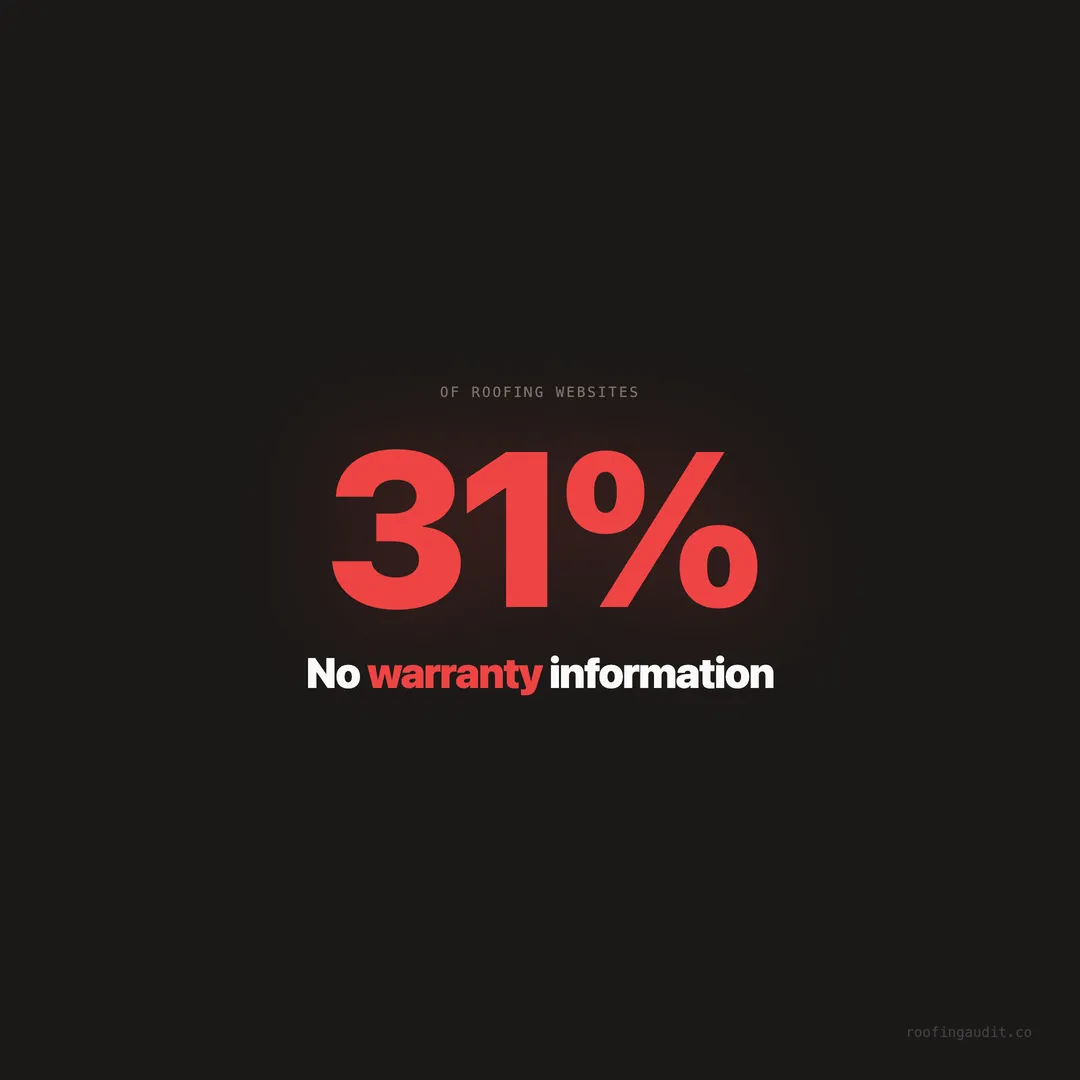
31% of Roofing Websites Have No Manufacturer Warranty Information Page
438 of 1,409 roofing websites have zero warranty details. On $8K-$25K jobs, the warranty is often the deciding factor between two quotes.
A homeowner in Fort Worth has two quotes on the kitchen counter. Both are for a full roof replacement. Both are within $1,000 of each other. She Googles both companies. The first roofer’s website has a dedicated warranty page explaining the difference between a GAF System Plus and a Golden Pledge warranty, what each covers, how long each lasts, and what happens if something goes wrong.
The second roofer’s website says “we stand behind our work.”
She calls the first roofer. Not because the quote was cheaper — it wasn’t. Because the warranty was clearer. On a $15,000 purchase, clarity about what happens after the check is written is worth more than a vague promise.
When we audited 1,409 roofing websites across Texas, Florida, and Georgia, 438 — 31% — had no warranty information page. No explanation of manufacturer warranties. No breakdown of coverage tiers. No workmanship guarantee details. Nothing about what the homeowner gets after the job is done.
On jobs ranging from $8,000 to $25,000, the warranty is often the single factor that breaks a tie between two equally qualified roofers. And nearly a third of the industry isn’t even talking about it.
Why Warranty Information Decides the Sale
A new roof isn’t like buying an appliance. There’s no box to return. No 30-day money-back guarantee. Once the crew is gone and the job is paid, the homeowner’s only protection is the warranty. That makes warranty information the most decision-critical content on a roofing website — and the most neglected.
Here’s why it matters so much on high-ticket roofing jobs:
The purchase is permanent. A roof lasts 20-50 years. The homeowner isn’t just buying a roof — she’s buying decades of protection. The warranty determines whether those decades are covered or exposed.
The stakes are high. If a $15,000 roof fails after 3 years, the homeowner faces another $15,000 expense. A warranty that covers that failure is worth thousands. The homeowner knows this, even if she doesn’t articulate it.
The competition uses it. Among the top 3% of roofing websites in our audit, every single one has a warranty page. If your competitor explains their warranty and you don’t, they win the comparison — even if your warranty is identical.
Insurance companies care. In storm markets, insurance companies increasingly factor the roof’s warranty into their assessments. A GAF Golden Pledge warranty with full workmanship coverage signals to insurers that the roof was installed by a certified, accountable contractor.
The Three Warranty Types Homeowners Need to Understand
Most homeowners don’t know the difference between a manufacturer warranty and a workmanship warranty. That’s exactly why your website needs to explain it. The roofers who educate win. The ones who don’t leave the homeowner confused — and confused homeowners don’t call.
Manufacturer Warranty (Materials)
This covers the roofing materials — shingles, underlayment, ridge caps, ventilation. If a shingle fails due to a manufacturing defect, the manufacturer (GAF, Owens Corning, CertainTeed) covers the replacement materials.
What it doesn’t cover: installation errors. If the shingles were installed incorrectly and they fail, the manufacturer warranty doesn’t apply. This is the gap that most homeowners don’t understand until it’s too late.
Duration: Typically 25-50 years depending on the product line and whether the warranty is prorated or non-prorated. Non-prorated is significantly better — the manufacturer covers the full cost regardless of the roof’s age.
Workmanship Warranty
This covers the installation itself. If the roof leaks because the flashing was installed incorrectly, or the ventilation was inadequate, or the shingles were nailed wrong, the workmanship warranty covers the repair.
This is where certified contractors have a massive advantage. GAF Master Elite contractors can offer 25 years of workmanship coverage through the Golden Pledge warranty. Non-certified contractors typically offer 1-5 years of their own workmanship guarantee — and that guarantee is only as good as the company’s longevity.
The critical question: If the contractor goes out of business in year 3, who honors the workmanship warranty? With a manufacturer-backed warranty (like Golden Pledge), GAF covers it. With a contractor-only warranty, nobody does. This is the argument for certified contractors — and the argument for explaining it on your website.
Extended Warranty (System Warranty)
When all components of the roofing system come from the same manufacturer — shingles, ridge caps, starter strip, ventilation, underlayment — the manufacturer may offer an enhanced system warranty. GAF’s “Lifetime Roofing System” and Owens Corning’s “Total Protection Roofing System” are examples.
These system warranties offer better coverage than mix-and-match installations. They also give the contractor a selling point: “We use a complete GAF system, which qualifies you for their enhanced warranty.” That’s a concrete, dollar-value reason to choose one roofer over another.
What the Best Warranty Pages Include
From our analysis of the top-scoring roofing sites, the most effective warranty pages share these elements:
Plain-Language Comparison Table
A table comparing warranty tiers — what each covers, how long, and what certification level is required. The homeowner shouldn’t need to visit the manufacturer’s website to understand her options. The roofer who explains it clearly on their own site is the one she trusts.
Dollar-Value Examples
“A standard warranty covers materials but not labor. If your roof develops a leak in year 5, materials might cost $500 — but the labor to repair it costs $3,000-$5,000. The Golden Pledge warranty covers both.” Dollar amounts make warranty differences tangible. Percentages and technical terms don’t.
What’s NOT Covered
Every warranty has exclusions — hurricane damage (covered by insurance, not warranty), improper attic ventilation, acts of nature. The best warranty pages mention these honestly. Transparency about limitations builds more trust than pretending the warranty covers everything.
How to File a Claim
If something goes wrong, what does the homeowner do? Call the contractor? Call the manufacturer? Fill out a form? The warranty page should include a clear process — even a simple “Call us first and we’ll handle the claim with the manufacturer” statement.
Connection to Certifications
The warranty page should explicitly link to your certifications and explain how those certifications enable better warranty options. “As a GAF Master Elite contractor, we can offer the Golden Pledge warranty — something non-certified roofers cannot provide.”
The Warranty Conversation Happens Online First
Here’s what’s changed in the last five years: homeowners research warranties before the estimate, not after.
A decade ago, the warranty conversation happened on the doorstep. The roofer explained the options, the homeowner asked questions, and the decision was made face-to-face. Today, the homeowner has already Googled “GAF warranty tiers” or “best roofing warranty” before the roofer shows up. She knows the Golden Pledge exists. She knows it requires a Master Elite contractor.
When she arrives at your website and finds no warranty information, one of two things happens:
She assumes you don’t offer the good warranties. If you’re not explaining them, maybe you can’t offer them. Maybe you’re not certified. Maybe the warranty is weak and you’re hiding it.
She goes to the manufacturer’s website instead. Now she’s on GAF.com, comparing contractors in their directory. She might find a competitor there. You’ve just sent her to a platform where your competition is listed.
Both outcomes cost you. The warranty page prevents both.
The Storm Market Warranty Problem
In Texas and Florida, the warranty conversation has an added dimension: storm damage.
Manufacturer warranties typically exclude weather damage — that’s what homeowners insurance is for. But the quality of the installation directly affects whether storm damage occurs. A properly installed roof survives a hailstorm that destroys a poorly installed one. That’s where the workmanship warranty matters.
In Texas, after 529 hail events in 2024, thousands of homeowners discovered that their roofs failed not because the shingles were defective, but because they were installed incorrectly. High nailing, improper sealing, inadequate flashing — all installation errors that a workmanship warranty would cover.
Storm chasers who flood into storm markets typically offer no workmanship warranty — or they offer one that’s backed by a company that won’t exist in 12 months. Local roofers with manufacturer-backed workmanship warranties have a decisive advantage. But only if they explain it.
In Florida, where $25 billion in insured losses in 2024 created massive demand for roof replacements, the warranty conversation intersects with insurance. Insurance adjusters are increasingly asking about warranty documentation. A homeowner with a Golden Pledge warranty has documentation that proves the installation meets manufacturer standards. A homeowner without workmanship coverage has no such proof.
The “We Stand Behind Our Work” Problem
The most common warranty statement on roofing websites is: “We stand behind our work.” It appears on hundreds of sites in our audit. It communicates absolutely nothing.
Stand behind it how? For how long? Covering what? If there’s a leak in year 3, does the homeowner call you? Do you come out for free? Is there a deductible? Is there a limit?
“We stand behind our work” is the warranty equivalent of “quality craftsmanship” — it sounds good and proves nothing. The homeowner has no idea what she’s actually getting. And when she can’t determine what she’s getting, she assumes the worst.
Compare: “Every roof we install comes with our 10-year workmanship warranty, in addition to the manufacturer’s 50-year material warranty. If anything we installed fails within 10 years, we repair it at no cost.” That’s specific. That’s verifiable. That’s what the top-scoring sites say instead of “we stand behind our work.”
The Warranty Page as a Sales Tool
Beyond trust, the warranty page is a sales tool that works around the clock:
It captures search traffic. Homeowners search “roofing warranty comparison,” “GAF Golden Pledge explained,” and “best warranty for roof replacement.” A dedicated warranty page with clear, comprehensive content ranks for these queries and brings in potential customers who are deep in the decision process.
It pre-qualifies leads. A homeowner who reads your warranty page and then requests an estimate already understands the value of your coverage. The sales conversation is shorter because the education happened online. She’s not asking “what’s the warranty?” — she’s saying “I want the Golden Pledge.”
It justifies your pricing. If your quote is $2,000 more than a competitor’s, the warranty page explains why. Better warranty coverage = more long-term protection = worth the premium. Without the warranty page, the homeowner only sees the price difference — not the value difference.
It differentiates from storm chasers. A warranty page with specific, verifiable warranty details is something a storm chaser can’t replicate. They don’t have the certifications. They can’t offer the enhanced warranties. And they won’t be around to honor any promise they make.
Building a Warranty Page That Converts
Based on our audit of the highest-performing roofing websites, here’s the structure that works:
Section 1: Manufacturer Warranty Overview. A plain-language explanation of what the manufacturer covers (materials) and what it doesn’t (installation). Name the manufacturer(s) you use. Include a comparison table if you offer multiple tiers.
Section 2: Workmanship Warranty Details. What your company guarantees about the installation itself. Duration, what’s covered, what’s not covered, and the process for filing a claim. If your workmanship warranty is backed by the manufacturer (like GAF Golden Pledge), highlight that.
Section 3: Why Certification Matters. Explain how your certifications enable better warranty options. Link to your certifications page. This connects two trust signals that reinforce each other.
Section 4: What to Look for in a Roofing Warranty. Educate the homeowner about prorated vs. non-prorated, materials-only vs. full-system, and contractor-backed vs. manufacturer-backed. This positions you as the expert and helps the homeowner evaluate competitors — who likely won’t explain this.
Section 5: CTA. “Get a free estimate and learn which warranty options apply to your roof.” The warranty page should end with a clear CTA that moves the homeowner to the next step.
Warranty Information and the 34-Element Checklist
Of all 34 elements in our roofing website checklist, warranty information has one of the highest impact-to-effort ratios. It requires no photos, no technical work, no ongoing maintenance. It requires writing one page of content that explains what the homeowner gets after the job is done.
438 roofing companies in our audit haven’t done this. In an industry where the average job costs $8,000-$25,000 and the warranty is frequently the tiebreaker between two quotes, that’s not a minor omission. It’s a competitive gap — one that the roofers who explain their warranties are already exploiting with every quote they win.
The warranty isn’t just a document filed with the job. It’s a selling point, a differentiator, and a trust signal. Put it on your website. Explain it clearly. Let the homeowner see exactly what she’s paying for — and she’ll pick the roofer who showed her over the one who hid it behind “we stand behind our work.”
Keep reading
Want to know your score?
Drop your URL — full report in 48 hours.
We're on it.
Report in your inbox within 48 hours.