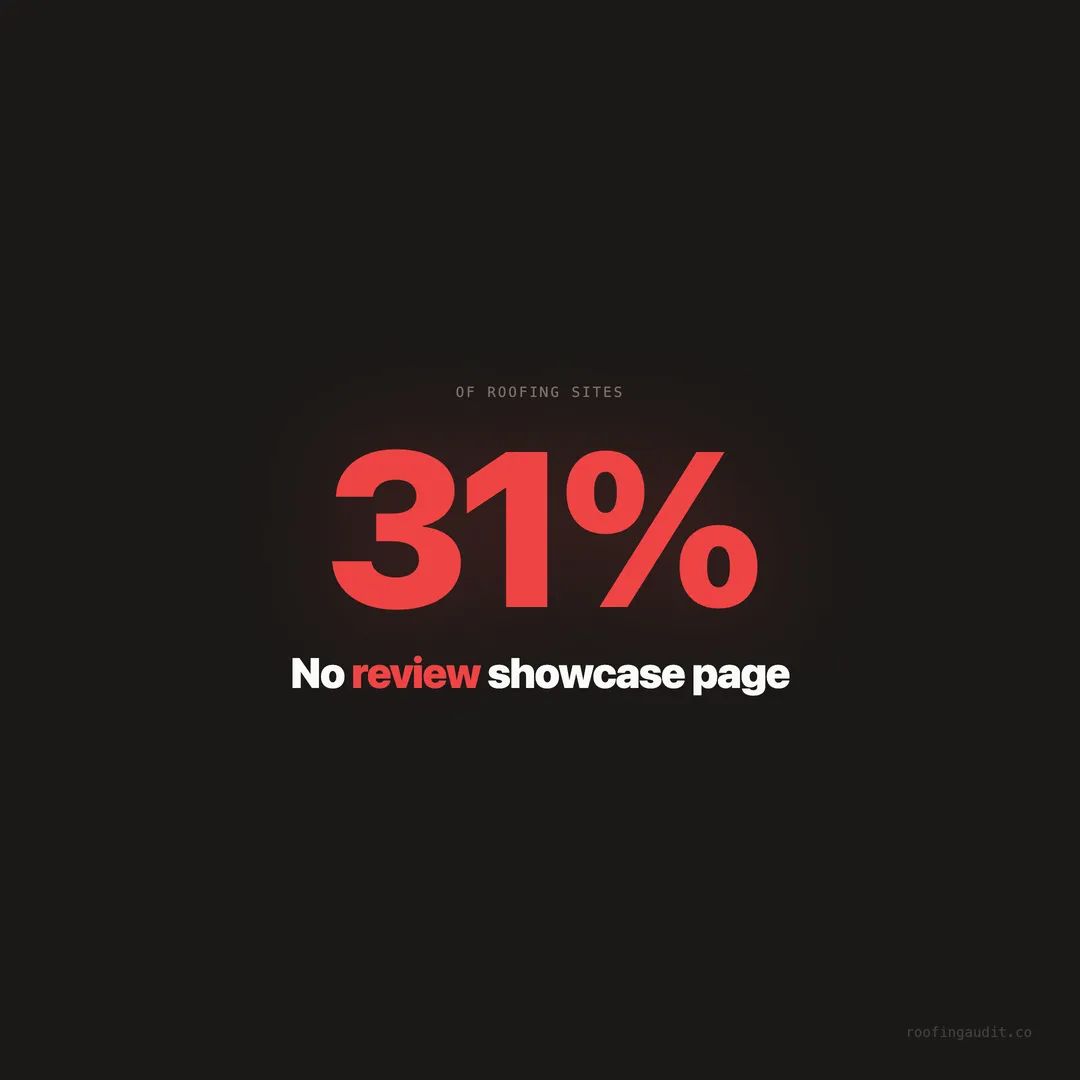
31% of Roofing Sites Have No Testimonial or Review Showcase Page
433 of 1,409 roofing websites display zero reviews on-site. Their 5-star Google reviews stay on Google — where competitors also appear.
A homeowner in Tampa is comparing three roofers for a full replacement. She visits the first website — clean layout, clear free estimate CTA, storm damage gallery. But she wants to know what other homeowners think. She looks for a reviews page. There isn’t one. So she goes to Google, searches the company name, and reads the reviews there.
While she’s on Google, she sees two other roofers with higher review counts. She clicks one of those instead. The first roofer — the one with the good website — never gets the call. Not because the reviews were bad. Because the reviews were on Google instead of the website. And Google showed her the competition.
When we audited 1,409 roofing websites across Texas, Florida, and Georgia, 433 — 31% — had no testimonial or review showcase on their site. No dedicated reviews page. No homepage testimonial section. No embedded Google reviews. Nothing.
These companies may have excellent reviews on Google — 4.8 stars, 200+ reviews. But by not displaying them on their own website, they’re sending every homeowner to a platform where competitors are one click away.
Why Reviews on Google Aren’t Enough
Google reviews are powerful. They’re public, verified, and homeowners trust them. But they have a critical flaw when used as your only review strategy: they exist on Google’s platform, not yours.
When a homeowner leaves your website to check your Google reviews, three things happen:
She sees your competitors. Google’s “People also search for” section and the local pack show other roofers right next to your listing. You’ve just introduced competition into your own sales process.
She may not come back. The average website visit is under 60 seconds. Once the homeowner is on Google, she’s in browsing mode — clicking competitors, comparing ratings, reading other reviews. The chances of her returning to your website drop significantly.
She questions why you didn’t show the reviews yourself. A company with 200 five-star reviews that doesn’t display them on their website raises a subtle question: “If the reviews are so good, why aren’t they showcased?” It’s a missed opportunity that introduces doubt where there should be confidence.
The top 3% of roofing websites in our audit all have on-site reviews. Not just a link to Google — actual testimonials displayed on their homepage, service pages, and a dedicated reviews page. They keep the homeowner on their site throughout the entire decision process.
What Happens When Reviews Are on Your Site
The difference between “go check our Google reviews” and “here are 47 reviews from homeowners in your area” is the difference between confidence and friction.
The homeowner stays on your site. She reads the reviews, sees the star ratings, reads specific stories about storm damage repairs and insurance claims. She doesn’t need to leave. She doesn’t see competitors.
She reads more reviews. On Google, most homeowners read 3-5 reviews before making a decision. On a dedicated reviews page, they read more — because there’s no competing content pulling their attention. More reviews read means more trust built.
She sees reviews in context. A review on your storm damage page — from a homeowner who had hail damage repaired — is more persuasive than a random review on Google. Context-specific testimonials match the homeowner’s situation, making the trust transfer immediate.
She moves to action faster. The path from “reading reviews” to “requesting an estimate” should be one click. On your website, it is. On Google, it’s a multi-step journey back to your site, then to the contact form or phone number. Every step loses people.
The Five Types of Review Displays That Work
From our analysis of the top-performing sites, review displays fall into five effective formats:
The Dedicated Reviews Page
A full page with 20-50+ reviews, organized by service type or location. This page serves two purposes: it convinces visitors who are comparing roofers, and it captures search traffic for queries like “roofer reviews [city].”
The best reviews pages include the customer’s first name and city, the type of work performed (full replacement, storm repair, gutter install), and the star rating. Some include the date of service. All of this adds specificity that generic reviews lack.
Homepage Testimonial Slider
Three to five featured testimonials rotating on the homepage, typically below the hero section and counter bar. These should be your best, most specific reviews — the ones that mention a dollar amount, a timeline, or a specific problem solved.
“They replaced our roof in 2 days after the hailstorm. Insurance approved the full amount. $16,200 replacement done right.” That’s a homepage-worthy testimonial. “Great company, highly recommend” is not.
Service Page Contextual Reviews
A storm damage page with 2-3 reviews from homeowners who had storm damage repaired. A replacement page with reviews from homeowners who got full replacements. Context-matched reviews are more persuasive because they mirror the visitor’s situation.
This is something Google can’t do. Google shows reviews in chronological order. Your website can show the right review on the right page — matching the homeowner’s intent with a testimonial that addresses exactly what she’s looking for.
Embedded Google Review Widget
A widget that pulls directly from your Google Business Profile and displays reviews on your website. This combines the credibility of Google’s platform (the reviews are verified and public) with the convenience of on-site display. The homeowner sees the Google logo, recognizes the format, and trusts the reviews — without leaving your site.
Several free and low-cost tools generate these embeds. The technical implementation takes under an hour for most websites.
Video Testimonials
The most powerful format — and the rarest. A 60-90 second video of a homeowner standing in front of their new roof, describing the experience, is more persuasive than any written review. Among the top-scoring sites in our audit, only 8% had video testimonials. It’s a competitive advantage specifically because so few roofers do it.
What Makes a Review Persuasive
Not all reviews are created equal. “Good company” adds nothing. Here’s what makes a testimonial effective on a roofing website:
Specificity about the job. “They replaced our 30-year-old roof with GAF Timberline shingles” is better than “they did a great job.” Details prove the review is real.
Dollar amounts. “Our $14,500 replacement was completed on schedule and on budget.” The number tells other homeowners what to expect and signals transparency.
Insurance experience. In storm markets, reviews mentioning insurance are gold. “They handled the entire insurance claim — we didn’t have to deal with the adjuster at all.” This directly addresses the homeowner’s biggest anxiety in insurance-heavy markets.
Timeline details. “From estimate to completion in 8 days.” Speed matters in roofing, especially after storm damage. Timeline mentions reassure the homeowner that the process won’t drag.
Location mention. “We’re in Katy, TX and they were here the next day.” Location proves the company is local and services the homeowner’s area — critical in differentiating from storm chasers.
Name and neighborhood. ”— Sarah M., Sugar Land” adds credibility. Anonymous reviews feel less trustworthy. Even a first name and city add accountability.
The Review Volume Threshold
How many reviews should you display on your website? From our audit data, there’s a clear threshold:
Under 10 reviews — Better than nothing, but the sample size feels small. A homeowner might think these are cherry-picked.
10-25 reviews — Credible. Enough to show a pattern of satisfaction. This is where most mid-tier sites in our audit sit.
25-50 reviews — Strong. The volume alone communicates that this company does consistent work and customers care enough to leave feedback.
50+ reviews — Exceptional. At this volume, the reviews page becomes a resource. Homeowners browse by service type, read 5-10 reviews, and feel confident. Among the top 3% of sites in our audit, 72% display 50 or more reviews.
The key is not to wait until you have 50. Start with what you have — even 5 good reviews on your website is better than 200 on Google alone. Add new reviews as they come in. The page grows over time.
How to Get More Reviews (And the Right Kind)
Most roofing companies know they should ask for reviews. Few do it systematically. Here’s what the highest-reviewed companies in our audit do differently:
Ask at the right moment. The best time to request a review is the day the job is completed — when the homeowner is looking at a new roof and feeling relieved. Not two weeks later when the emotion has faded. Not via email when the request gets buried. At the job site, face to face.
Make it specific. “Would you mind mentioning the type of work we did and your neighborhood?” prompts the kind of detail-rich review that’s actually persuasive on your website. Generic “please leave us a review” requests get generic responses.
Follow up once. A text message the day after completion with a direct link to your Google review page converts at a higher rate than any other method. One follow-up. Not three. Not a drip campaign.
Curate for your website. Not every Google review belongs on your homepage. Select the ones that mention specific services, dollar amounts, timelines, and locations. These are the reviews that do the heavy lifting on your website.
Reviews and the Storm Market Advantage
In Texas and Florida, reviews carry extra weight because of the storm chaser problem.
When 529 hail events hit Texas in 2024, thousands of out-of-state contractors flooded the market. Homeowners couldn’t tell who was local and who was a storm chaser. Reviews from local homeowners — especially reviews mentioning specific neighborhoods, insurance companies, and timelines — prove you’re established in the community.
A testimonial that says “They’ve done three roofs on our street in Plano over the last four years” is devastating to storm chaser competition. It proves permanence, local presence, and repeat business — three things a storm chaser can never claim.
In Florida, where $25 billion in hurricane losses in 2024 created a feeding frenzy for roofing leads, reviews mentioning insurance claim assistance are the most valuable. “They handled our Citizens Insurance claim start to finish — approved in 3 weeks” addresses the homeowner’s biggest fear in a market where 42% of claims get denied.
The Connection Between Reviews and Other Trust Signals
Reviews compound with every other trust element on your website:
Reviews + certifications — A review that mentions the GAF warranty reinforces the certification badge. “The Golden Pledge warranty gave us peace of mind” paired with the GAF Master Elite badge is a one-two punch.
Reviews + social proof numbers — “4.9 stars across 287 Google reviews” on the counter bar, backed by 50+ actual reviews on the reviews page. The number promises. The page delivers.
Reviews + storm gallery — A before/after photo paired with a testimonial from that homeowner is the most persuasive combination in roofing marketing. The photo shows the work. The review confirms the experience.
Reviews + license number — Displaying the license alongside reviews tells the homeowner: “We’re verified by the state AND by your neighbors.” Both are trust anchors.
The One-Hour Implementation Plan
Getting reviews on your website doesn’t require a redesign:
-
Select 10-15 of your best Google reviews. Prioritize ones with specifics: job type, location, dollar amount, insurance experience, timeline.
-
Create a reviews page. A simple page with reviews listed by service type. Include the reviewer’s first name, city, star rating, and the date.
-
Add 3 featured testimonials to your homepage. Place them below the hero section or after the services section. Use your most compelling reviews.
-
Add contextual reviews to service pages. Put storm damage reviews on the storm damage page. Replacement reviews on the replacement page.
-
Consider an embedded Google review widget. Free tools pull from your Google Business Profile automatically. New reviews appear on your website without manual updates.
433 roofing companies in our audit have reviews on Google but not on their website. They’re sending homeowners to a platform where competitors are one click away — on $8,000-$25,000 decisions where trust is the determining factor. The fix takes an hour. The cost of not fixing it is measured in leads that went to the roofer whose website showed the reviews instead of hiding them.
Keep reading
Want to know your score?
Drop your URL — full report in 48 hours.
We're on it.
Report in your inbox within 48 hours.