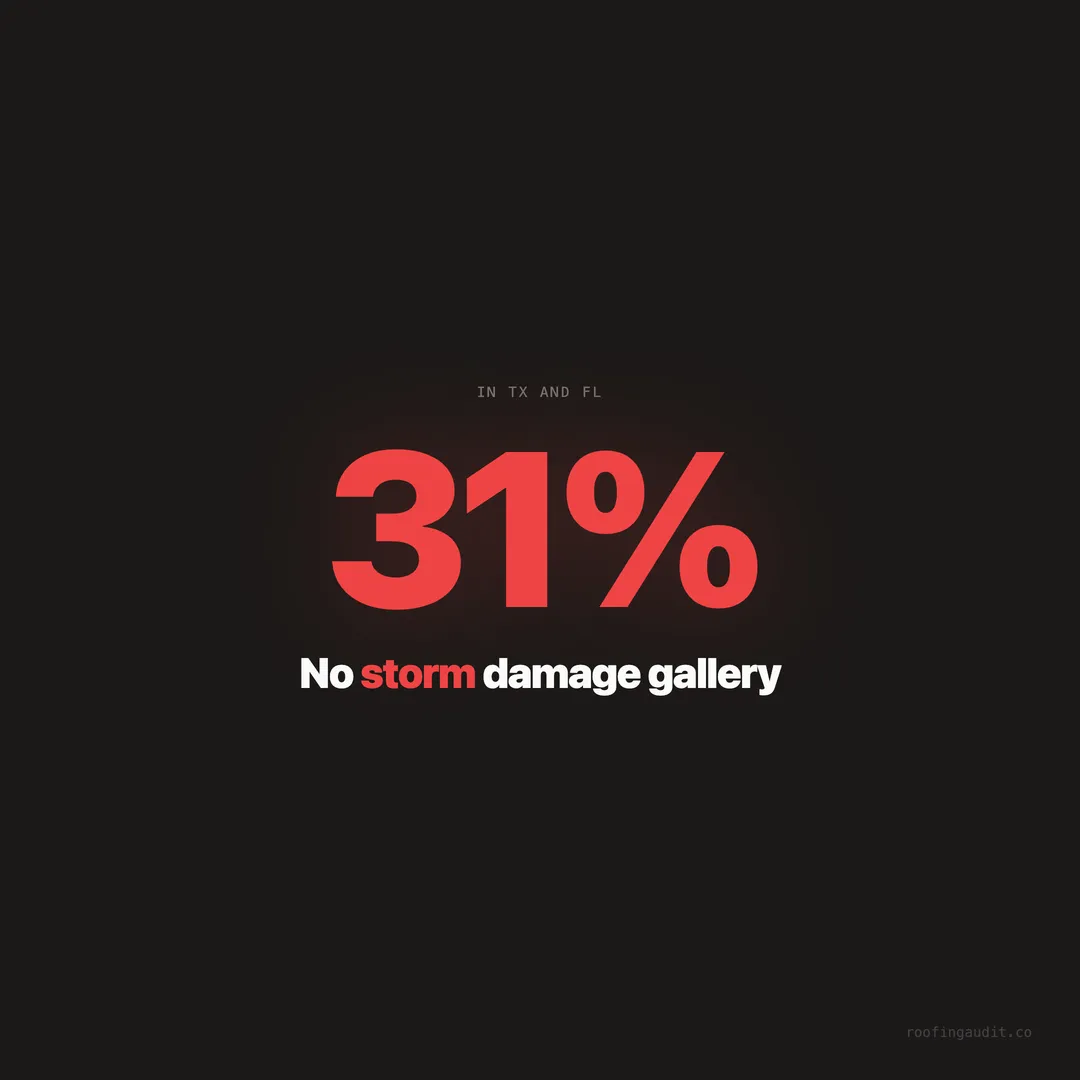
31% of Roofing Sites Have No Storm Damage Gallery — In the Two Worst Storm States in America
438 of 1,409 roofing websites show zero storm damage work. Texas had 529 hail events in 2024. Florida had $25B in hurricane losses. No gallery = no trust.
A hailstorm rips through a Dallas suburb on a Tuesday afternoon. By Wednesday morning, every homeowner on the block is searching “roof repair near me.” They click three roofers. Two have stock photos of pristine houses. The third has 40 before-and-after photos from hail jobs in their exact neighborhood — shingle damage, crew on the roof, completed repair, insurance approval noted.
The third roofer’s phone doesn’t stop ringing. The other two wait.
When we audited 1,409 roofing websites across Texas, Florida, and Georgia, 438 — 31% — had no storm damage gallery at all. No before-and-after photos. No hail damage shots. No completed repairs. Nothing.
This is happening in the two worst storm states in America. Texas recorded 529 hail events in 2024 — a 167% increase over the prior year. Florida saw $25 billion in insured hurricane losses in 2024. These are markets where storm damage drives the majority of roofing revenue. And nearly a third of roofers have zero visual proof of storm work on their websites.
Why Galleries Matter More in Roofing Than Any Other Trade
A plumber doesn’t need before-and-after photos. A cleaner might benefit from them. But a roofer needs them — and here’s why.
The purchase is invisible. A homeowner can see a clean floor or a working faucet. They can’t see a properly installed roof from the ground. Photos are the only way to show quality.
Storm damage is emotional. The homeowner is stressed, anxious, and often dealing with insurance companies. Photos of repaired storm damage say: “We’ve handled this exact situation. We can handle yours.”
The job is expensive. At $8,000-$25,000, the homeowner needs proof before committing. A gallery with 20+ completed projects gives them the confidence to call.
Competitors show the work. Among the top 3% of roofing websites in our audit, every single one has a project gallery. Zero exceptions. If your competitor shows their work and you don’t, you lose. Period.
What the Best Storm Galleries Include
From our analysis of top-scoring roofing sites, the most effective galleries share these characteristics:
Volume: 15-30+ Projects
A gallery with 3 photos doesn’t build confidence. It looks like the company just started. The best galleries show 15-30 completed projects — enough to prove a pattern of experience, not a one-off.
Labeled by Location
“Hail damage repair — Plano, TX” tells the homeowner: this company works in my area. Location labels are especially powerful in metro areas where homeowners want a local roofer, not a storm chaser.
Organized by Damage Type
The best galleries are categorized:
- Hail damage (biggest TX category)
- Wind damage (biggest FL category)
- Age-related deterioration
- Emergency tarping
- Full replacements
A homeowner with hail damage wants to see hail damage repairs — not scroll through 30 random photos looking for a relevant one.
Before AND After
Before-only photos show damage. After-only photos show a clean roof. Both together show transformation — the exact journey the homeowner wants. Before/after pairs are the most persuasive format for high-ticket visual services.
Insurance Approval Notes
In storm markets, the homeowner’s biggest anxiety is insurance. A photo caption that says “Insurance-approved — GAF Timberline HDZ shingles — $18,500 replacement” tells the homeowner: this roofer knows how to work with insurance companies. That’s a powerful signal, especially in Florida where 42% of claims are denied.
What Happens Without a Gallery
The homeowner lands on the site. She sees a headline about “quality roofing services.” There’s a phone number. Maybe a list of services. But no photos of actual work.
Three things happen:
-
She questions whether the company is real. No photos = no proof = no trust. In an industry plagued by storm chasers, looking unverifiable is the same as looking suspicious.
-
She can’t differentiate. Without photos, every roofer’s website says the same thing: “quality,” “experienced,” “trusted.” The site becomes interchangeable with a hundred others.
-
She goes to Google. She searches the company name + “reviews” or “photos” — and now she’s off your site, on Google, where she’ll also see your competitors. The gallery’s job is to keep her on your site long enough to call.
The Time It Takes to Fix This
Building a storm gallery isn’t a redesign project. It’s documentation:
| Step | Time |
|---|---|
| Photograph the next 10 jobs (phone is fine) | 2 weeks of normal work |
| Add before/after pairs to website | 2-3 hours |
| Label each with city, damage type, roof material | 1 hour |
| Add insurance approval notes where applicable | 30 minutes |
| Organize into categories | 30 minutes |
Total effort: ~4 hours of web work (after accumulating 10 jobs worth of photos). That investment eliminates one of the biggest lead-killing gaps in the roofing industry.
For roofers who already have photos on their phone — from past jobs, insurance adjuster meetings, completed repairs — the gallery can go live today. The photos don’t need to be professional. They need to be real.
The Gallery as Lead Magnet
The storm gallery isn’t just a trust builder. It’s a search engine magnet.
Homeowners search:
- “hail damage roof repair [city]”
- “roof replacement before and after”
- “storm damage roofer near me”
A gallery page with properly tagged images (alt text including city and damage type) captures these searches. Each photo becomes a search engine entry point — especially in Google Image Search, where homeowners often start when evaluating storm damage.
31% of sites also have zero image alt tags, meaning even the photos they do have are invisible to Google. Adding alt text to gallery images is a double win: accessibility + SEO.
This Is the Most Fixable Problem in Roofing Websites
Of all 34 elements in our roofing website checklist, the storm gallery has the highest impact-to-effort ratio in storm markets. It costs nothing but time. It builds trust, captures search traffic, differentiates from competitors, and proves you’re local.
438 roofing companies in our audit are missing this. In the two states with the worst storm damage in America.
The roofers who photograph their work and put it on their website aren’t doing anything special. They’re doing the obvious thing — and capturing the leads that 31% of their competitors are leaking.
Keep reading
Want to know your score?
Drop your URL — full report in 48 hours.
We're on it.
Report in your inbox within 48 hours.