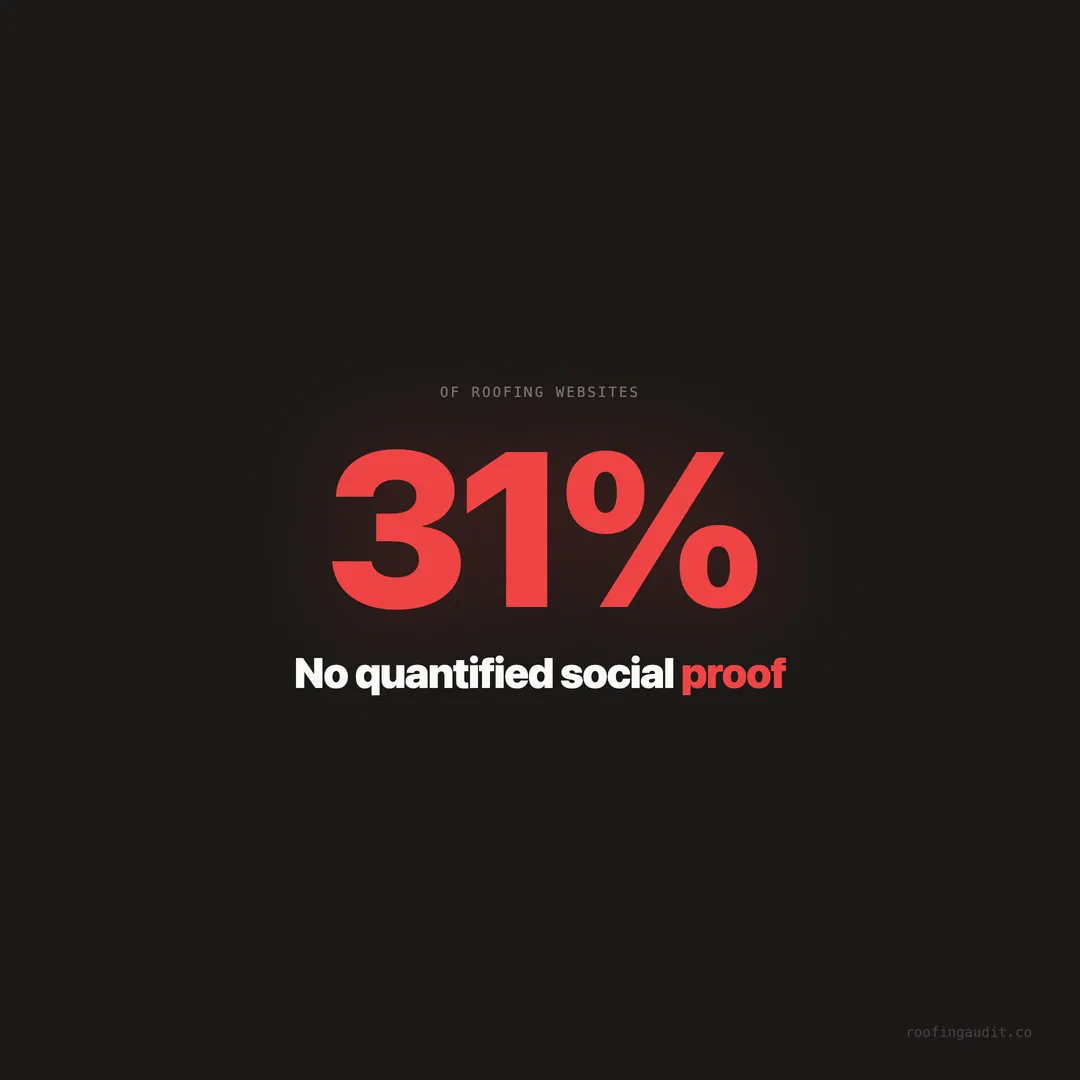
31% of Roofing Websites Have No Quantified Social Proof — Projects Completed, Homes Served, Years in Business
438 of 1,409 roofing websites use words like 'trusted' without a single number. Specific counts build credibility. Vague claims don't.
“Trusted by homeowners across the greater Houston area.”
That sentence is on hundreds of roofing websites. It sounds professional. It says nothing. Trusted by how many homeowners? Ten? Ten thousand? Across what timeframe? There’s no way for the homeowner to know — and when she can’t verify a claim, she ignores it.
Now compare: “2,847 roofs replaced since 2009. 15 years in business. 4.9 stars across 312 Google reviews.”
Same idea — trust. Completely different impact. The second version gives the homeowner three verifiable numbers. She can check the Google reviews right now. She can calculate that 2,847 roofs over 15 years means roughly 190 per year — this is a real company doing real volume. The trust isn’t claimed. It’s proven.
When we audited 1,409 roofing websites across Texas, Florida, and Georgia, 438 — 31% — had no quantified social proof anywhere on the site. No project count. No review count. No years-in-business number. Just words like “trusted,” “experienced,” “reliable,” and “family-owned” without a single digit to back them up.
Why Numbers Beat Adjectives on High-Ticket Purchases
Roofing is a $8,000 to $25,000 decision. At that price point, homeowners are risk-averse. They’re not looking for the roofer who sounds the best — they’re looking for the one who proves the most.
Psychology research calls this the specificity effect: specific claims are more believable than vague ones. “We’ve been in business for a long time” triggers skepticism. “We’ve been in business since 2006 — 18 years” triggers acceptance. The number anchors the claim in reality.
This effect intensifies with price. On a $50 purchase, the homeowner might not care about specifics. On a $15,000 roof replacement, she’s scrutinizing everything. Every unquantified claim on your website is an opportunity for doubt.
The top-scoring roofing websites in our audit averaged 4.3 quantified proof points on their homepage. The bottom quartile averaged 0.6. That’s a seven-to-one gap in proven credibility between the best and worst sites.
The Five Numbers Every Roofing Website Needs
From our analysis of 1,409 sites, the most effective quantified proof points fall into five categories:
Projects Completed or Roofs Replaced
This is the single most powerful number a roofing website can display. “3,200+ roofs replaced” tells the homeowner this company has volume. Volume implies competence — you don’t replace 3,200 roofs without knowing what you’re doing.
Among the top-performing sites in our audit, 87% display a project count on the homepage. Among the bottom quartile, only 12% do. That’s the clearest correlation between a single data point and overall website quality in our entire dataset.
The number doesn’t need to be huge. “347 roofs replaced since 2018” is still powerful because it’s specific. It tells the homeowner: this company counts its work, tracks its projects, and has a real operating history.
Years in Business
“Family-owned since 2004” is better than “family-owned.” The year gives the homeowner a way to calculate longevity. 22 years is verifiable — she can check the business registration, the BBB listing, the Google Business Profile.
In storm markets like Texas and Florida, years in business carries extra weight because it proves you’re not a storm chaser. Storm chasers don’t have 15-year operating histories. They show up after hail events and disappear. A specific founding year is proof of permanence.
Google Review Count and Rating
“Great reviews” means nothing. “4.8 stars across 287 Google reviews” means everything. The homeowner can verify this in seconds — and she will.
Displaying the exact count and rating on your website does two things: it saves her the step of going to Google to check (keeping her on your site), and it shows confidence. You’re not hiding behind vague language. You’re pointing to a public, verifiable metric.
Homes or Families Served
This is a softer version of the project count, but it works because it frames the number in human terms. “4,100 families served” feels more personal than “4,100 projects completed.” Both are effective. The best sites in our audit use both — one for the hero section, one for an interior page.
Insurance Claims Handled
In Texas and Florida, this number is a differentiator. “Helped homeowners file 800+ insurance claims since 2016” tells the homeowner you understand the insurance process — a critical concern in markets where 42% of Florida claims get denied and homeowners are anxious about navigating the insurance process.
The Vague Language Problem
When we examined the 438 sites without quantified proof, a pattern emerged: they overcompensate with adjectives. The fewer numbers a site has, the more it relies on words that feel good but prove nothing.
Here are the most common vague trust phrases we found — and what they actually communicate:
“Trusted by homeowners” — Trusted by how many? Two? Two thousand? Without a number, the homeowner assumes the worst.
“Years of experience” — How many years? If it were impressive, you’d say the number. Omitting it suggests it’s not.
“Quality craftsmanship” — Every roofer says this. It’s the white noise of roofing websites. Without a project count or photo gallery to prove it, it’s invisible.
“Family-owned and operated” — This is actually a good trust signal — but only if it’s paired with a founding year. “Family-owned since 2003” is powerful. “Family-owned” alone is just another adjective.
“Licensed and insured” — This is a legal requirement, not a differentiator. Saying “licensed and insured” without displaying the actual license number is like saying “we follow the law.” It should be the baseline, not the selling point.
Where to Place Quantified Proof on Your Website
Position matters as much as the numbers themselves. Based on the top-performing sites in our audit, here’s the placement hierarchy:
Hero Section Counter Bar
The most effective placement is a counter bar directly below the hero section. Three to four numbers in a horizontal row: roofs replaced, years in business, Google rating, insurance claims handled. The homeowner sees these within 3 seconds of landing — right inside the critical first-impression window.
About Page Data Block
The about page is where homeowners go to verify who you are. A dedicated section with expanded numbers — including team size, service area, project milestones — gives the about page substance beyond the standard bio.
Service Page Reinforcement
Each service page should include at least one relevant number. A storm damage page might show “450+ storm damage repairs completed since 2019.” A full replacement page might show “1,200+ roofs replaced.” Context-specific numbers are more persuasive than generic ones.
Footer Trust Bar
A footer row with “18 Years | 2,800+ Roofs | 4.9 Stars | 287 Reviews” ensures that every page on the site carries quantified proof — including blog posts, market pages, and service pages.
The Counter Bar That Converts
The counter bar — a horizontal strip with 3-4 numbers — is the most common format among high-scoring roofing websites. Here’s what the best ones include:
The number itself. Large, bold font. The eye catches numbers faster than words. “2,847” is more visually compelling than “two thousand eight hundred forty-seven.”
The label. Below the number: “Roofs Replaced” or “Families Served.” Keep it to 2-3 words. Brevity increases scan-ability.
A “since” anchor. “Since 2006” or “Since 2009” adds time context. It tells the homeowner this isn’t a new operation.
An icon. Optional but effective — a simple icon (house, star, shield, calendar) helps the eye find each number quickly. The best sites use minimal icons, not clipart.
The Accuracy Question
Some roofers hesitate to display numbers because they’re not sure of the exact count. “I think we’ve done around 2,000 roofs but I’m not sure of the exact number.”
Here’s the solution: use a conservative round number with a plus sign. “2,000+ roofs replaced” is honest and effective. It signals volume without claiming false precision. Most homeowners understand that a company doing 150+ roofs per year isn’t going to have an exact lifetime count.
What you should never do is inflate the number. Claiming 5,000 roofs when you’ve done 500 will catch up with you — especially in markets where homeowners talk and competitors check.
And what you should also never do is show zero numbers. No number at all is worse than a conservative estimate. “500+ roofs since 2012” beats “trusted by homeowners” every single time.
How Social Proof Compounds With Other Trust Signals
Quantified proof doesn’t work in isolation. It compounds with other elements on the 34-point checklist:
Numbers + certifications = “GAF Master Elite contractor with 2,800+ roofs replaced.” The certification proves the standard. The number proves the volume. Together, they’re far more powerful than either alone.
Numbers + storm gallery = “See our 40+ completed storm damage repairs across Dallas-Fort Worth.” The gallery proves the work visually. The number proves the scale. A gallery with 40 projects is more convincing when labeled as 40.
Numbers + testimonials = “Read what 312 homeowners say about their experience.” The testimonial page is more credible when the count is displayed. One testimonial could be the owner’s friend. Three hundred twelve is a track record.
Numbers + license display = “Licensed contractor (#TXRC-12345) with 18 years and 2,800+ projects.” The license number proves legitimacy. The number proves longevity. Both are verifiable.
This compounding effect is why the top-scoring sites in our audit score high across multiple categories, not just one. Each proof point reinforces the others.
The Competitive Math
In a market where 31% of competitors show no quantified proof, adding numbers to your website creates immediate differentiation. But the math goes further.
Google Ads roofing leads average $187 per click. If a homeowner clicks three competitors and visits three websites, the one with specific numbers wins the call more often than the one with vague language. That means the roofer with quantified proof converts more of those $187 clicks into actual estimates — effectively lowering the cost per lead while competitors overpay.
For a roofer spending $5,000/month on Google Ads, improving conversion by even one percentage point through better social proof can mean 2-3 extra leads per month — worth $24,000-$75,000 in potential job revenue at average ticket prices.
The numbers on your website pay for themselves. The absence of numbers costs you on every visit.
The 30-Minute Fix
Adding quantified proof to a roofing website takes less than an hour:
-
Count your completed projects. Check your CRM, invoicing system, or estimate roughly by years and annual volume. Use a conservative number with ”+.”
-
Calculate years in business. Use your founding year. If you incorporated in 2008, you’ve been in business 18 years.
-
Check your Google review count and rating. Copy the exact numbers from your Google Business Profile.
-
Add a counter bar below your hero section. Three to four numbers in a horizontal row. Large font for the number. Small label beneath each.
-
Repeat in the footer. A condensed version ensures every page carries the proof.
That’s it. No redesign. No new photos. No outside help needed. Just numbers that already exist in your business — moved from your filing cabinet to your website where homeowners can see them.
438 roofing companies in our audit are competing without a single number on their site. In an industry where the average job costs $8,000-$25,000 and the average Google Ads lead costs $187, that omission is one of the most expensive oversights a roofing company can make. And one of the easiest to fix.
Keep reading
Want to know your score?
Drop your URL — full report in 48 hours.
We're on it.
Report in your inbox within 48 hours.