30% of Roofing Sites Have No Metal Roofing Page — The Fastest Growing Segment
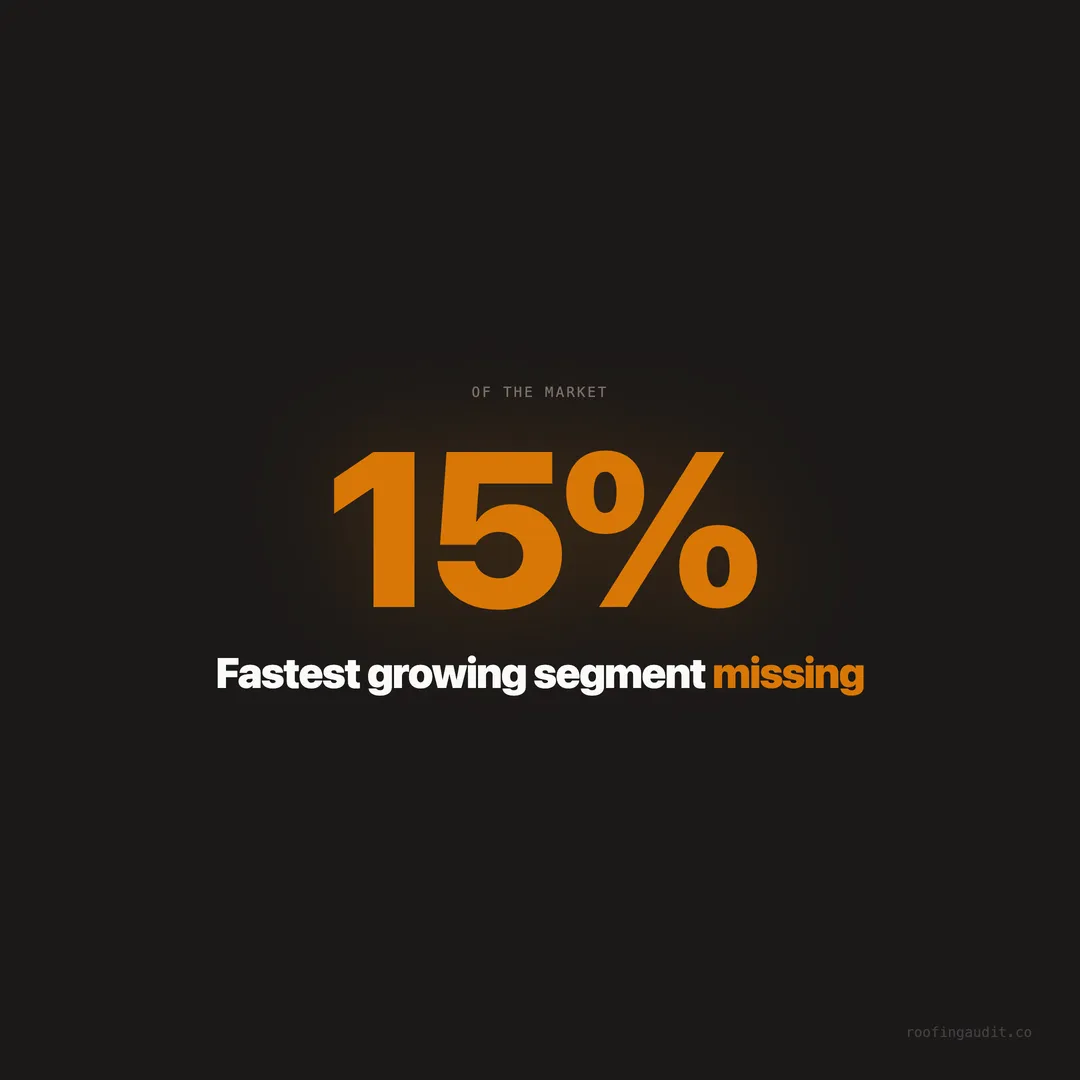
426 of 1,409 roofing sites have no metal roofing page. Metal is 15-20% of the market and growing — every missing page leaks high-value $18K+ leads.
A homeowner in Austin is replacing her 22-year-old composition shingle roof. She’s done the research. She knows metal roofs last 40-70 years, reflect heat in the Texas sun, and survive hailstorms that destroy asphalt shingles. She’s ready to spend $18,000-$25,000 on a standing seam metal roof.
She searches “metal roof installation Austin.” She clicks three results. Two of them have dedicated metal roofing pages with material comparisons, color galleries, project photos, and warranty details. The third — your company — has a general “Roofing Services” page that mentions metal in a bullet point between “shingles” and “tile.”
She calls the two companies with dedicated pages. You never get the chance to quote.
When we audited 1,409 roofing websites across Texas, Florida, and Georgia, 426 — 30% — had no metal roofing page. No dedicated page explaining metal roof options, costs, benefits, or the installation process. In the fastest-growing segment of residential roofing, nearly one in three roofers is invisible.
Metal Roofing Is Growing While Roofers Ignore It Online
Metal roofing isn’t a niche product anymore. It’s a 15-20% market share segment, and it’s growing faster than any other roofing material category.
The numbers tell the story. Metal roofing has experienced consistent year-over-year growth driven by durability, energy efficiency, and insurance incentives. In Texas and Florida — where hail, hurricanes, and extreme heat punish traditional shingles — metal has become the upgrade of choice for homeowners who want a roof that lasts.
The homeowner who searches “metal roof” is a premium buyer. They’ve already rejected the cheapest option. They’re willing to pay 2-3 times more than asphalt shingles for a roof that lasts twice as long. The average metal roof job in our dataset lands between $18,000 and $25,000 — the top of the residential roofing range.
Insurance companies encourage it. In Florida, some insurers offer premium discounts of 15-25% for impact-resistant metal roofs. In Texas, hail-resistant roofing materials can reduce premiums. This creates a financial incentive that pushes more homeowners toward metal — and they search for roofers who specialize in it.
Yet 426 roofing websites treat metal as an afterthought. A bullet point. A passing mention. No dedicated page to capture a buyer who’s ready to spend $20,000.
The Metal Buyer Is a Different Customer
The homeowner shopping for a metal roof is not the same person who needs an emergency tarp after a storm. Understanding this buyer matters because their decision process — and what they need from your website — is completely different.
They research extensively. The metal roof buyer has already spent hours reading about standing seam vs corrugated, Galvalume vs steel vs aluminum, and the differences between exposed fastener and concealed fastener systems. They arrive at your website with specific questions. If your site can’t answer those questions, they leave.
They compare materials, not just prices. An asphalt shingle buyer compares three roofers on price. A metal buyer compares materials, warranties, energy savings, hail ratings, and aesthetics. Your page needs to address all of this — not just say “we install metal roofs.”
They care about aesthetics. Metal roofing comes in dozens of colors and profiles. Standing seam looks dramatically different from corrugated panels or metal shingles. The buyer wants to see what each option looks like on an actual house — preferably in their climate and architectural style.
They expect expertise. Metal installation is more specialized than shingle installation. The buyer wants proof that you’ve done this before — photos, certifications, manufacturer warranties, and case studies. A roofer who treats metal as an add-on service doesn’t inspire confidence.
They have a higher budget. This buyer has already accepted the premium price point. They’re not trying to spend less. They’re trying to spend wisely. Price isn’t the objection — expertise and trust are.
What a Metal Roofing Page Needs to Convert
From the top-performing roofing websites in our audit, the metal roofing pages that generate leads share seven elements.
Material Comparison Section
The buyer wants to see their options side by side. A comparison table covering standing seam, corrugated panels, metal shingles, and stone-coated steel — with price ranges, lifespans, hail ratings, and aesthetic descriptions — gives them the information they came looking for.
This section alone can keep a visitor on your page for 3-5 minutes. In an industry where the average session duration is under 90 seconds, that’s a massive engagement win.
Cost Breakdown
Metal roof buyers know they’re paying a premium. What they want is clarity on what drives the cost. Material type, roof complexity (pitch, valleys, penetrations), removal of old roof, underlayment, and labor — each contributes to the final price.
A page that says “metal roofs cost $18,000-$25,000 for a typical home” with a breakdown of factors gives the buyer confidence. A page that says “call for a free estimate” gives them nothing.
Project Gallery With Metal-Specific Photos
Not mixed in with shingle jobs. A dedicated metal roofing gallery showing completed standing seam installations, color options on real houses, and close-up detail shots. The buyer wants to see the finished product on a home that looks like theirs.
Energy Efficiency Data
In Texas and Florida, energy savings are a primary driver of metal roof purchases. Metal roofs reflect solar radiant heat, reducing cooling costs by 10-25% in hot climates. A section with actual energy data — including the Energy Star certification that many metal roofing products carry — speaks directly to the buyer’s financial justification.
Warranty Information
Metal roof warranties are more complex than shingle warranties. There’s the manufacturer’s material warranty (often 40-50 years), the finish warranty (paint/coating — typically 25-35 years), and the installer’s workmanship warranty. Explaining all three builds trust and differentiates you from the roofer who just says “warranty included.”
Insurance Benefits
In Florida, impact-resistant metal roofs qualify for insurance premium discounts. In Texas hail corridors, similar discounts apply. This is money back in the homeowner’s pocket every year — and for a $20,000 roof, a 15% annual premium reduction can save thousands over the roof’s lifetime. This section converts fence-sitters.
Certification Proof
Metal roof manufacturers require specific training and certification for installers. If you’re a certified installer for companies like Standing Seam Systems, DECRA, or ATAS International, show those certifications. The buyer is investing $20,000+ and wants to know you’re not learning on their house.
The Revenue Math on Missing Metal Pages
Let’s run the numbers for a roofing company in the Dallas-Fort Worth market:
Market opportunity. Metal roofing represents 15-20% of the residential roofing market. In a metro area generating 200 roofing searches per day, that’s 30-40 searches daily from homeowners specifically looking for metal roofing.
Lead capture without a metal page: near zero. If your website mentions metal only as a bullet point, you won’t rank for “metal roof installation Dallas” or “standing seam roof cost Fort Worth.” Those searches go to the three roofers who have dedicated pages.
Lead capture with a metal page: 5-10 leads per month is realistic for a well-optimized page in a major metro. At an average job value of $20,000, that’s $100,000-$200,000 per month in potential revenue — from a single page.
Compared to paid acquisition: At $187 per lead in Google Ads, buying 10 metal roofing leads costs $1,870 per month. A dedicated organic page generates the same leads for free after the initial content investment.
Metal Pages Also Capture Commercial Leads
Metal roofing isn’t just residential. Commercial buildings — warehouses, retail centers, churches, schools — overwhelmingly use metal roofing systems. TPO, EPDM, and standing seam are standard commercial materials.
A dedicated metal roofing page captures both residential homeowners and commercial property managers searching for metal roof solutions. Without it, you miss both markets.
39% of commercial roofers in our audit offer solar installation services — and solar panels are most commonly installed on metal roofs because of the compatible mounting systems. A metal roofing page naturally connects to solar content, creating a service pathway that captures the growing solar roofing market (CAGR of 13.8%).
What Most Metal Pages Get Wrong
Even among the 70% of sites that have some metal roofing content, many make critical mistakes:
Too short. A paragraph and a phone number is not a metal roofing page. The buyer has spent hours researching. They expect depth. Pages under 500 words don’t rank and don’t convert.
No photos. Stock photos of metal roofs don’t build trust. Project photos from your own installations — showing the color, the profile, the finished result — do. Every metal job you complete should be photographed and added to this page.
No price guidance. “Call for a quote” isn’t helpful to the buyer who wants to know if they can afford a metal roof before calling. Price ranges — even broad ones like “$12-$18 per square foot installed” — respect the buyer’s time and filter leads by budget.
No material education. Standing seam, corrugated, metal shingles, stone-coated steel — most homeowners don’t know the differences. A page that explains each type, with photos and use cases, positions you as the expert and gives the buyer confidence.
Buried in the site. If the metal roofing page is three clicks deep in a dropdown menu, it might as well not exist. It should be in the main navigation under “Services” and linked from the homepage.
Building This Page Takes One Day
| Element | Time |
|---|---|
| Write material comparison content | 3 hours |
| Add 5-10 project photos with descriptions | 1 hour |
| Create cost breakdown section | 1 hour |
| Add warranty and certification info | 30 minutes |
| Write insurance benefits section | 30 minutes |
| Add energy efficiency data | 30 minutes |
| Add to main navigation | 10 minutes |
Total: ~7 hours. One working day to capture a segment worth $18,000-$25,000 per job — the highest-value residential roofing work available.
426 roofing companies in our audit of 1,409 sites don’t have this page. The segment is growing. The buyers are searching. The roofers who build this page first in their market will capture leads that almost a third of their competitors will never see.
Metal roofing isn’t going away. It’s accelerating. The question isn’t whether homeowners will search for metal roofers in your city. They already are. The question is whether they’ll find you — or the competitor who took a day to build the page you didn’t.
Keep reading
Want to know your score?
Drop your URL — full report in 48 hours.
We're on it.
Report in your inbox within 48 hours.