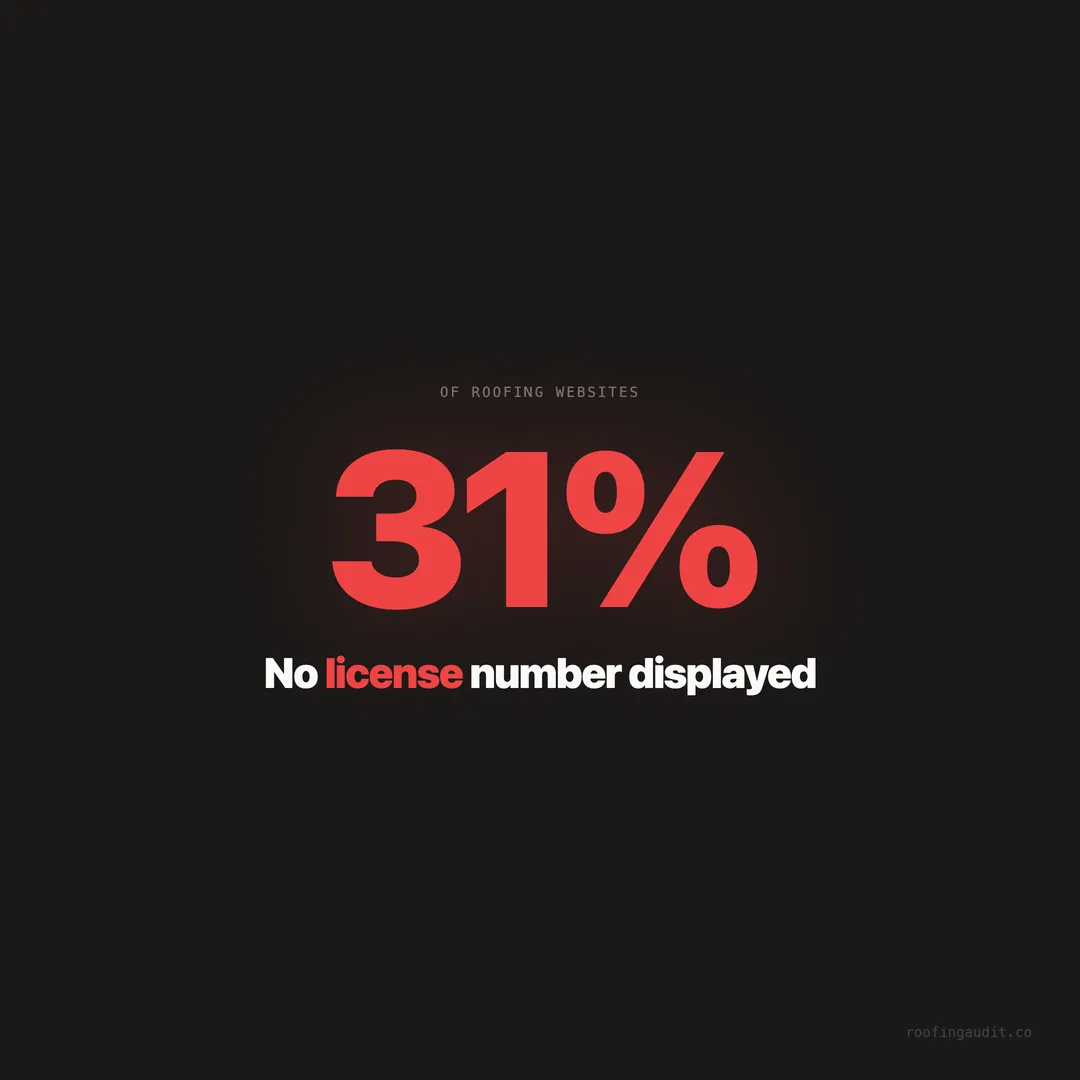
31% of Roofers Don't Display Their License Number Online
431 of 1,409 roofing websites show no license number. It's a trust signal, a compliance tool, and the one thing storm chasers can't fake.
A homeowner in Jacksonville is comparing two roofing companies. Both have good reviews. Both offer free estimates. Both show certification badges. She scrolls to the footer of the first site and sees: “FL License #CCC1332456.” She can verify that number on the state website in 30 seconds.
The second site says “licensed and insured.” No number. No way to verify. She moves on.
That license number — twelve characters in a footer — just decided a $15,000 purchase. The roofer who displayed it got the call. The one who didn’t got forgotten.
When we audited 1,409 roofing websites across Texas, Florida, and Georgia, 431 — 31% — displayed no contractor license number anywhere on the site. Not in the footer. Not on the about page. Not on any page at all.
These companies may be fully licensed. They probably are. But the homeowner has no way to know that from the website — and in a market where storm chasers flood in after every hail event and hurricane, “trust me, I’m licensed” isn’t enough.
Why the License Number Is the Hardest Trust Signal to Fake
Every roofer says “licensed and insured.” It’s on thousands of websites. It’s become background noise — the homeowner barely registers it anymore because everyone says it.
But the actual license number is different. It’s specific. It’s verifiable. It’s connected to a state database that anyone can search. And most importantly: an unlicensed contractor can’t display one.
This is what makes the license number uniquely powerful as a trust signal. Certifications can be misrepresented. Project counts can be inflated. Testimonials can be fabricated. But a license number points to a public record that the homeowner can independently verify.
In Florida, where roofing contractor fraud has been a statewide issue, the license number is especially critical. The Florida Department of Business and Professional Regulation (DBPR) maintains a searchable database. Homeowners have been trained — through news coverage and consumer advocacy — to check that database before hiring. A roofer whose website includes the license number is inviting that verification. One who omits it is avoiding it.
The Storm Chaser Filter
This is the uncomfortable truth about the license number gap: storm chasers typically can’t display a valid local license because they don’t have one.
When Texas experienced 529 hail events in 2024, contractors from dozens of states flooded DFW, San Antonio, and Houston. Many operated without a Texas-specific contractor license, relying on the state’s relatively permissive rules or simply ignoring licensing requirements while chasing short-term storm repair contracts.
A visible license number on your website does something that no amount of marketing language can do: it proves you’re not one of them. It tells the homeowner: “I’m registered with the state. I’m accountable. You can look me up.” Storm chasers can’t make that claim — because the license doesn’t exist.
In Florida, the distinction is even sharper. The state requires a Certified Roofing Contractor (CCC) license or a Registered Roofing Contractor (RC) license for all roofing work. Out-of-state storm chasers who skip this process are operating illegally. Displaying your CCC or RC number is a direct signal that you’re compliant and they’re not.
For homeowners who’ve read about roofing scams — and in Florida, most have — the license number is the first thing they verify. 431 legitimate roofers in our audit are making that verification impossible by hiding the number.
State Licensing Requirements: What You’re Accountable For
Licensing rules differ significantly across the three states in our audit, and understanding those differences explains why the license number matters in different ways:
Texas
Texas doesn’t require a statewide roofing contractor license. However, many cities and counties require local registration. Houston, Dallas, San Antonio, and Austin all have contractor registration requirements. The absence of a statewide mandate makes it even more important to display local registrations — it shows you’ve gone through the process even when it’s optional in some areas.
Additionally, Texas requires general liability insurance and compliance with local building codes. Displaying your city-level registration number proves you’re operating within the system — not outside it.
Florida
Florida requires a Certified Roofing Contractor (CCC) license or a Registered Roofing Contractor (RC) license. This is a statewide requirement with no exceptions. The CCC number is the gold standard — it means the contractor has passed the state exam and can work anywhere in Florida.
Florida law also requires that the license number appear in all advertising, which technically includes the website. The 31% of Florida roofers in our audit who don’t display their license number may actually be out of compliance with state advertising regulations — on top of missing a trust signal.
Georgia
Georgia requires a Residential-Light Commercial (RLC) or General Contractor (GC) license for roofing work exceeding $2,500. Given that the average roofing job runs $8,000-$25,000, virtually all roofing work requires a license. The Georgia Secretary of State maintains a searchable database, and homeowners in metro Atlanta are increasingly checking it before hiring.
Where the License Number Should Appear
Based on the top-performing sites in our audit, the license number should appear in at least three locations:
Footer — every page. This is the most common and most effective placement. The license number sits alongside the company name, phone number, and service area. It’s visible on every page of the site, whether the homeowner lands on the homepage, a blog post, or a service page.
About page. The about page is where homeowners go to verify legitimacy. The license number belongs here, ideally with a brief note explaining what the license means and how to verify it.
Contact page. Alongside the phone number and address, the license number reinforces legitimacy at the moment the homeowner is deciding whether to reach out.
Google Business Profile. Not a website placement, but critical. The license number in your Google listing matches what the homeowner sees on your website, creating consistency that builds confidence.
Some top-scoring sites go further — they link the license number directly to the state verification database. One click, and the homeowner can confirm the license is active, in good standing, and matches the company name. That level of transparency is rare. It’s also extremely effective.
The Insurance Connection
In storm markets, the license number and insurance documentation are deeply connected. Here’s why:
When a homeowner files an insurance claim for storm damage, the insurance company often verifies the contractor’s license before approving the work. An unlicensed contractor can result in a denied claim — a catastrophic outcome for the homeowner on a $15,000-$25,000 repair.
In Florida, where 42% of claims are already denied, the last thing a homeowner wants is to add “unlicensed contractor” as a denial reason. A license number on the website tells the homeowner: “Your insurance company will accept our work.” That’s a powerful reassurance in a market where insurance anxiety runs high.
The same applies after hurricanes. FEMA-funded repairs require licensed contractors. State emergency disaster relief programs require licensed contractors. When a storm hits and the homeowner is scrambling, the roofer whose website clearly displays a license number is the one who gets the call — because the homeowner knows the work will be accepted by insurance and government programs.
The Compliance Angle
Beyond trust, there’s a legal dimension that 31% of roofers in our audit may be overlooking.
Florida law requires the contractor license number to appear in all advertising. A website is advertising. Omitting the license number could constitute a violation — one that a competitor, a consumer protection agency, or an angry customer could report.
Georgia has similar advertising requirements for licensed contractors. The license number is supposed to be visible in consumer-facing communications.
Texas, while lacking a statewide roofing license, has city-specific requirements. Houston, for example, requires registered contractors to display their registration number in advertising.
None of these rules are heavily enforced through website audits. But enforcement isn’t the point. The point is that displaying the license number is both a trust signal AND a compliance action. Omitting it creates risk on both fronts.
What the License Number Says About Your Business
A displayed license number communicates several things simultaneously, all without requiring a single word of marketing copy:
Permanence. You have a fixed business presence. You’re not going to disappear after cashing the check. Licensed contractors are trackable — by the state, by consumers, by courts if necessary.
Accountability. The license is attached to your name. If something goes wrong, the homeowner has recourse. This is the fundamental difference between licensed and unlicensed work — accountability through a public system.
Competence. In states with exam requirements (Florida, Georgia), the license proves you passed a test of knowledge. In states with insurance requirements (all three), it proves you carry coverage. Neither can be claimed by someone without the license.
Compliance. You follow the rules. In an industry where homeowners worry about getting scammed, compliance with state regulations is a baseline that too many websites fail to demonstrate.
Confidence. You’re not hiding anything. You’re inviting the homeowner to look you up. That transparency is rare enough to be a differentiator — and it builds trust faster than any testimonial.
License Number + Other Trust Signals: The Compound Effect
The license number works best when combined with other verified trust signals:
License + certifications — “FL License #CCC1332456 | GAF Master Elite Contractor.” The license proves state verification. The certification proves manufacturer verification. Two independent authorities vouching for the same company.
License + social proof numbers — “Licensed since 2006 | 2,800+ roofs replaced.” The license anchors the founding year. The project count proves sustained activity. Both are verifiable.
License + reviews — A reviews page with the license number in the footer creates a trust loop. The homeowner reads good reviews, scrolls down, sees the license number, and thinks: “This company is legitimate AND well-reviewed.” Each reinforces the other.
License + warranty info — Many manufacturer warranties require the installing contractor to be licensed. Displaying the license alongside warranty details proves the warranty is valid — a critical concern on $8,000-$25,000 jobs.
Why Homeowners Check Licenses Before Calling
Consumer behavior has changed. Ten years ago, homeowners hired roofers based on a neighbor’s recommendation and a handshake. Today, they verify online before making contact. Here’s what drives that behavior:
News coverage of roofing scams. Every storm season produces local news stories about unlicensed contractors taking deposits and disappearing. These stories make homeowners cautious — and they make license verification a habit.
Insurance company requirements. Many insurance companies require proof that the contractor is licensed before approving a claim. Homeowners know this, especially in Florida’s insurance-heavy market.
BBB and state complaint databases. Homeowners increasingly check complaint records tied to the license number. A clean record is a selling point. No license to search means no record to verify — which feels suspicious.
$8,000-$25,000 at stake. The purchase size drives verification behavior. A homeowner doesn’t check a plumber’s license for a $200 repair. She absolutely checks a roofer’s license for a $15,000 replacement. The bigger the purchase, the more verification the homeowner does.
The 5-Minute Fix
Adding a license number to a website is the simplest change in our entire 34-element checklist. It requires:
-
Find your license number. Check your state licensing board, your original license documentation, or your insurance paperwork. It’s a short alphanumeric code.
-
Add it to your footer. Right next to your company name and phone number. Format: “License #[number]” or “FL CCC #[number].”
-
Add it to your about page. Include a one-line note about what the license means and how to verify it.
-
Add it to your Google Business Profile. Under the business description or in the attributes section.
That’s it. Five minutes. No developer needed. No design changes.
431 roofing companies in our audit are missing this — the simplest, most verifiable trust signal in the industry. In storm markets where homeowners are trained to be suspicious, where storm chasers exploit the gap between legitimate and fraudulent contractors, the license number is the clearest proof of which side you’re on. It takes five minutes to display. It takes five seconds for a homeowner to verify. And it takes one missing license number to lose a $15,000 job to the roofer who showed hers.
Keep reading
Want to know your score?
Drop your URL — full report in 48 hours.
We're on it.
Report in your inbox within 48 hours.