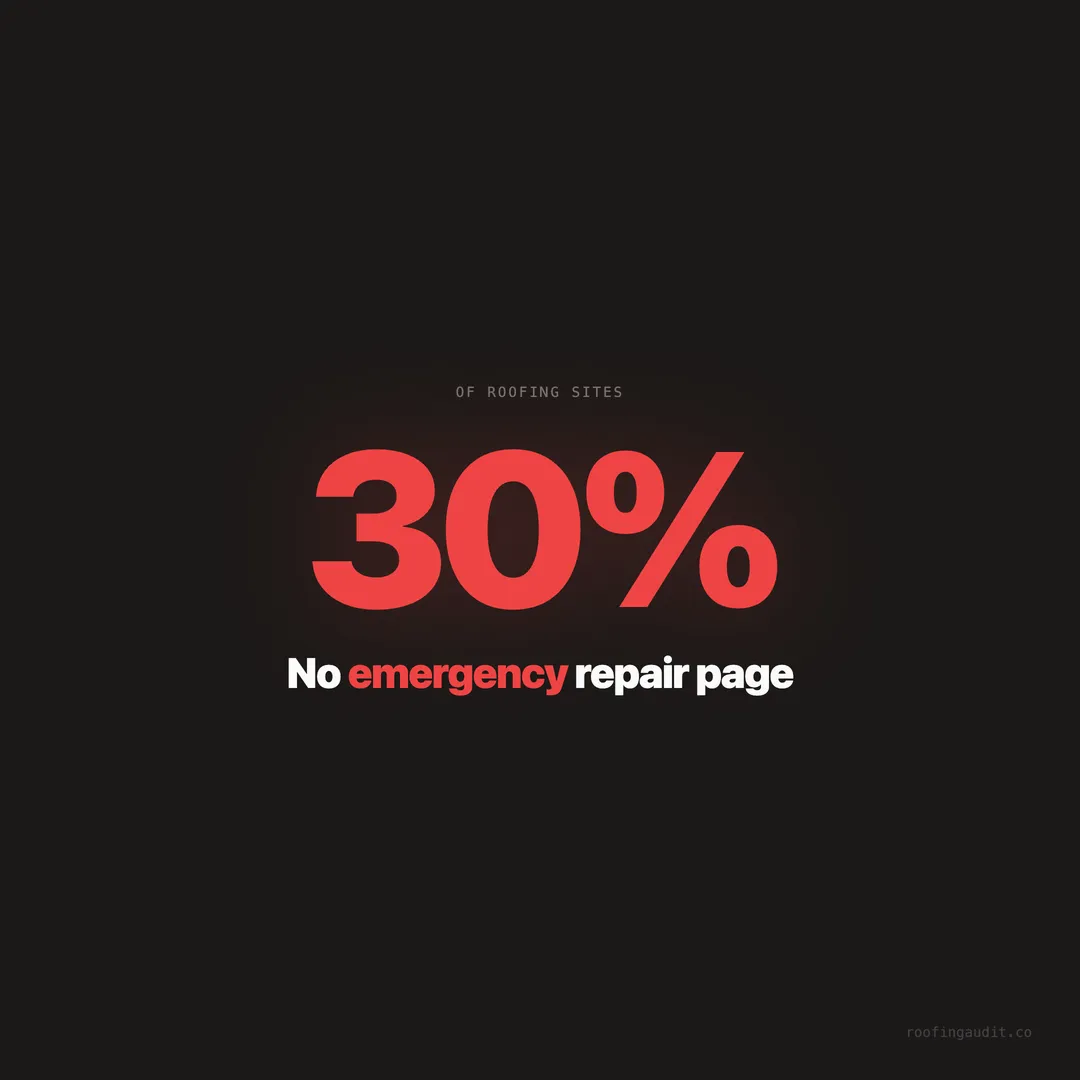
30% of Roofing Sites Have No Emergency Repair Page — Here's What That Costs After a Storm
429 of 1,409 roofing sites have no emergency page. After storms, every missed after-hours call goes to the competitor who does.
It’s 11 PM on a Thursday in Tampa. A tree branch just crashed through a homeowner’s roof during a thunderstorm. Rain is pouring into the living room. She grabs her phone and searches “emergency roof repair near me.”
She finds three roofers. Two have normal business websites — “Quality Roofing Services” with business hours listed as 8 AM to 5 PM. The third has a page titled “Emergency Roof Repair & Tarping — Available 24/7” with a clickable phone number and the promise: “On-site within 2 hours.”
She taps the number. The third roofer answers. The other two won’t know about this lead until morning — by which time another roofer has already tarped the roof and quoted the replacement.
When we audited 1,409 roofing websites across Texas, Florida, and Georgia, 429 — 30% — had no emergency repair or tarping page. No dedicated page. No after-hours messaging. No promise of rapid response.
In states where storms generate the majority of roofing demand, missing an emergency page means missing the highest-urgency, highest-value leads in the market.
Why Emergency Pages Convert at the Highest Rate
Emergency roofing leads are different from every other lead type:
Maximum urgency. The homeowner isn’t comparing three quotes. They need a tarp on their roof tonight. The first roofer who answers gets the job — and the full replacement that follows.
Highest intent. An emergency caller isn’t browsing. They’re buying. There’s no research phase. No “let me think about it.” The problem is happening right now.
Lead-to-job pipeline. An emergency tarping job almost always converts into a full roof replacement. The roofer who tarps the roof has the inside track on the $8,000-$25,000 replacement. The relationship is already established.
Premium pricing accepted. Homeowners expect to pay more for emergency service. The margin on emergency work is higher because urgency eliminates price shopping.
What an Effective Emergency Page Includes
From the top-scoring roofing sites in our audit, emergency pages that convert share five elements:
A Massive Clickable Phone Number
Not in the header. Not in regular text. A large, high-contrast, tap-to-call button that dominates the page. The homeowner with a hole in their roof at midnight shouldn’t have to hunt for a number.
Response Time Promise
“On-site within 2 hours in the Tampa Bay area.” Specific. Measurable. Confidence-building. Generic “fast response” means nothing. A time commitment means everything.
24/7 Availability Messaging
“Emergency service available 24 hours, 7 days a week — including holidays.” Homeowners searching at 11 PM need to know you answer at 11 PM. If you use an answering service after hours, say so: “After-hours calls answered by our dispatch team.”
Photos of Emergency Work
Before/after photos of tarping jobs. A crew working in the rain. Blue tarps on damaged roofs. These photos say: “We’ve done this at 2 AM in a thunderstorm. We’ll do it for you.”
Insurance Information
Link to your insurance claim guide. After an emergency, insurance is the next thought: “How will I pay for this?” A link to the guide — or even a single paragraph explaining that emergency tarping is typically covered — reduces anxiety and keeps the homeowner on your page.
The Revenue Impact of Missing Emergency Pages
Consider this scenario for a roofer in the Houston market:
- 10 emergency calls per month during storm season (March-June)
- 60% close rate on emergency calls (highest of any lead type)
- 6 emergency tarping jobs/month at $500-$1,500 each = $3,000-$9,000/month in tarping revenue
- 50% convert to full replacements = 3 jobs × $12,000 = $36,000/month in replacement revenue
- Total storm-season value of emergency leads: $39,000-$45,000/month
A roofer without an emergency page captures zero of those after-hours calls. They all go to the competitor whose website says “24/7 Emergency Service — Call Now.”
Over a 4-month storm season, that’s potentially $156,000-$180,000 in missed revenue. From a page that takes half a day to build.
Emergency Pages Also Win During Non-Storm Emergencies
Storm season isn’t the only time roofs leak. Year-round emergencies include:
- Pipe burst causing water to back up through roof vents
- Animal damage — raccoons, squirrels tearing through shingles
- Fallen tree limbs during regular thunderstorms
- Failed previous repair — a patch that gives way during rain
- Ice dam damage (less common in TX/FL but relevant in GA)
A year-round emergency page captures these leads every month — not just during storm season. The roofer with this page is the default “emergency roofer” in the homeowner’s mind.
The Page Takes Half a Day to Build
| Element | Time |
|---|---|
| Write emergency page content | 2 hours |
| Add clickable phone number (tel: link) | 10 minutes |
| Add 3-5 emergency/tarping photos | 30 minutes |
| Add response time promise | 10 minutes |
| Link to insurance guide | 5 minutes |
| Add to navigation menu | 10 minutes |
| Test on mobile | 15 minutes |
Total: ~3-4 hours. That’s the investment between capturing emergency leads and losing them.
Among the 34 elements in our roofing website audit, the emergency page has one of the highest revenue-per-hour-of-work ratios. 429 roofing companies in our audit are missing it — and losing the most valuable leads in the industry.
The storms come whether your website is ready or not. The emergency calls happen whether you have a page or not. The difference is whether those calls reach you — or the roofer who planned ahead.
Keep reading
Want to know your score?
Drop your URL — full report in 48 hours.
We're on it.
Report in your inbox within 48 hours.