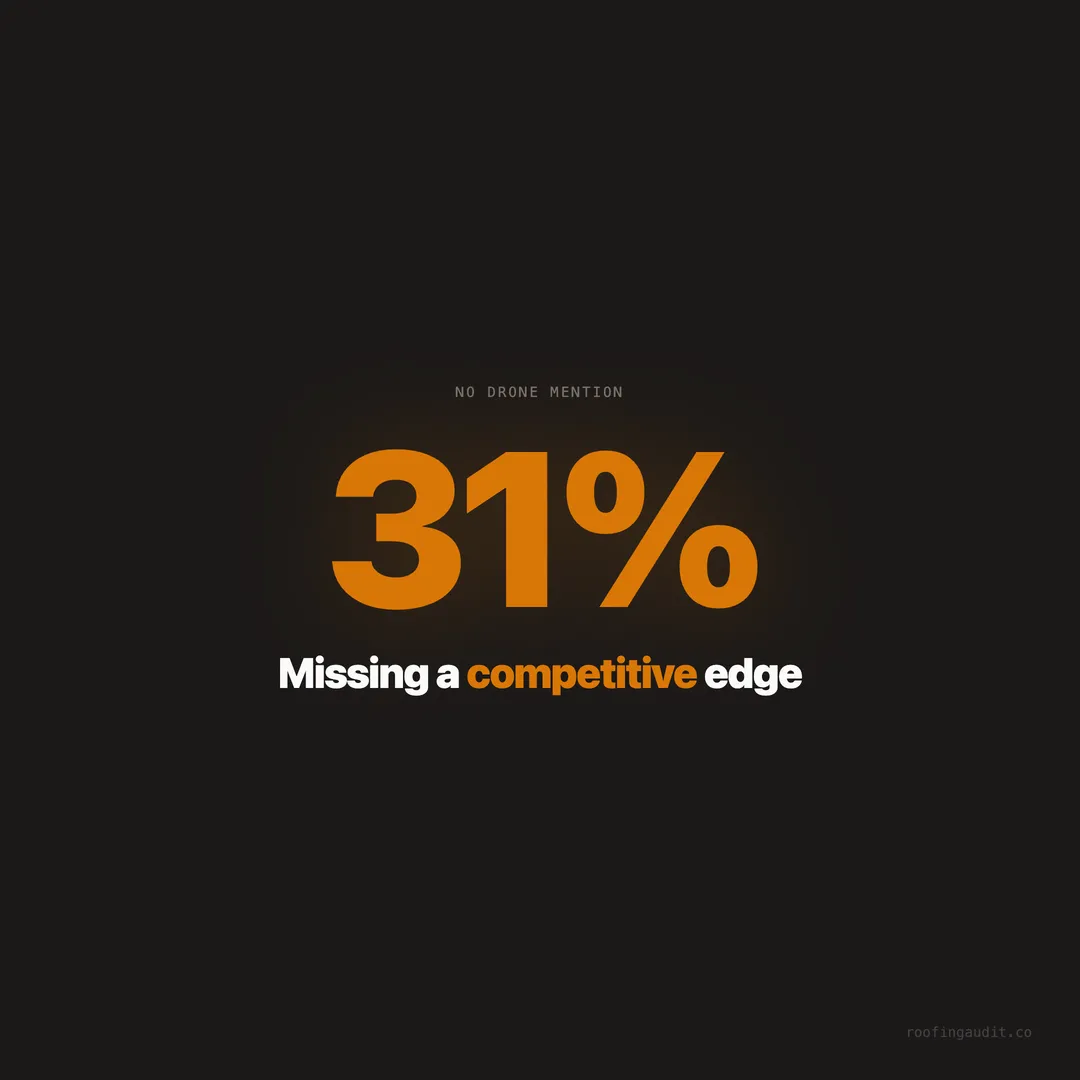
31% of Roofing Sites Have No Drone or Aerial Technology Mention — Missing a Competitive Edge
437 of 1,409 roofing websites never mention drone or aerial inspections. In 2026, not mentioning it makes you look outdated to homeowners.
A homeowner in Austin needs a roof inspection after a hailstorm. She narrows her search to two roofers. The first site mentions “comprehensive roof inspection” and shows a photo of a guy on a ladder. The second site has a dedicated section on drone-assisted inspections — aerial photos of past inspections, images captured from 200 feet showing damage patterns invisible from ground level, and a note about safety: “No one climbs on your storm-damaged roof until we’ve mapped it from the air first.”
She calls the second roofer. The first one looked like he was still working in 2015.
When we audited 1,409 roofing company websites across Texas, Florida, and Georgia, 437 — 31% — had no mention of drone inspections, aerial photography, or any kind of aerial technology anywhere on their site. No drone photos. No mention of the word “drone.” No aerial imagery. Nothing that signals they’ve adopted the technology that has become standard in professional roofing.
Drone Inspections Are Now Industry Standard
The roofing industry’s adoption of drone technology accelerated between 2020 and 2024. What started as a premium offering by a few forward-thinking companies is now expected by insurance adjusters, homeowners, and general contractors. Here’s what changed:
Insurance companies use drones. Major carriers including State Farm, Allstate, and USAA use drone inspections for claims assessment. When the insurance adjuster shows up with a drone and the roofer doesn’t have aerial documentation to match, there’s a credibility gap.
Homeowner awareness has grown. Home improvement shows, storm coverage news segments, and competitor marketing have all normalized drone inspections. Homeowners in storm markets now expect professional roofers to use drones. Not mentioning it doesn’t make a company neutral — it makes them look like they haven’t kept up.
Safety regulations favor drone-first inspections. OSHA considers roof access one of the most dangerous activities in construction. Drone pre-inspections reduce the need for initial manual roof access on storm-damaged roofs where structural integrity is uncertain. A roofer who mentions drones signals that they take crew safety seriously.
The technology is affordable. A commercial-grade inspection drone costs $1,500-$3,000 — less than the profit on a single roof replacement. FAA Part 107 certification for commercial drone operation takes a few weeks and costs under $200. The barrier to entry is no longer cost. It’s awareness.
What Homeowners Think When They Don’t See Drone Mentions
The absence of drone technology on a roofing website sends specific signals to homeowners — none of them positive.
They Think You’re Behind the Times
A homeowner comparing three roofers sees two that mention drone inspections with aerial photos, and one that doesn’t mention them at all. The roofer without drone content looks less professional. Not because drone inspections are inherently better than manual ones — but because the homeowner expects a modern roofer to use modern tools. Not mentioning drones in 2026 is like not having a website in 2010. You might be a great roofer, but you look like you haven’t kept up.
They Wonder About Thoroughness
Drone inspections capture angles that manual inspections miss. A bird’s-eye view of the entire roof surface reveals damage patterns — hail impact distribution, wind uplift areas, flashing failures — that are difficult or impossible to see from a ladder at the eave line.
A homeowner whose roof took hail wants to know that the inspector saw everything. A drone photo showing the entire roof surface — every ridge, every valley, every transition — communicates thoroughness in a way that “we’ll send a guy up there” cannot.
They Worry About Safety
Storm-damaged roofs are dangerous. Shingles are loose. Decking may be compromised. Walking on a hail-damaged roof before assessing it from above risks injury to the inspector and further damage to the roof.
When a roofing company’s website mentions drone pre-inspection — assessing the roof from the air before anyone sets foot on it — that signals care for worker safety and responsible professional practice. It’s a small but meaningful trust signal, especially for homeowners who feel uneasy about strangers climbing on their damaged roof.
They Question the Inspection Report
Insurance claims require documentation. A manual inspection produces notes and some photos from ground level or the roof edge. A drone inspection produces high-resolution overhead imagery that can be overlaid with damage markers, measurements, and annotations.
The drone report looks professional. The manual report looks… like notes. When the homeowner submits their claim, the quality of the inspection documentation affects how the adjuster responds. Roofers who don’t mention drone capability are implicitly saying: our documentation is less comprehensive than the roofer down the street.
The SEO Value of Drone Content
Beyond homeowner perception, drone content has real SEO value that 437 roofing sites are missing.
“Drone roof inspection [city]” is a growing search term in every metro market. Homeowners search for it because they’ve seen it in the news or heard about it from a neighbor. The roofer whose site has a dedicated drone inspection page — with alt-tagged aerial photos, service descriptions, and city-specific content — captures these searches. The roofer without any drone content doesn’t even compete for them.
Image search traffic. Drone photos are visually distinctive. They look different from every other photo on roofing websites. When properly tagged with descriptive alt text — “Drone aerial photo of hail-damaged roof in Plano TX” — they rank in Google Image Search for highly specific, high-intent queries.
Long-tail keyword capture. Drone technology opens up content opportunities:
- “What to expect during a drone roof inspection”
- “Drone vs manual roof inspection — which is better”
- “How drones detect hidden roof damage”
- “Drone roof inspection cost”
- “Does insurance accept drone roof inspections”
Each of these is a blog post or FAQ section that captures organic traffic. The roofing companies in our audit that had dedicated drone content were targeting search terms that the 31% without any drone mention couldn’t rank for.
What Effective Drone Content Looks Like
Among the 388 sites (28%) that had dedicated drone content, the most effective examples shared common elements.
A Dedicated “Drone Inspection” Page
Not a sentence on the services page. A full page explaining:
- What the drone inspection involves
- What the homeowner should expect
- What the aerial report includes
- How the drone findings connect to the repair estimate
- How drone documentation supports insurance claims
This page targets “drone roof inspection [city]” directly and gives the homeowner a clear picture of the process before they call.
Actual Drone Photos
Aerial photos of real inspections — not stock images of drones. The best sites show:
- Overhead view of a full roof with damage areas highlighted
- Close-up drone shots of specific damage (hail impacts, missing shingles, flashing gaps)
- Before-and-after aerials (damaged roof vs. completed repair from the same angle)
- The drone report output with annotations
These photos do double duty: they demonstrate capability and they build the visual portfolio that drives gallery-based trust.
The Inspection Process Explained
Homeowners who haven’t experienced a drone inspection want to know what happens:
- The pilot positions the drone and maps the roof surface
- High-resolution images are captured from multiple angles and heights
- Images are reviewed for damage markers — cracked shingles, lifted flashings, ponding areas, damaged vents
- A documented report is generated with annotated images
- Findings inform the repair estimate and insurance claim documentation
Walking through this process on the website removes uncertainty and makes the homeowner more likely to book.
FAA Compliance and Certification
Mentioning that pilots are FAA Part 107 certified — the commercial drone operator license — adds credibility. It tells the homeowner this isn’t a kid with a hobby drone. It’s a certified, insured, professional operation.
You Don’t Need a Drone to Add Drone Content
Here’s an important nuance: a roofing company doesn’t need to own a drone to benefit from drone content on its website. Many roofing companies hire third-party drone operators for inspections on an as-needed basis. Others partner with inspection services that provide drone imagery as part of their assessment package.
The website just needs to communicate that aerial inspection is part of the process. Whether the company owns the drone, contracts a pilot, or uses a partner service is an operational detail. The homeowner doesn’t care who flies the drone. She cares that her roof is being inspected thoroughly from every angle.
If the company does own a drone and has a Part 107 certified pilot on staff, that’s worth prominently featuring. It communicates investment, capability, and professionalism. But even a company that subcontracts drone work should mention it — because the alternative is being one of the 437 sites that say nothing, and looking outdated by comparison.
How to Add Drone Content to Your Site This Week
This is one of the faster fixes in our 34-element checklist. The content can be added in a day.
Step 1: Create a “Drone Inspection” section or page. Write 300-500 words explaining your drone inspection process, what it captures, and how it benefits the homeowner. Include the terms “drone inspection,” “aerial roof inspection,” and your city name for SEO.
Step 2: Add aerial photos. If you have drone photos from past inspections, upload them with proper alt text — “Drone aerial view of storm-damaged roof in [city].” If you don’t have drone photos yet, commit to capturing them on your next 3 jobs. The photos build your portfolio and your website simultaneously.
Step 3: Mention drones in your services overview. The main services page should reference drone-assisted inspections as part of your process. A single sentence — “Every inspection begins with a drone survey to map the full roof surface before anyone climbs up” — communicates technology adoption in a way that resonates.
Step 4: Add drone mentions to your Google Business Profile. In your business description and service offerings on Google, include “drone roof inspection” as a service. This helps with Map Pack rankings for drone-related searches.
Step 5: Blog about it. A blog post titled “What to Expect During a Drone Roof Inspection in [City]” captures long-tail searches and gives homeowners the information they’re looking for. Include real photos, process descriptions, and the benefits of aerial documentation for insurance claims.
The Competitive Math Is Simple
437 roofing companies in our audit don’t mention drones. Their competitors in the same markets do. In the homeowner’s eyes, the company with drone content looks more professional, more thorough, and more modern.
At $8,000-$25,000 per job and $187 per Google Ads click, losing a single job because a competitor’s website mentioned drone inspections and yours didn’t is an expensive omission. Losing one job per month to this gap adds up to $96,000-$300,000 per year in missed revenue.
The fix costs nothing. A few hours of content creation. Some photos from your next job. A page on your website. And you move from the 31% who are invisible on drone-related searches to the 69% who communicate that they use the tools homeowners now expect.
Only 2% of roofing contractors earn GAF Master Elite status. But 100% of roofers can mention drone inspections on their website. The ones who don’t are choosing to look like they stopped investing in their business years ago.
Your competitors are putting aerial photos on their websites while you’re not mentioning drones at all. That gap has a price. And unlike a new drone, closing it on your website is completely free.
Keep reading
Want to know your score?
Drop your URL — full report in 48 hours.
We're on it.
Report in your inbox within 48 hours.