Gutter and Soffit Pages: The Service Pages Roofers Forget
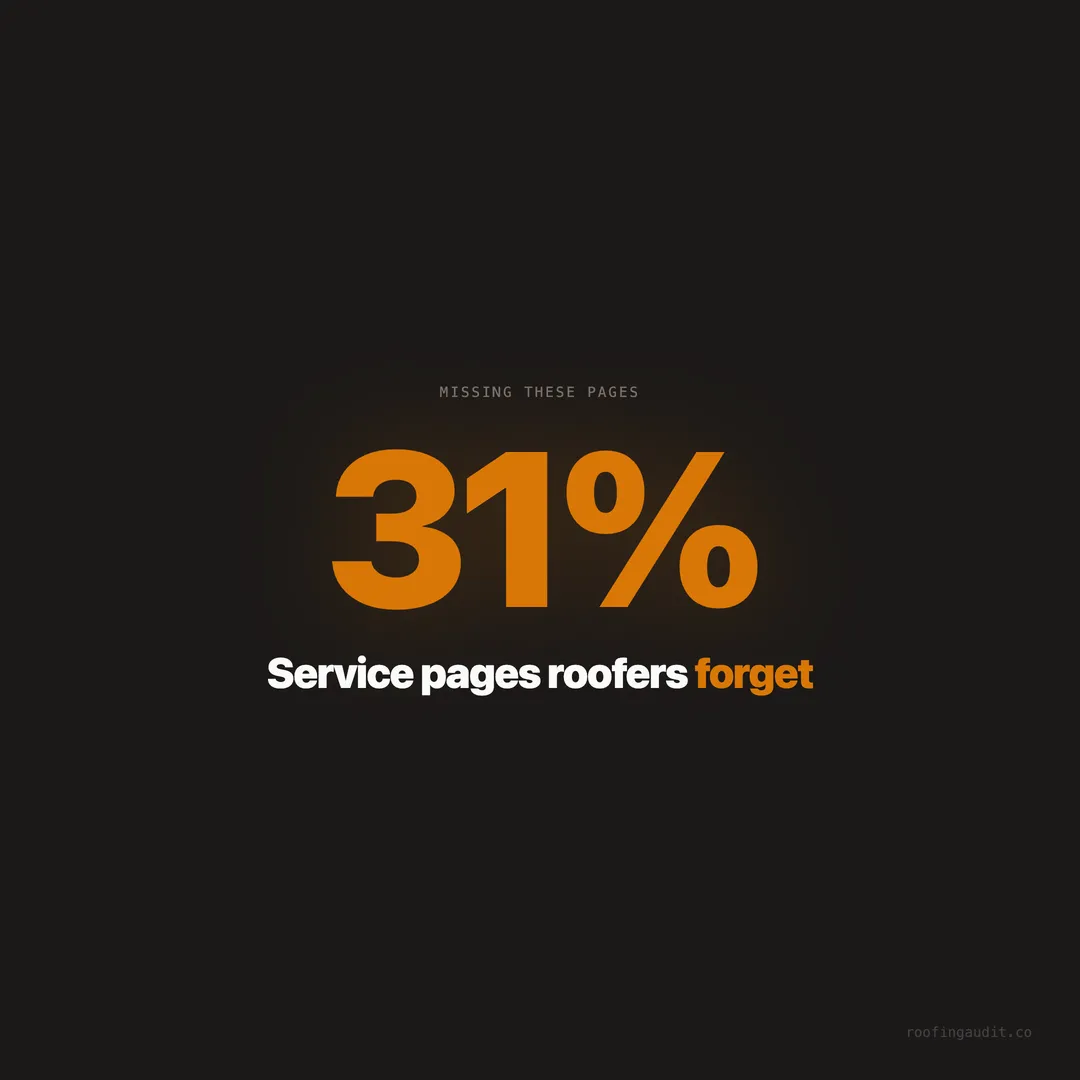
31% of 1,409 roofing sites have no gutter page, 31% no soffit/fascia page. Complementary services drive upsells and capture traffic competitors miss.
A homeowner in Fort Worth notices water pouring over the edge of her roof during a rainstorm. It’s not the roof — it’s the gutters. They’re sagging, clogged, and pulling away from the fascia board. She searches “gutter replacement Fort Worth” and clicks three results.
None of them are roofing companies. They’re gutter-specific contractors. Her roofer — the one who replaced her roof two years ago, the one who could have handled the gutters during the original job, the one who would have been the obvious choice — doesn’t show up because they don’t have a gutter page on their website.
The gutter contractor replaces her gutters. He notices the soffit is rotting. He refers her to another contractor for the soffit work. Her original roofer could have done all of it — the gutters, the soffit, the fascia — but they didn’t have the pages, so they didn’t get the calls.
When we audited 1,409 roofing websites across Texas, Florida, and Georgia, 31% had no gutter page and 31% had no soffit or fascia page. These aren’t edge services. They’re core complementary services that every roofer performs — and nearly a third don’t mention them on their website.
Why Gutters and Soffits Are Roofing Services
Every roofer knows this, but their websites don’t reflect it. Gutters, soffits, and fascia are part of the roofing system. They’re not add-ons. They’re not separate trades. They’re integral to how a roof functions.
Gutters channel water off the roof and away from the foundation. When gutters fail, water pools on the fascia, seeps into the soffit, and damages the roof deck from below. A new roof with bad gutters is a ticking clock.
Soffits provide ventilation to the attic space. Without proper soffit ventilation, heat and moisture build up in the attic, accelerating shingle deterioration from underneath. A roof with blocked or rotted soffits will fail years before its warranty expires.
Fascia is the board that gutters attach to. When fascia rots — usually from failed gutters — the gutters can’t stay mounted, the roof edge becomes exposed, and water infiltration begins.
These three components are inspected, repaired, or replaced during every roof replacement. The roofer is already on the roof. The equipment is already in the driveway. Yet 31% of roofers don’t have pages for these services — which means they’re invisible when homeowners search for them independently.
The Upsell Opportunity Roofers Leave on the Table
Gutter and soffit services represent two revenue opportunities that most roofers miss entirely on their websites.
During Roof Replacement: The Natural Upsell
When a crew is replacing a roof, they remove the existing gutters (or work around them). The drip edge gets replaced. The fascia is exposed and inspected. This is the ideal moment to upsell gutter replacement, soffit repair, or fascia replacement — because the labor cost is minimal when the crew is already there.
Average gutter replacement: $1,500-$3,000 for a typical home. Average soffit/fascia repair: $1,000-$2,500. These are high-margin add-ons to a roof replacement because the mobilization cost is zero — the crew, the equipment, and the dumpster are already on-site.
A roofer who adds gutter replacement to 40% of roof jobs at $2,000 per gutter job adds $800 per roof replacement in average revenue — without additional marketing spend. Over 100 roof jobs per year, that’s $80,000 in additional revenue from a service they already perform.
But the homeowner won’t ask about gutter replacement during a roof job if the roofer’s website doesn’t mention gutters. The website sets the expectation. The homeowner assumes the roofer only does “roofing.” The upsell never happens.
As Standalone Services: The Traffic Roofers Miss
Homeowners search for gutter and soffit services independently:
- “gutter replacement near me”
- “gutter installation [city]”
- “soffit repair [city]”
- “fascia board replacement”
- “rotted soffit repair”
- “seamless gutters [city]”
These searches have high local intent and low competition from roofing companies — because most roofers don’t have pages for these services. The traffic goes to gutter-specific contractors, handymen, and siding companies instead.
A roofing company with dedicated gutter and soffit pages captures these searches — and then has the opportunity to cross-sell roof inspections, repairs, and replacements. The homeowner who calls about gutters today becomes the roof replacement customer tomorrow.
What a Gutter Service Page Needs
From the top-performing roofing websites in our audit, the gutter pages that generate leads share these elements:
Material Options
Homeowners searching for gutters want to know their options:
- Aluminum — the most common, lightweight, rust-proof, available in many colors, $6-$12 per linear foot installed
- Copper — premium, develops patina, extremely durable, $25-$40 per linear foot installed
- Steel — heavy-duty, better for heavy rain areas, but can rust, $8-$15 per linear foot installed
- Vinyl — cheapest but least durable, not recommended for TX/FL heat, $3-$6 per linear foot installed
Include the distinction between sectional and seamless gutters. Seamless gutters — fabricated on-site from a single piece of metal — are the standard for quality gutter installation. If you offer seamless gutters, say so prominently. It’s a differentiator.
Gutter Guard Options
Gutter guards are a popular add-on that homeowners actively search for. A section covering leaf guard types — micro-mesh, screen, reverse curve, and foam — with recommendations based on tree coverage and climate captures traffic that most roofers ignore.
Gutter guard installation can add $1,000-$2,500 to a gutter job. The margin is high because the product cost is low relative to the labor, which is minimal when you’re already installing gutters.
Downspout and Drainage
Cover downspout placement, sizing, and drainage direction. Homeowners with foundation issues are often told by their foundation contractor: “Your gutters aren’t draining away from the house.” This creates a gutter lead that turns into a gutter replacement job — and the roofer who has a page about proper drainage captures it.
The Roof Connection
Every gutter page should explain the relationship between gutters and roof health. Failed gutters cause:
- Fascia rot — which compromises the roof edge
- Ice dam formation (relevant for some GA locations) — backed-up water freezes under shingles
- Foundation damage — water pooling at the base of the house
- Landscape erosion — uncontrolled runoff carving channels in the yard
This section positions the roofer as the logical provider for gutter services — because they understand how gutters connect to the entire roofing system. A gutter-only contractor doesn’t have this perspective.
What a Soffit and Fascia Page Needs
The soffit/fascia page serves a different buyer — often one who noticed a specific problem.
Common Problems That Drive Searches
Homeowners searching for soffit and fascia repair usually noticed something:
- Peeling or flaking paint on the underside of the roof overhang
- Visible rot or soft spots in the wood
- Animal entry points — squirrels, birds, or wasps nesting in the soffit
- Sagging sections where the soffit material has come loose
- Mold or mildew growth on the underside of the overhang
Address each of these on the page. When the homeowner with raccoons in their attic searches “soffit repair near me,” your page should include “animal entry points” as a problem you solve. Specificity captures the search.
The Ventilation Angle
Most homeowners don’t know that soffits provide attic ventilation. A section explaining the role of soffit vents — and what happens when they’re blocked or damaged — educates the homeowner and elevates the conversation from “fix the cosmetic problem” to “protect your entire roof system.”
Blocked soffit vents cause:
- Attic temperatures exceeding 150 degrees in Texas summers — accelerating shingle deterioration from below
- Moisture buildup in the attic — leading to mold, mildew, and wood rot on the roof deck
- Premature shingle failure — voiding manufacturer warranties that require adequate ventilation
- Higher energy bills — the HVAC system works harder to cool the house when the attic is a furnace
This positions soffit repair not as cosmetic maintenance, but as roof protection. The homeowner goes from “I should fix that sometime” to “I need to fix that now.”
Material Options
- Aluminum soffit — most common, durable, pre-finished, available in vented and solid panels
- Vinyl soffit — affordable but can warp in extreme heat (a consideration in TX/FL)
- Wood soffit — traditional, requires painting and maintenance, susceptible to rot
- Fiber cement soffit — durable, fire-resistant, low maintenance, premium option
Include fascia material options as well — aluminum wrap (over existing wood), composite boards, PVC, and cedar. Each has different maintenance requirements and lifespans.
The Revenue Impact Across Three Scenarios
Scenario 1: The Standalone Gutter Job
A homeowner needs gutters replaced on a 2,000 sq ft home. Approximately 160-200 linear feet of gutter at $8-$12/ft for seamless aluminum = $1,280-$2,400. Add downspouts, hangers, and gutter guards = total job of $2,500-$4,500.
This job takes one day. It’s high-margin because materials are inexpensive relative to labor. And the roofer is now the homeowner’s “roof guy” — positioned for the roof replacement in 5-10 years.
Scenario 2: The Upsell During Roof Replacement
The crew is replacing a roof. During tear-off, they note the fascia has water damage and the gutters are 15 years old. The roofer presents the add-on: $2,000 for gutter replacement + $1,500 for fascia repair = $3,500 addition to a $15,000 roof job.
23% upsell rate is realistic for roofers who mention these services on their website and train their crews to present the option. Over 100 jobs, that’s 23 upsells × $3,500 = $80,500 in annual add-on revenue.
Scenario 3: The Cross-Sell from Gutter to Roof
The homeowner calls about gutters. The technician inspects and says: “Your gutters need replacement, but I also noticed your shingles are curling — they’re about 22 years old. I’d recommend a full roof inspection.” The gutter job ($3,000) leads to a roof replacement ($15,000). Total captured revenue: $18,000 — from a lead that came through the gutter page.
These Pages Also Feed Your Inspection Pipeline
Every gutter or soffit call is a roof inspection opportunity. The technician is already at the house. The homeowner already trusts them. A simple: “While I’m here, mind if I take a quick look at your shingles?” opens the door to the full inspection conversation.
This pipeline works because the homeowner didn’t call about a roof. They called about gutters. The anxiety around “do I need a new roof” hasn’t been activated yet. The technician’s casual observation — “Your shingles are showing their age, I’d recommend a full inspection” — feels helpful, not salesy.
The roofer who has gutter and soffit pages captures the initial call. The roofer who trains their crew to cross-reference the roof condition converts that call into the $15,000 job that the gutter lead opened the door to.
What Search Traffic You’re Missing Without These Pages
Here’s what homeowners search for — and where the traffic goes when roofers don’t have pages for it:
Gutter searches (going to gutter-only companies):
- “gutter installation [city]” — high intent, ready to buy
- “seamless gutters near me” — product-aware buyer
- “gutter repair [city]” — immediate need
- “gutter guards [city]” — add-on buyer
- “gutter replacement cost” — price-aware, near decision
Soffit/fascia searches (going to siding companies and handymen):
- “soffit repair near me” — visible problem, needs fixing
- “rotted fascia board repair” — urgent, often water-damage related
- “soffit and fascia replacement cost” — price-aware buyer
- “animal damage soffit repair” — urgent, emotional
- “soffit ventilation problems” — educated homeowner
Each of these searches represents a lead that could go to a roofer — if the roofer had the page. Without it, the lead goes to a specialist who can’t offer the full roofing system perspective that the homeowner actually needs.
Building Both Pages Takes One Day
| Element | Time |
|---|---|
| Write gutter page (materials, guards, drainage, roof connection) | 2.5 hours |
| Write soffit/fascia page (problems, ventilation, materials) | 2.5 hours |
| Add 3-5 photos per page (installed gutters, soffit repair, fascia work) | 1 hour |
| Add pricing guidance for both services | 30 minutes |
| Link to roof replacement and inspection pages | 15 minutes |
| Add both to navigation under “Services” | 10 minutes |
| Internal link to checklist and market data | 10 minutes |
Total: ~7 hours. One working day to capture two entire service categories that 31% of competitors are ignoring.
These aren’t secondary services. They’re part of the roofing system. Every roofer already does gutter and soffit work. Every roofer already inspects these components during roof replacements. The only difference between the roofer who captures these leads and the roofer who doesn’t is two pages that describe what they already do.
31% of 1,409 roofing websites in our audit are missing these pages. The searches happen every day. The leads go somewhere. The question is whether they go to a roofer who understands the full system — or a gutter contractor who only sees part of it.
Keep reading
Want to know your score?
Drop your URL — full report in 48 hours.
We're on it.
Report in your inbox within 48 hours.