Why Google Isn't Showing Your Roofing Business to Local Homeowners
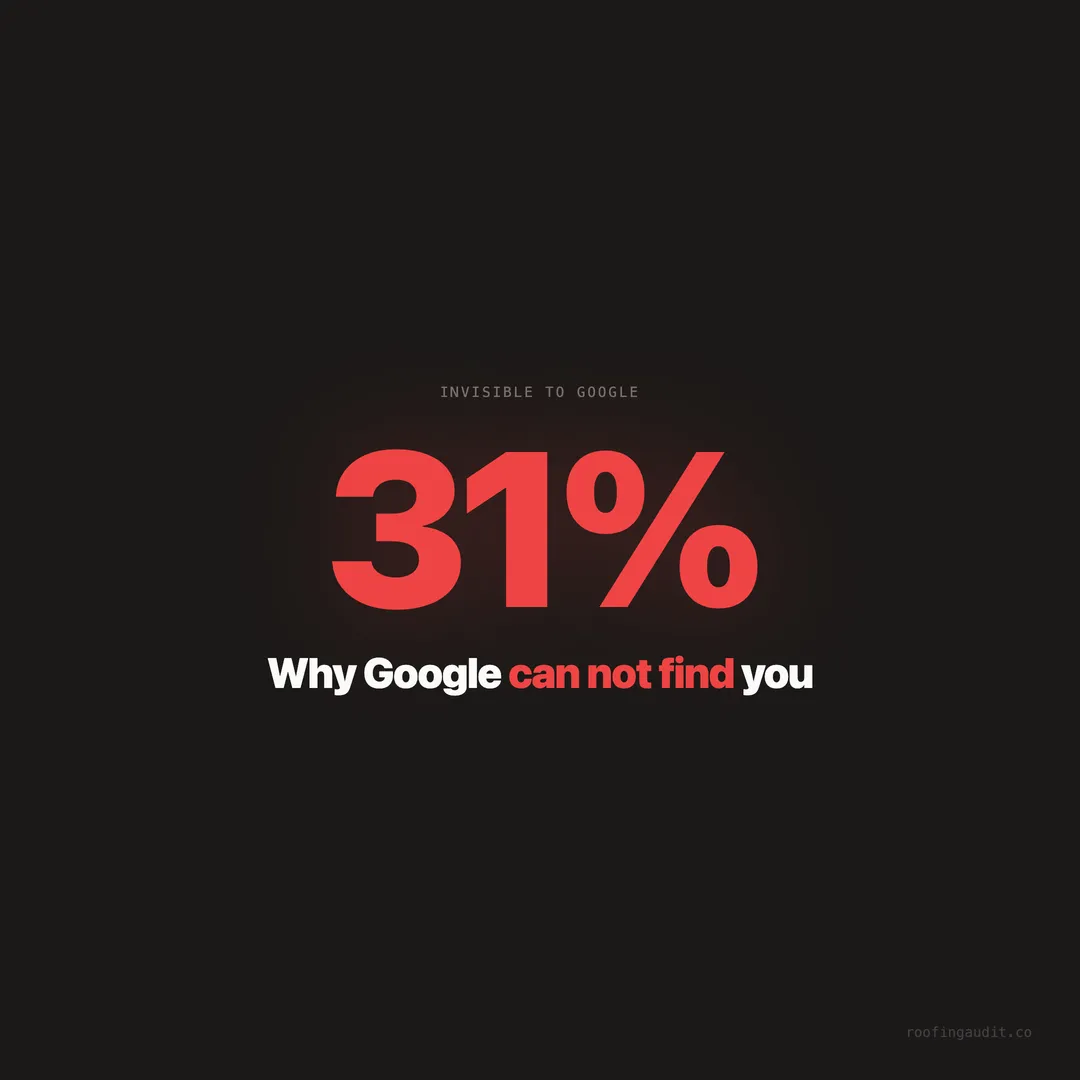
We audited 1,409 roofing websites and found 31% have no schema markup and 31% have weak meta descriptions. Here's why Google can't find your business.
You’re paying for the truck wraps. You’re running the Google Ads. You’ve been roofing homes in your city for 15 years. But when a homeowner types “roof repair near me” into her phone, your company doesn’t appear.
When we audited 1,409 roofing company websites across Texas, Florida, and Georgia, we found the reason. It’s not that Google dislikes your business. It’s that your website doesn’t speak Google’s language — and three fixable problems explain most of the invisibility.
This post translates those technical problems into plain business terms. No jargon. No developer-speak. Just the things standing between your roofing company and the homeowners searching for you right now.
Google Needs Specific Information From Your Website — And Most Roofing Sites Don’t Provide It
Google doesn’t send humans to read your website. It sends software — crawlers — that scan your pages and try to understand what your business does, where you operate, and whether you’re trustworthy.
The problem: 31% of roofing websites in our audit give Google almost nothing to work with. No structured business data. No clear page titles. No service area signals. The website looks fine to a human visitor, but to Google’s crawlers, it’s a blank page with some photos.
Think of it this way. Imagine you hand someone a business card with no name on it, no phone number, and no address. That’s what 438 roofing websites in our study are doing to Google. The information might be buried somewhere on the site, but it’s not in the format Google is looking for.
Your Business Name and Services Aren’t in the Right Places
Every page on your website has two versions. There’s the version humans see — the design, the photos, the text. And there’s the version Google sees — the code behind the design.
Google reads your page title (the text that appears in the browser tab) and your meta description (the two-line summary that shows up in search results) before it reads anything else. These two elements tell Google what the page is about and whether to show it to searchers.
31% of the roofing sites we audited — that’s 438 companies — have weak or missing meta descriptions. Their search result listing looks like this: a random sentence pulled from the middle of their homepage, often cut off mid-word. Compare that to a competitor whose listing says “GAF Master Elite roofer serving Dallas since 2008. Free inspections. 4.9 stars, 680 reviews.”
Which one gets clicked?
The page title matters even more. We found sites with titles like “Home” or “Welcome to Our Website” instead of “Roof Repair & Replacement in Houston | ABC Roofing.” Google uses that title to decide which searches your page matches. A title that says “Home” matches nothing.
These aren’t cosmetic issues. They’re the reason Google doesn’t know your business exists.
Google Can’t Tell You’re a Roofing Company
This is the most common invisible problem. It’s called schema markup — a block of code that tells Google exactly what type of business you are, where you’re located, what services you offer, and what hours you’re open.
31% of roofing sites in our study have no schema markup at all. That means 438 companies are relying on Google to figure out what they do by reading their website like a human would. Google doesn’t do that well.
In business terms, schema markup is like filling out your business registration with the city. Without it, you’re technically operating — but you don’t show up in the directory. With it, Google can confidently say “this is a roofing company in Fort Worth that does residential re-roofing, is open Monday through Saturday, and has 4.8 stars.”
The roofing companies that rank in the Google Map Pack — the three businesses shown on the map at the top of search results — almost always have schema markup. It’s not the only factor, but its absence is like running a race with your shoes untied.
We cover the exact fix in our post on schema markup for roofing sites. It takes about five minutes and zero technical skill if you use a generator tool.
Your Website Doesn’t Tell Google Where You Work
A homeowner in Plano, Texas searches “roofer near me.” Google looks at your website and tries to figure out if you serve Plano. If the only mention of your location is a street address in your footer, Google may not connect you to Plano at all — especially if your office is in Dallas.
49% of the roofing sites we audited have no individual pages for the cities they serve. They have one homepage that says “serving the DFW metroplex” and that’s it. Meanwhile, their competitor has a dedicated page for Plano, another for Frisco, another for McKinney — each one telling Google exactly what services they offer in that specific city.
Google ranks pages, not websites. If you don’t have a page about roofing in Plano, you won’t rank for “roofer in Plano.” It’s that direct.
The roofing companies scoring above 80 in our Website Quality Index have service area pages for every city they actively work in. Not thin pages stuffed with keywords — real pages that mention local landmarks, show projects from that city, and include city-specific reviews.
We explain how to build these pages in our guide on service area pages for roofing companies.
The Google Business Profile Connection Most Roofers Miss
Your Google Business Profile (GBP) is the listing that appears in Google Maps and the Map Pack. Most roofers have one. But many don’t realize that Google cross-checks your GBP against your website — and mismatches hurt your ranking.
Here’s where it breaks down. Your GBP shows one phone number. Your website shows a different one (maybe a tracking number for ads). Your GBP says you’re open until 6 PM. Your website says 5 PM. Your GBP lists “roof repair” as a service. Your website doesn’t have a roof repair page.
Every mismatch is a signal to Google that something’s off. Google’s algorithm prizes consistency — what the SEO world calls NAP consistency (Name, Address, Phone). When the numbers don’t match, Google loses confidence in your listing and pushes you down.
We found roofing companies in our audit with three different phone numbers across their GBP, their website, and their Facebook page. That’s three signals telling Google “we’re not sure either.”
The fix is straightforward: audit your GBP, your website header and footer, your contact page, and every social profile. Make sure the business name, address, and phone number are identical — character for character. More detail in our Google Business Profile guide for roofers.
Your Competitors Are Getting the Clicks You’re Paying For
Here’s the math that should keep you up at night. The average roofing company pays $187 per click on Google Ads. That’s among the highest of any home service trade. You pay for the click. The homeowner lands on your website. And then one of three things happens:
1. They leave immediately. The page loads slowly on mobile, or there’s no clear next step. 68% of roofing leads start on a phone. If your site isn’t mobile-first, you’re losing most of the traffic you paid for.
2. They don’t trust you. No reviews on the page. No certifications. No license number. No project photos. They hit the back button and click on the next result — your competitor.
3. They can’t figure out how to contact you. The phone number isn’t clickable on mobile. There’s no “Free Estimate” button. The contact form asks for 12 fields. They give up.
In all three cases, you paid $187 and got nothing. Your competitor — whose website has a visible phone number, a “Free Inspection” button, real project photos, and a 4.9-star review badge — gets the lead. They might even be paying less for the same ad because Google rewards higher-quality landing pages with lower costs per click.
The 34-element checklist we use in our audits covers every factor that determines whether a visitor converts or bounces. Most roofing websites are missing 11 of those 34 elements.
Mobile Visibility Is Where Most Roofers Lose
68% of roofing leads start on a mobile device. A homeowner notices missing shingles. She’s standing in her driveway, phone in hand, searching “roof repair near me.” Your website loads. What does she see?
On the top-performing sites in our audit, she sees a clickable phone number, a “Free Inspection” button, a 4.9-star badge, and a photo of a completed roof — all above the fold, all in under three seconds.
On the average site, she sees a logo, a stock photo, a hamburger menu, and text that’s too small to read. No phone number visible without scrolling. No clear call to action. She’s gone in six seconds.
Google tracks this behavior. When people click on your site and immediately go back to the search results (called a “bounce”), Google notices. Over time, it stops showing your site because it’s learned that searchers don’t find what they need there.
The gap between the best and the rest is enormous. And most of the difference comes down to basics — not advanced marketing tactics.
Reviews Are a Ranking Factor — And Most Sites Hide Theirs
Google uses your review count and rating as a ranking signal. A roofing company with 200 reviews and a 4.8 rating will outrank a competitor with 12 reviews and a 4.5 rating, all else being equal.
But there’s a second layer most roofers miss. Displaying reviews on your website — not just on Google — helps in two ways. First, it keeps the homeowner on your site instead of going to Google to read reviews (where she’ll see your competitors listed right next to you). Second, Google can read those reviews in your page content, which reinforces your relevance for local search terms.
31% of the sites in our audit have no testimonial or review showcase at all. The reviews exist on Google, but they’re invisible on the website. That’s lost trust and lost ranking signal.
Our guide on getting more Google reviews covers the ask-timing strategy that top roofers use to build their review count month over month.
The Five Things to Fix First (In Business Terms)
You don’t need to hire an SEO agency. You don’t need to rebuild your website. The biggest visibility gains come from five specific fixes that are either free or low-cost.
1. Add schema markup. This tells Google you’re a roofing company, where you’re located, and what services you offer. It’s a one-time addition to your website’s code. A web developer can do it in under an hour. A free generator tool can do it in five minutes.
2. Write real page titles and meta descriptions. Every page on your site should have a title that includes your service, your city, and your company name. The meta description should include your strongest trust signal (years in business, review count, certification). This is the text people see before they click.
3. Build service area pages. One page for each city you work in. Not copies of the same page with the city name swapped — actual pages with local references, local project photos, and local reviews. More on how to build service area pages that rank.
4. Match your Google Business Profile to your website. Same phone number. Same address format. Same business name. Same service list. Character for character.
5. Make your phone number clickable on mobile. This sounds absurdly simple, and it is. But 59% of roofing websites in our audit don’t have a click-to-call button visible above the fold on mobile. When 68% of leads start on a phone, that’s money left on the table.
Google Invisibility Costs More Than You Think
Here’s the cost calculation most roofing companies never do. The average roof replacement is $8,000 to $25,000. The average roofing lead through Google Ads costs $187. Organic search leads — the ones that come from ranking in Google — cost $0 per click.
A roofing company ranking on page one of Google for “roof replacement [city name]” gets 15-30 calls per month from that single keyword. At an average job value of $12,000 and a close rate of 25%, that’s 4-8 jobs per month worth $48,000 to $96,000 in revenue — from a search term that costs nothing to rank for once you’ve done the work.
The roofing companies in our audit that score above 80 on the Website Quality Index have done this work. They show up in the Map Pack. They rank in organic results. They still run Google Ads — but as a supplement, not a lifeline.
The companies scoring below 40 — which is the majority — are paying $187 per click because organic search doesn’t send them anything. Their website is invisible to Google, and Google Ads is the only thing keeping the phone ringing.
Your Website Is Either Working for You or Against You
Every day your website stays invisible to Google is a day your competitor gets the call instead. The homeowner in your service area is searching right now. She’s going to click on someone’s listing. The question is whether it’s yours.
The fixes aren’t complicated. Schema markup, page titles, meta descriptions, service area pages, mobile experience, and NAP consistency. These are the basics that 69% of roofing websites in our three-state audit haven’t implemented — the basics that separate the companies Google shows from the companies Google ignores.
We built the 34-element roofing website checklist to give you the exact list. Run through it. Fix the gaps. The homeowners are already searching. Make sure Google can find you when they do.
See how your market compares in our roofing market reports.
Keep Reading
Want to know your score?
Drop your URL — full report in 48 hours.
We're on it.
Report in your inbox within 48 hours.