Google Ads vs SEO for Roofing Companies: Where to Spend First
Roofing leads cost $187 on Google Ads. We audited 1,409 sites and found why fixing your website first saves thousands before you spend on ads or SEO.
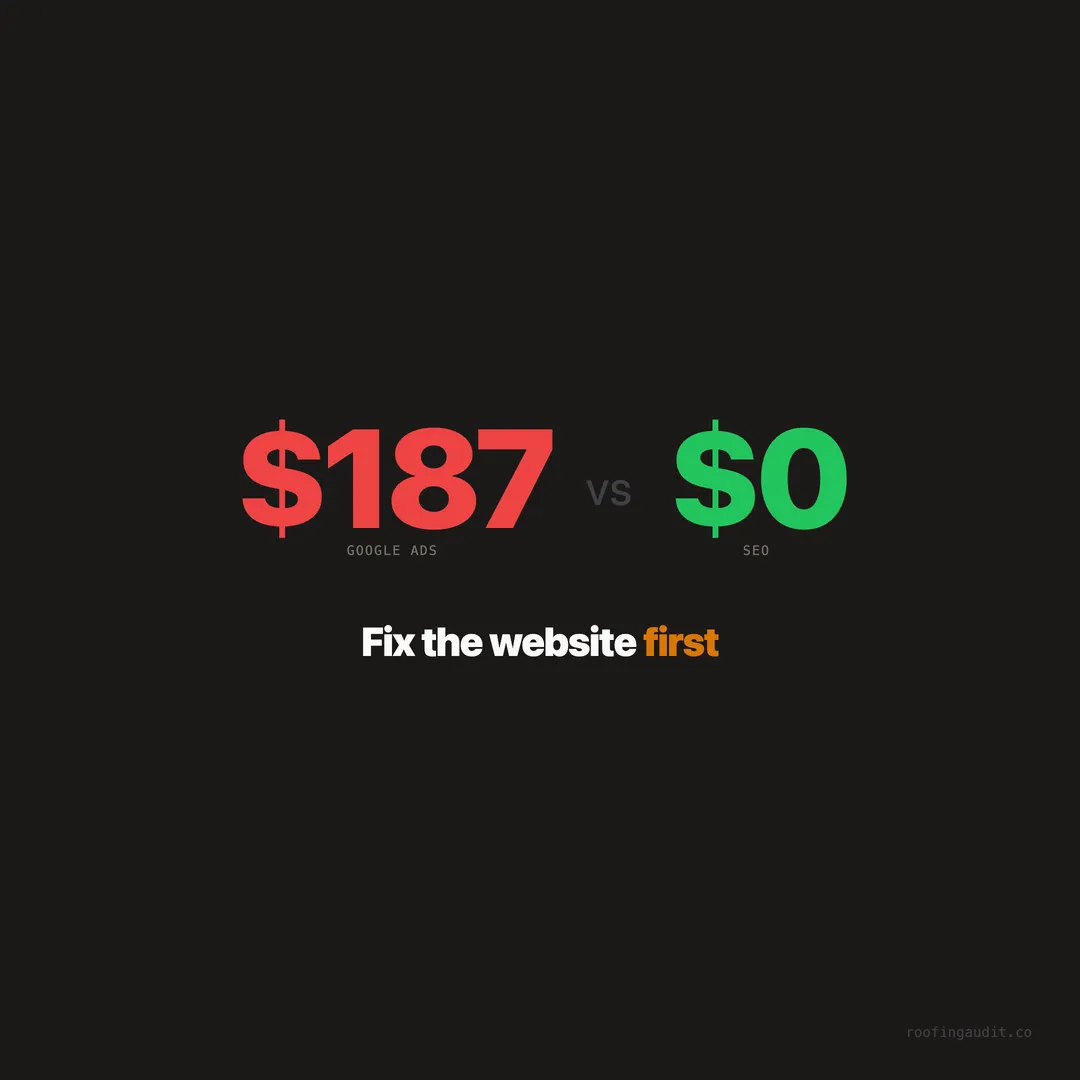
A roofing company owner asks the same question every marketing agency hears: “Should I spend on Google Ads or SEO?” The answer is neither — not yet. You should fix your website first.
When we audited 1,409 roofing company websites across Texas, Florida, and Georgia, we found that the average site is missing 32% of the elements that convert visitors into leads. Running Google Ads to a broken website is like pouring water into a bucket with holes. Running SEO to rank a broken website is like putting a billboard on a road that leads to a locked door.
The order matters. Fix the website. Then invest in SEO. Then layer on Google Ads. Here’s the data behind that sequence, what each channel actually costs, and how to decide where your next dollar should go.
The $187 Problem: Why Google Ads Costs So Much for Roofers
Google Ads for roofing keywords costs more than almost any other home service trade. The average cost per click for “roof replacement near me” is $45-$85 depending on the market. The average cost per lead — meaning a click that actually turns into a phone call or form submission — is $187.
Why so high? Two reasons.
The job values are high. A roof replacement costs $8,000-$25,000. Google’s ad auction system prices keywords based on the lifetime value of the customer they attract. High job values mean high click costs.
The competition is fierce. In a city like Houston, there are 200+ roofing companies bidding on the same keywords. In Dallas, it’s 300+. More bidders means higher auction prices. During storm season, costs spike further as every roofer in the market increases their ad budgets.
At $187 per lead, a roofing company needs to close 1 in 5 leads on a $12,000 average job just to break even on ad spend after accounting for overhead and materials. That’s before paying for the ads themselves.
Here’s the math. You spend $5,000/month on Google Ads. That generates roughly 27 leads at $187 each. You close 25% of those — that’s 7 jobs. At a $12,000 average job value, that’s $84,000 in revenue from $5,000 in ad spend. Sounds great — until you subtract the cost of materials, labor, insurance, overhead, and profit margin. The real return is thin.
Now imagine half of those 27 leads bounce from your website because it loads slowly, has no Free Estimate CTA, or shows no certifications. You’re left with 13 usable leads. Same $5,000 spend. Half the return.
Fix the Website First — The Math Is Overwhelming
Before spending a dollar on Google Ads or SEO, fix the website. Here’s why this is step one.
31% of roofing websites have no Free Estimate CTA — the single most important conversion element on the page. A homeowner who lands on your site and sees “Contact Us” instead of “Free Estimate” faces a psychological barrier. A roof costs $8,000-$25,000. “Free Estimate” removes the financial fear. “Contact Us” doesn’t.
31% have no schema markup, making them invisible to Google’s structured data systems. 31% have weak meta descriptions, meaning their search listings look generic. 30% don’t display certifications that could differentiate them from competitors.
The average roofing website in our audit scores 38 out of 100 on our Website Quality Index. That means it’s operating at 38% of its potential — converting roughly a third of the visitors it should be converting.
Same $5,000 ad budget. Same market. The only difference is the website catching the traffic. The optimized site generates double the revenue — not because it gets more clicks, but because it converts more visitors and Google rewards higher-quality landing pages with more clicks at lower costs.
This is why website fixes come first. Every dollar spent on ads or SEO is multiplied by a better website, and divided by a worse one.
What “Fix the Website” Actually Means
“Fix your website” is vague advice. Here’s the specific list, derived from our audit of 1,409 sites and the 34-element checklist we use for scoring.
Conversion elements (fix first):
- Add “Free Estimate” or “Free Inspection” CTA above the fold on every page
- Make phone number clickable and visible on mobile (above the fold)
- Add a simple contact form — name, phone, email, service needed
- Display your license number in the footer
- Show certifications (GAF, Owens Corning, CertainTeed) in the header or hero
Trust elements (fix second):
- Add real project photos — at least 15-20, organized by service type
- Display Google review count and rating on the homepage
- Add 5-10 customer testimonials with first names and cities
- Create an insurance claim guide page (critical in storm states)
- Add emergency repair page with response time promise
SEO elements (fix third):
- Add RoofingContractor schema markup
- Write proper page titles (service + city + company name)
- Write meta descriptions with your strongest trust signal
- Ensure mobile load time is under 3 seconds
- Add internal links between service pages
These fixes take 2-4 weeks for a web developer or 1-2 months of DIY effort. The cost ranges from $500-$3,000 depending on your platform and who does the work. Compare that to $5,000+ per month in Google Ads — the website fixes pay for themselves in the first month of improved conversion rates.
Then SEO: The Long Game That Pays the Biggest Returns
Once your website converts well, SEO is where the real leverage lives. Organic search leads cost $0 per click. A roofing company ranking on page one for “roof replacement [city]” gets 15-30 calls per month from that single keyword — indefinitely.
SEO for roofers has three components.
1. Service area pages. Individual pages for each city you serve, with unique content, local photos, and city-specific reviews. 49% of roofing sites in our audit don’t have these. Building them is the single highest-ROI SEO activity. More on service area pages for roofers.
2. Google Business Profile optimization. Your GBP drives Map Pack rankings. Reviews, photos, posts, and complete information. The Map Pack gets more clicks than all organic results combined for local searches. Full guide on GBP for roofing companies.
3. Content marketing. Blog posts about roofing topics homeowners search for: “how to tell if your roof needs replacing,” “roof repair vs replacement cost,” “does homeowner’s insurance cover storm damage.” Each post is a new entry point for homeowners who aren’t ready to call yet but will be soon.
The SEO timeline is the main drawback. Results take 3-6 months to materialize. Service area pages need 4-8 weeks to start generating impressions and 4-8 months to reach competitive positions. Content takes even longer to build authority.
But the payoff is enormous. Once ranking, organic positions generate leads for free — month after month, year after year. A #1 ranking for “roofer [city]” is worth $30,000-$100,000 per month in equivalent ad spend.
Then Google Ads: The Immediate Lever
Google Ads belong in the strategy — just not as the first move. Here’s when and how to use them effectively.
Use case 1: Immediate lead flow. Your website is fixed, your SEO strategy is in motion, but rankings take months to build. Google Ads bridge the gap. They produce leads this week while SEO builds for next quarter.
Use case 2: Storm season surge. Hail hits your city. Everyone needs a roofer right now. Google Ads let you scale up immediately — something organic search can’t do. Doubling your ad budget after a major storm doubles your lead flow overnight.
Use case 3: New service areas. You’re expanding into a new city. Your service area page is live but hasn’t ranked yet. Google Ads put you in front of searchers in that city while SEO catches up.
Use case 4: Testing keywords. Not sure which services generate the most valuable leads? Run ads for “metal roofing,” “storm damage repair,” and “roof replacement” for 30 days and compare lead quality. Then focus your SEO efforts on the keywords that produce the best leads.
The mistake most roofers make is using Google Ads as their only lead generation channel. At $187 per lead, that’s unsustainably expensive. Google Ads should supplement organic traffic, not replace it.
The Three-Phase Investment Order
Based on our audit data and the performance patterns we observed across 121 cities, here’s the investment sequence that maximizes return.
Phase 1: Website fixes (Weeks 1-4, $500-$3,000 one-time)
Fix conversion elements, add trust signals, implement schema, optimize for mobile. This is foundation work that makes every future marketing dollar more effective.
Expected result: 2x improvement in conversion rate from existing traffic.
Phase 2: SEO (Months 2-6, $1,000-$3,000/month or DIY)
Build service area pages, optimize GBP, start publishing content, build review collection system. Results compound over time.
Expected result: 15-30 organic leads per month by month 6-8 for primary city, scaling to 50-100+ leads per month across multiple cities by month 12.
Phase 3: Google Ads (Month 3+, $2,000-$10,000/month)
Start ads once the website converts well. Use ads to fill the gap while SEO builds, then scale back as organic traffic grows. Maintain ads for storm season surges and new market entry.
Expected result: 27-53 leads per month depending on budget, at a lower cost per lead than before website fixes.
The total investment in Phase 1 + early Phase 2 is roughly $3,000-$9,000 — less than two months of a typical Google Ads budget. But that investment reduces your cost per lead, increases your close rate, and builds a channel (organic search) that generates leads for free.
The Compound Effect: How the Three Channels Work Together
The three channels don’t just add — they multiply. Here’s how they compound.
Better website → lower ad costs. Google Ads uses a “Quality Score” system. Ads that point to better landing pages get lower cost per click. A website scoring 80+ on our index can see 20-30% lower CPCs than a website scoring 38.
More reviews → better ads and SEO. Reviews drive Map Pack ranking (SEO) and build trust on your website (conversion). More reviews also enable review extensions in Google Ads, which increase click-through rate.
Service area pages → more ad landing pages. Instead of sending all ads to your homepage, you can send “roof repair Plano” ads to your Plano service area page. Matching ad copy to landing page content improves Quality Score and conversion rate.
SEO traffic → more review opportunities. Organic traffic brings customers who aren’t paying $187 per lead. Each completed job is a chance to get a review that strengthens both SEO and ad performance.
The roofing companies in our audit scoring above 80 on the Website Quality Index use all three channels in coordination. They’re not choosing between ads and SEO — they’re using each channel where it’s strongest, supported by a website that converts everything it touches.
By month 12, the blended cost per lead drops to $35-$45 — a fraction of the $187 starting point. The key is the sequence: website first, SEO second, ads third.
The Mistake: Spending $5,000/Month on Ads Before Fixing a $38 Website
The most expensive mistake a roofing company can make is running Google Ads to a website that doesn’t convert. We see it constantly in our audit data.
A roofing company spends $5,000-$10,000 per month on Google Ads. Their website scores 38 on our quality index. They’re getting clicks — but 62% bounce immediately. Of the leads that do come through, many are low quality because the website failed to pre-qualify them with trust signals.
That same company, if they spent $2,000 on website fixes and then ran the same ad campaign, would see double the leads at the same cost. The website investment pays for itself within the first week of improved ad performance.
This isn’t hypothetical. We’ve seen the pattern across 1,409 companies. The companies getting the best return on Google Ads are the ones with websites scoring 70+ on our index. They convert more clicks into leads, Google gives them lower CPCs, and their blended cost per lead drops every month as organic traffic grows.
Where Your Next Dollar Should Go
Here’s the decision framework, based on where you are right now.
If your website scores below 50: Your next dollar goes to website fixes. Add CTAs, fix mobile experience, add schema, display certifications. Nothing else matters until the bucket stops leaking.
If your website scores 50-70 and you have fewer than 50 reviews: Split your investment between continuing website improvements and building your review collection system. Reviews drive both Map Pack ranking and on-site conversion.
If your website scores 70+ and you have no service area pages: Build city pages. This is the highest-ROI SEO activity for multi-city roofing companies. One page per week, starting with your top revenue cities.
If your website scores 70+, you have 50+ reviews, and you have service area pages: Now is the time to add Google Ads. Your website converts well, your organic presence is building, and ads will produce leads at a reasonable cost per lead.
If you’re already running ads on a low-scoring website: Don’t stop the ads — you need the leads. But reallocate 30-40% of your ad budget to website fixes for the next 30 days. The improved conversion rate will more than compensate for the reduced ad spend.
Run your website through the 34-element checklist to see where you stand. Check how your competitors are performing in our roofing market reports. And read the full findings from our audit of 1,409 roofing websites to understand where the industry stands.
The question isn’t ads vs. SEO. It’s which investment, in which order, produces the highest return. And the data is clear: website first, then SEO, then ads.
Keep Reading
Want to know your score?
Drop your URL — full report in 48 hours.
We're on it.
Report in your inbox within 48 hours.