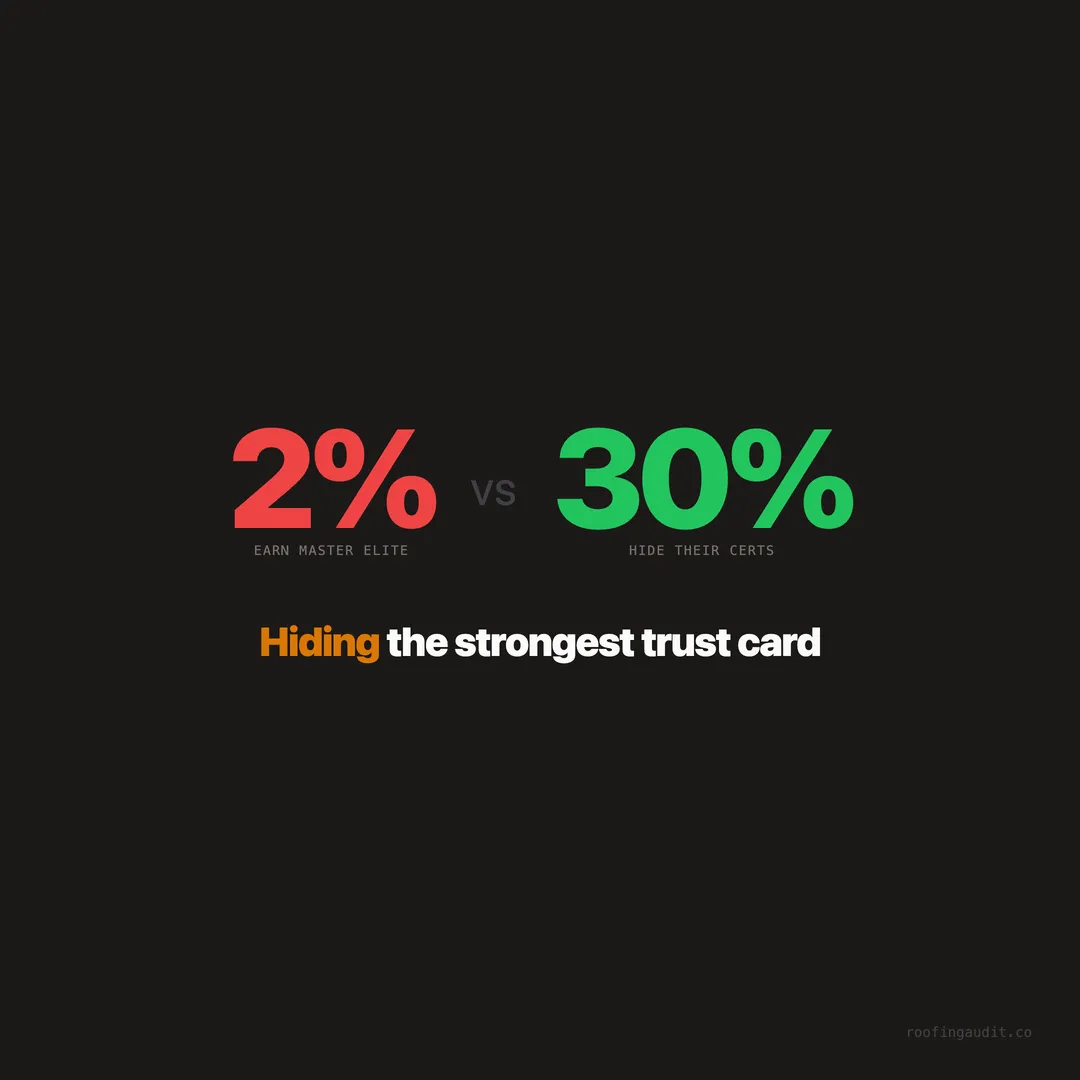
Only 2% of Roofers Are GAF Master Elite — But 30% Don't Show Any Certifications at All
430 of 1,409 roofing websites display zero manufacturer certifications. Only 2% earn GAF Master Elite. That gap decides who wins the quote.
Two roofers show up to the same house on the same Tuesday. Both give a quote for a full replacement. Both are within $500 of each other. Both seem professional. The homeowner pulls out her phone and looks at their websites.
One site has a section titled “Our Certifications” with the GAF Master Elite badge, an Owens Corning Preferred Contractor seal, and a CertainTeed ShingleMaster logo — each linked to a verification page. The other site says “quality you can trust” and shows a stock photo of a house.
She calls the first roofer. The second one never hears back.
When we audited 1,409 roofing websites across Texas, Florida, and Georgia, 430 — 30% — displayed zero manufacturer certifications. No GAF badges. No Owens Corning seals. No CertainTeed logos. Nothing that tells a homeowner this company has been vetted by the brands whose shingles are going on their roof.
Meanwhile, only 2% of roofers nationwide hold GAF Master Elite status — the highest certification in the industry. That means the vast majority of roofers are competing without the top badge. But nearly a third aren’t showing any badge at all.
Certifications Are the Tiebreaker on $8K-$25K Decisions
Roofing is one of the highest-ticket home services. A full replacement runs $8,000 to $25,000 depending on the market, material, and roof size. At that price, homeowners don’t pick the cheapest option. They pick the one that feels safest.
Certifications provide that safety signal. A GAF Master Elite badge tells the homeowner: this roofer passed a background check, maintains proper insurance, has a proven track record, and is among the top 2% in the country. An Owens Corning Preferred badge says something similar.
Without any certification displayed, the homeowner has nothing to differentiate you from the guy who started roofing last month and bought a $200 website template. You might have 20 years of experience. But if your website doesn’t show it, the homeowner doesn’t know it.
The top 3% of roofing websites in our audit display at least two manufacturer certifications on their homepage. Among the bottom quartile, zero display any certifications. That’s not coincidence — it’s a direct correlation between trust signals and overall website quality.
What GAF Master Elite Actually Means
GAF is the largest roofing manufacturer in North America, covering roughly 32% of the U.S. residential market. Their certification tiers work like this:
GAF Certified — The baseline. The contractor has completed GAF training and can offer standard manufacturer warranties. Roughly 7% of roofers hold this.
GAF Master Elite — The top tier. Requires proper licensing, adequate insurance, a proven reputation, and commitment to ongoing professional training. Only about 2% of all roofing contractors in the country qualify.
The difference between these tiers isn’t cosmetic. A GAF Master Elite contractor can offer the Golden Pledge Warranty — a 50-year, non-prorated warranty that covers both materials and workmanship. A non-certified roofer can only offer a standard manufacturer warranty on materials, with zero coverage for installation errors.
On a $15,000 roof replacement, the difference between a Golden Pledge and a standard warranty is the difference between full protection and a prayer. Homeowners who understand this — and many do, because they research before spending five figures — will choose the certified contractor every time.
The Three Major Manufacturer Certifications
GAF isn’t the only game. Here’s what the top roofing websites in our audit display:
GAF Master Elite / Certified
The most recognized badge in residential roofing. GAF products cover 32% of the U.S. market. Homeowners see GAF shingles at Home Depot and Lowe’s, so the brand is familiar. A GAF badge on your website connects your company to a brand they already know.
Owens Corning Preferred / Platinum
Owens Corning holds roughly 20% of the shingle market. Their Preferred Contractor program requires training, proper insurance, and a commitment to customer satisfaction. The Platinum tier adds performance criteria. Their pink panther branding is widely recognized.
CertainTeed ShingleMaster / SELECT ShingleMaster
CertainTeed covers about 15% of the market. Their ShingleMaster certification requires product training and proper credentialing. The SELECT tier adds integrity requirements and allows offering their best warranties.
Here’s the critical point: you don’t need all three. Even one manufacturer certification displayed on your website puts you ahead of the 430 roofing companies in our audit that show nothing. One badge is infinitely more than zero.
Why 30% of Roofers Don’t Show Certifications
We see three patterns across the sites that are missing certifications:
They Have Certifications But Don’t Display Them
This is the most common scenario. The roofer is GAF Certified but never added the badge to the website. The certification exists in a filing cabinet somewhere. It does nothing for the homeowner who’s deciding between two quotes right now.
They Haven’t Pursued Certification
Some roofers — especially smaller operations — haven’t invested in manufacturer certification programs. The programs require training time, insurance documentation, and in some cases minimum volume requirements. But the return on that investment is measurable in every quote where certification becomes the deciding factor.
They’re Storm Chasers Who Can’t Get Certified
This is the uncomfortable truth. Storm chasers — the contractors who chase hail and hurricane damage, do the work, and move on — typically can’t get manufacturer certifications because they lack the permanent business presence, insurance history, and local reputation required. Displaying certifications is one of the clearest ways to differentiate from storm chasers, especially in Texas with 529 hail events in 2024 and Florida with $25 billion in hurricane losses.
Where Certifications Should Appear on Your Website
Based on our analysis of the top-scoring sites, certification badges should appear in at least four locations:
Homepage hero or trust bar. A row of certification logos immediately below the hero section. This is the first thing the homeowner sees after the headline and CTA. Among the highest-scoring sites in our audit, 100% display at least one certification badge on the homepage.
Dedicated certifications page. A full page explaining what each certification means, what it requires, and what warranty options it unlocks. This page does double duty: it builds trust AND it captures search traffic for queries like “GAF Master Elite roofer near me.”
Service pages. On every service page — roof replacement, storm damage repair, emergency service — include the relevant certification badge. If you’re installing GAF shingles, the GAF badge should be on that page.
Footer. A persistent row of certification logos in the footer means every page on your site carries the trust signal. No matter where the homeowner lands — a blog post, a market page, a service page — they see you’re certified.
Certifications vs “Trust” Language — Which Wins
Here’s a pattern we noticed across the 1,409 sites: companies without certifications tend to overcompensate with trust language. Words like “trusted,” “reliable,” “experienced,” and “quality” appear constantly — but without a single verifiable credential to back them up.
Compare these two approaches:
Site A: “We are a trusted roofing company with years of experience providing quality roofing services to homeowners in the area.”
Site B: “As a GAF Master Elite contractor — a designation held by only 2% of roofers nationwide — we offer the Golden Pledge warranty: 50-year coverage on materials and workmanship.”
Site B says less. But it proves more. The certification is verifiable. The warranty is specific. The homeowner can check GAF’s website and confirm the claim. Site A is just words — identical to what every other roofer says.
Among sites that don’t show quantified social proof, the over-reliance on generic trust language is even more pronounced. Certifications are one of the fastest ways to replace vague claims with verifiable proof.
The Warranty Angle Most Roofers Miss
Certifications aren’t just badges — they unlock warranty options that non-certified contractors simply cannot offer. And warranty information is one of the top factors homeowners research before choosing a roofer.
GAF Master Elite unlocks the Golden Pledge: 50 years non-prorated, covers materials + workmanship + tear-off costs.
GAF Certified unlocks the System Plus: 50 years on materials, 10 years workmanship.
Non-certified gets manufacturer’s standard: 25-30 years on materials only, no workmanship coverage.
On a $15,000 job, the difference between Golden Pledge and standard manufacturer warranty is worth thousands of dollars in potential future repair costs. Homeowners who understand this — and with average jobs at $8,000-$25,000, they tend to research — will always choose the contractor whose certification grants the better warranty.
This is why the certification page and the warranty page should link to each other. The certification proves you can offer the warranty. The warranty proves the certification matters. Together, they create a trust loop that the 30% of sites showing neither certification nor warranty details can’t compete with.
The Storm Market Certification Advantage
In Texas and Florida, certifications carry extra weight because of the storm chaser problem.
After every major hail event — Texas had 529 in 2024 alone — out-of-state contractors flood the market. They knock on doors, offer fast estimates, and undercut local roofers. Many homeowners later discover the work was done incorrectly, the company has disappeared, and they have no warranty recourse.
A GAF Master Elite badge is proof you’re not a storm chaser. Storm chasers don’t invest in multi-year certification programs with local reputation requirements. They can’t offer Golden Pledge warranties because they won’t be around to honor them.
In Florida, where 42% of insurance claims get denied and homeowners are already anxious about contractor fraud, certifications provide a critical layer of verification. The homeowner can check the manufacturer’s website and confirm the contractor is real, established, and certified.
Every local roofer in a storm market who doesn’t display certifications is missing the single most powerful differentiator against out-of-state competition. The certification says: “I’m local, I’m vetted, and I’ll be here in five years when you need me.”
How to Get Certified If You’re Not Already
For roofers who haven’t pursued manufacturer certifications, the process is straightforward:
GAF Certified: Complete the training courses (available online), maintain proper licensing and insurance, and apply through GAF’s contractor portal. Most roofers can achieve this within 30-60 days. The cost is minimal — primarily time.
GAF Master Elite: Requires GAF Certified status first, plus demonstrated volume, customer satisfaction metrics, and a commitment to ongoing education. This typically takes 6-12 months from starting the Certified program.
Owens Corning Preferred: Similar process — training, insurance verification, and application. The timeline is comparable to GAF Certified.
The investment in time pays for itself with the first job where your certification is the reason the homeowner chose you over an uncertified competitor. On jobs averaging $8,000-$25,000, that return is significant.
How to Display Certifications Effectively
Adding a badge to your footer is the minimum. Here’s what the best sites do:
Use official logos. Don’t create your own version of the GAF badge. Use the official assets from the manufacturer’s contractor portal. Unofficial logos look unprofessional and may violate trademark guidelines.
Link to verification. GAF, Owens Corning, and CertainTeed all have online directories where homeowners can verify a contractor’s certification. Link directly to your listing. This removes any doubt about whether the certification is real.
Explain what it means. Most homeowners don’t know the difference between GAF Certified and GAF Master Elite. A one-paragraph explanation — especially the warranty implications — turns the badge from a logo into a selling point.
Include it in your about page. Your about page is where homeowners go to verify who you are. Certifications belong there as much as they belong on the homepage.
Add it to your Google Business Profile. The certification doesn’t just belong on your website. It should be in your Google listing, where homeowners make initial decisions. The combination of a certification on Google AND your website creates consistency that builds confidence.
The 30% Gap Is an Opportunity for the Other 70%
Here’s the upside of this statistic: if 30% of your competitors show zero certifications, you don’t need to be GAF Master Elite to stand out. You just need to show something.
Even a single manufacturer certification badge — displayed prominently on your homepage, explained clearly on a dedicated page, and repeated in your footer — puts you ahead of nearly a third of the market. In a competitive bid on a $15,000 job, that badge might be the reason you win.
The roofers who display their certifications aren’t doing anything complicated. They earned the certification, downloaded the badge, and put it on their website. The 430 companies in our audit that show nothing are leaving the simplest trust signal in roofing on the table — and wondering why the homeowner chose the other guy.
In our full 34-element roofing website checklist, certification display is one of the highest-impact items. It costs nothing to add, takes minutes to implement, and directly influences the homeowner’s decision on the most expensive purchase they’ll make this year.
Keep reading
Want to know your score?
Drop your URL — full report in 48 hours.
We're on it.
Report in your inbox within 48 hours.