Contact Forms vs Phone Calls vs Online Scheduling: Which Gets More Roofing Leads
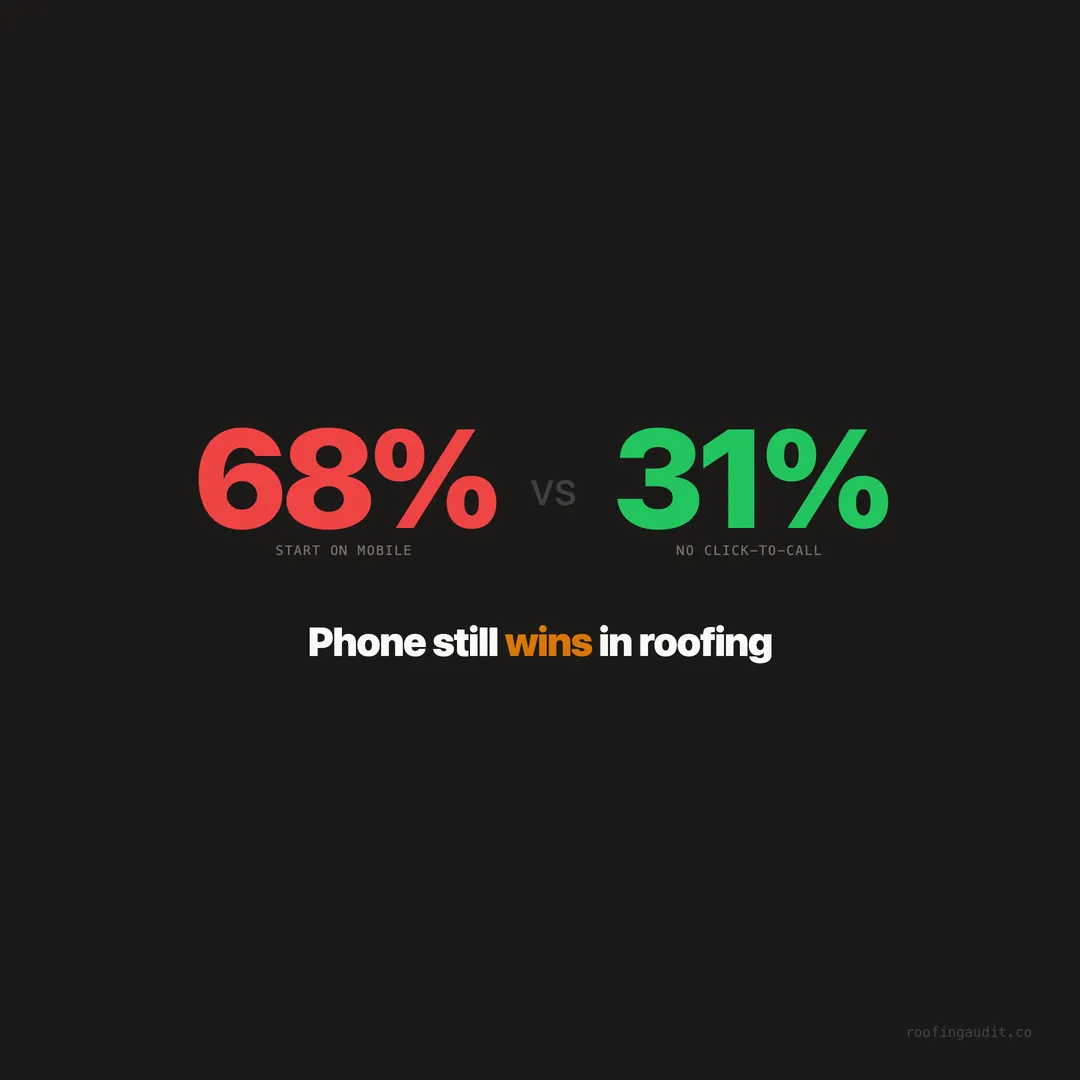
We compared lead capture methods across 1,409 roofing websites. Phone calls still dominate — but only when the number is clickable. 31% aren't.
A homeowner in Jacksonville just noticed missing shingles after a storm. She pulls out her phone and finds three roofers. The first has a contact form asking for name, email, phone, address, roof type, and “how did you hear about us.” The second has a phone number displayed as plain text. The third has a big green button: “Tap to Call — Free Inspection.”
She taps the button. The third roofer answers. The other two never knew she existed.
When we audited 1,409 roofing websites across Texas, Florida, and Georgia, we found that lead capture method matters as much as lead capture existence. 31% of sites have no clear Free Estimate CTA at all. But even among sites that do have lead capture, the method determines whether a visitor converts or bounces.
Phone Calls Still Win in Roofing
Roofing is different from lower-ticket home services. A $8,000-$25,000 purchase with insurance complications, storm urgency, and trust anxiety drives homeowners toward the phone — not a form.
The reasons are psychological:
Urgency. When a roof is leaking or storm damage just happened, homeowners want to talk to someone now. A form submission feels like shouting into a void. A phone call gets immediate confirmation.
Complexity. Roof problems are hard to describe in a form. “Water stain on ceiling” could mean a $300 repair or a $15,000 replacement. Homeowners want a human to ask the right questions.
Trust. Hearing a real person answer the phone builds trust faster than any website element. The homeowner confirms: this is a real company with real people.
68% of roofing searches happen on mobile. The phone is already in their hand. A clickable number is one tap away from a live conversation.
The Problem: 31% of Phone Numbers Aren’t Clickable
Having a phone number on the site isn’t enough. It needs to be a clickable tel: link on mobile. When we audited 1,409 sites, a significant portion display the number as plain text — forcing the homeowner to memorize it, switch apps, and manually dial.
On a phone screen, that friction kills the conversion. The homeowner doesn’t memorize the number. She swipes back to Google and taps the next result.
The fix takes 30 seconds: wrap every phone number in <a href="tel:5551234567">. Yet hundreds of roofing websites skip this basic step.
When Forms Work (and When They Don’t)
Contact forms aren’t dead in roofing — but they serve a different purpose than the phone.
Forms Work For:
After-hours inquiries. When a homeowner wants an estimate but it’s 10 PM, a simple form lets them submit a request without waiting until morning. The roofer calls them back first thing.
Non-urgent situations. An aging roof that needs replacement eventually — not a storm emergency. The homeowner is in research mode, comparing options, and doesn’t need an immediate conversation.
Insurance documentation. Some homeowners want to submit photos of damage or their insurance claim number. A form with a file upload handles this better than a phone call.
Forms Fail When:
They ask too many questions. Every additional form field reduces submissions by roughly 10-15%. A 6-field form gets half the submissions of a 3-field form. Name, phone, and a brief description — that’s all you need. Everything else can happen on the call.
They don’t confirm receipt. A form that submits and shows nothing — no confirmation message, no “we’ll call you within 2 hours” — leaves the homeowner wondering if it worked. That uncertainty sends them to the next roofer’s site.
They replace the phone number. Some sites hide the phone number behind a form, forcing every visitor through the submission process. For roofing — where urgency and trust drive the decision — this kills leads.
Online Scheduling: The Emerging Option
Some roofing websites now offer online scheduling — “Pick a date and time for your free inspection.” It’s a middle ground between forms and phone calls.
Advantages:
- Reduces back-and-forth scheduling calls
- Gives the homeowner control over timing
- Feels modern and professional
Disadvantages:
- Adds complexity for roofing (weather delays, crew availability)
- Some homeowners distrust automated systems for high-ticket services
- Requires calendar management that most roofers don’t have
Online scheduling works best as a supplement — not a replacement for click-to-call. The best sites we audited offer both: “Schedule Online” button + “Or Call Now” with a clickable number.
The Winning Combination
The top-performing roofing websites in our audit don’t choose one method. They layer all three:
| Element | Position | Purpose |
|---|---|---|
| Click-to-call (primary) | Header + hero + every section | Captures urgent and mobile leads |
| Simple form (secondary) | Mid-page + contact page | Captures after-hours and research leads |
| ”Schedule Online” (optional) | Service pages | Captures planning-stage leads |
The phone number appears on every page — header, footer, and within the content. On mobile, it’s always a tap-to-call link. The form is simple: 3 fields max. The scheduling option, when present, supplements but never replaces the other two.
What Happens After the Lead
The lead capture method also affects follow-up speed. And speed matters:
- Leads contacted within 5 minutes are 100x more likely to convert than leads contacted after 30 minutes
- The average roofing company takes 47 minutes to respond to a web form submission
- Phone calls are answered immediately (or missed and returned within minutes)
This is another reason phone calls dominate in roofing. The response is instant. With forms, the clock starts ticking — and most roofers lose the race.
The Lead Capture Checklist
Based on 1,409 audited sites, here’s the lead capture setup that generates the most roofing leads:
- Clickable phone number in header, hero, and footer (every page)
- “Free Estimate” or “Free Inspection” button above the fold
- Simple form (name, phone, brief description) on contact page and service pages
- Confirmation message after form submission (“We’ll call you within 2 hours”)
- After-hours message (“Leave a message — we return calls by 8 AM”)
Miss any of these and you’re leaving leads for the competitor who has them all. The 34-point checklist covers every element, and the city benchmarks show where your market stands.
The best lead capture method for roofing isn’t a debate. It’s all of them — layered, visible, and frictionless.
Keep reading
Want to know your score?
Drop your URL — full report in 48 hours.
We're on it.
Report in your inbox within 48 hours.