Angi vs Thumbtack vs Your Own Website: Where Should Roofers Invest
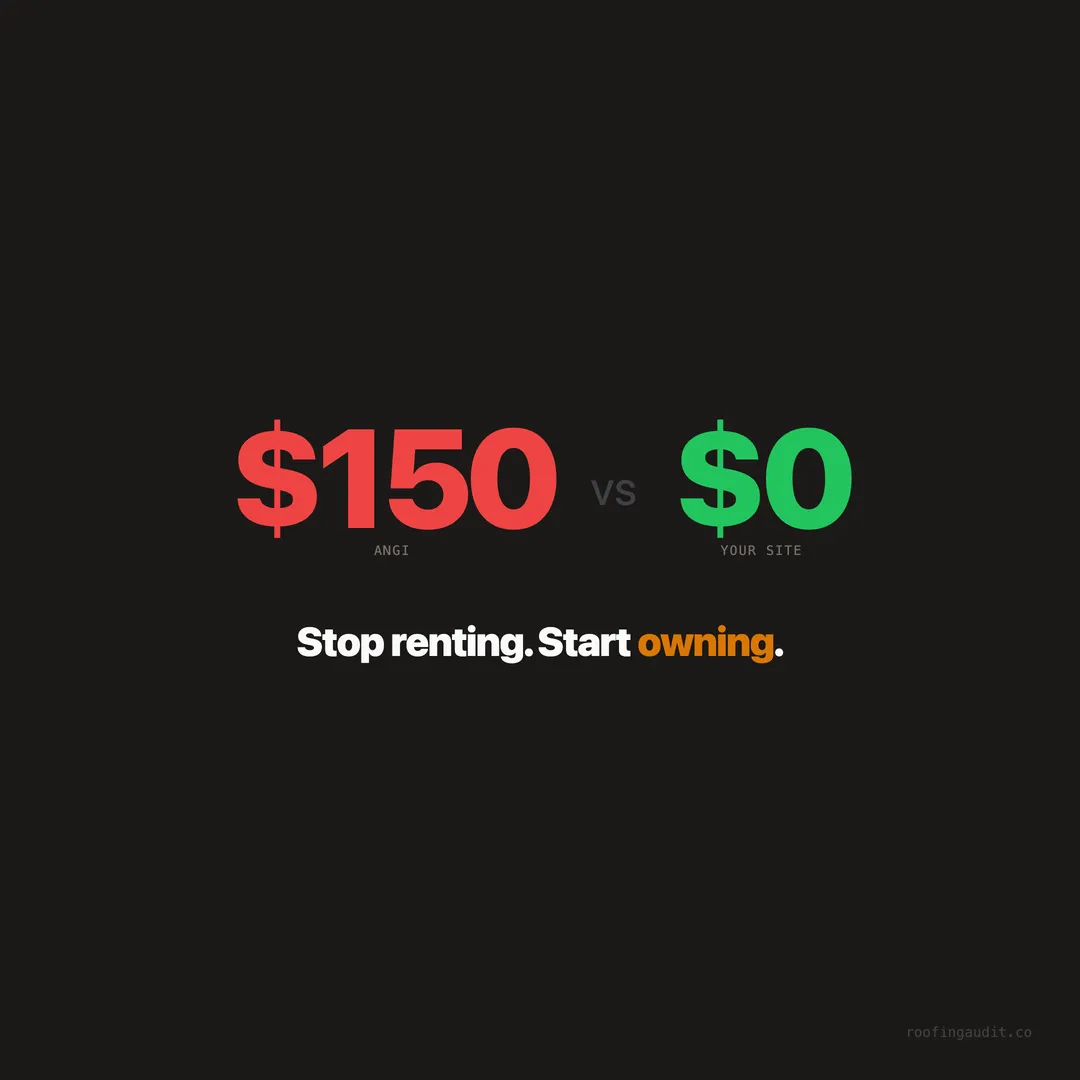
Angi and Thumbtack charge $50-$150/lead and share each one with 3-5 competitors. Your website generates exclusive leads for $0. Here's the full breakdown.
A roofer in Orlando gets a notification from Angi: new lead, homeowner needs a roof replacement. The roofer pays $85 for the lead. What the roofer doesn’t see: four other roofers in the same zip code got the same notification and paid the same $85. Five roofers are now racing to call the same homeowner. One will get the job. Four will get nothing — except the bill.
That math defines the lead-buying model. You pay for the opportunity to compete. Not for a customer. Not for an exclusive conversation. For a spot in a race you’ll lose 60-80% of the time.
When we audited 1,409 roofing websites across Texas, Florida, and Georgia, the roofers who relied least on lead platforms — and invested most in their own websites — were the ones with the highest quality scores and the fullest schedules. The correlation was unmistakable.
The Real Cost of Shared Leads
Lead platforms market their pricing as affordable compared to Google Ads. And on a per-lead basis, they are. But the per-lead cost is misleading when you factor in the shared nature of those leads.
Here’s the actual math:
Angi Lead Economics
- Cost per lead: $50-$150 (varies by market and job type)
- Leads shared with: 3-5 other roofers
- Your close rate on shared leads: 15-20% (vs. 30% on exclusive leads)
- Effective cost per closed job: $250-$1,000
A roofer spending $2,000/month on Angi leads in a mid-size Florida market gets roughly 15-25 leads. At a 17% close rate on shared leads, that’s 2.5-4.3 jobs per month. At an average job value of $12,000, that’s $30,000-$51,600 in revenue on $24,000 in annual lead costs.
The ROI looks positive — until you compare it to the alternative.
Thumbtack Lead Economics
- Cost per lead: $40-$100 (often lower than Angi but more variable)
- Leads shared with: 3-5 other pros
- Your close rate on shared leads: 12-18% (Thumbtack leads tend to be more price-sensitive)
- Effective cost per closed job: $220-$835
Thumbtack’s model adds another variable: the homeowner is often shopping explicitly on price. Thumbtack encourages comparison by design — showing multiple pros, their ratings, and their pricing. This drives close rates down further for roofers who compete on quality rather than price.
Your Website Lead Economics
- Cost per lead: $0 (after one-time investment of $500-$2,000)
- Leads shared with: Nobody
- Your close rate on exclusive leads: 25-35%
- Effective cost per closed job: $0 per lead, amortized site cost only
A roofer whose website generates 10 organic leads per month at a 30% close rate books 3 jobs per month — 36 jobs per year — at zero ongoing cost per lead. At $12,000 per job, that’s $432,000 in annual revenue from a one-time website investment.
The Five Problems With Lead Platforms
Beyond cost, lead platforms create structural problems that get worse over time:
Problem 1: You Don’t Own the Customer Relationship
When a homeowner contacts you through Angi, Angi owns that relationship. The homeowner is “an Angi customer” first and your customer second. If you stop using Angi, that homeowner won’t find you next time — they’ll go back to Angi and find your competitor.
When a homeowner contacts you through your website, you own the relationship entirely. Their name, email, phone number, and project details are in your system. You can follow up, nurture, and re-engage them for future work — gutter cleaning, maintenance, referrals — without paying anyone a fee.
Over a 10-year period, a single roofing customer is worth $15,000-$40,000 in lifetime value (original job + maintenance + referrals + re-roofing). Owning that relationship vs. renting it from Angi is the difference between building equity and renting it.
Problem 2: Shared Leads Destroy Close Rates
An exclusive lead from your website closes at 25-35%. The homeowner found you, chose you, and contacted you. The conversation starts from a position of trust.
A shared lead from Angi or Thumbtack closes at 12-20%. The homeowner contacted a platform, not you. They’re expecting multiple calls from multiple roofers. The conversation starts from a position of comparison.
That close rate difference means you need 2x the leads from platforms to match the job volume from your website. And each of those platform leads costs money, while website leads are free.
Problem 3: Price Competition Becomes the Default
Lead platforms attract price-sensitive homeowners by design. The platform interface emphasizes comparison: “Get quotes from 3-5 pros!” The homeowner expects to pick the cheapest one.
Your website attracts homeowners who’ve already decided they want you — or at least your type of company. They’ve read your content, seen your gallery, checked your reviews. They’re comparing quality, not just price. These homeowners are willing to pay 15-25% more for a roofer they trust.
The roofers who rely heavily on lead platforms report persistent price pressure. The roofers who generate leads from their own websites report healthier margins.
Problem 4: Platform Dependency Is Fragile
Angi changed its pricing model three times in the past four years. Thumbtack shifted from per-lead pricing to per-contact pricing and back. HomeAdvisor merged with Angi and eliminated features. Each change disrupted roofers who depended on the platform.
Your website doesn’t change pricing. It doesn’t merge with a competitor. It doesn’t alter its algorithm to show your listing less. It sits there, generating leads, controlled entirely by you.
The roofers who built their businesses on HomeAdvisor in 2019 and then saw their lead volume drop after the Angi merger learned this lesson the hard way. Platform dependency is a business risk that compounds over time.
Problem 5: No SEO Equity
Every dollar you spend on Angi or Thumbtack builds their SEO, not yours. Their domain gets stronger. Their pages rank higher. Your website stays invisible.
Every piece of content you add to your own website builds your SEO equity. Each service page, blog post, and gallery photo makes your site more visible in Google. Over time, this compounds — your site attracts more traffic, generates more leads, and reduces your need for paid channels.
The roofers in our audit who scored above 80 had invested in their own SEO. The roofers who scored below 40 were typically spending the most on lead platforms — and getting the least return.
When Lead Platforms Actually Make Sense
Lead platforms aren’t always wrong. There are specific situations where they serve a purpose:
New businesses with no web presence. If you just started your roofing company and your website isn’t generating leads yet, platforms provide immediate lead flow while you build organic presence. The key is treating platform leads as temporary — not permanent.
Filling gaps in slow seasons. Between storm seasons, lead volume drops naturally. A targeted Angi or Thumbtack campaign can supplement organic leads during slow months. The key is targeting specific job types (repairs, maintenance) rather than broad campaigns.
Testing new markets. If you’re expanding into a new city, platforms can generate initial leads while your website’s local SEO catches up. Once organic leads start flowing, reduce platform spend.
The danger is when platforms become the primary lead source. That’s when dependency sets in, costs escalate, and the roofer stops investing in the one asset that could reduce platform dependency: the website.
The Transition Plan: From Platform Dependency to Website Independence
Based on patterns from the top-performing sites in our audit, here’s how roofers successfully transition away from lead platform dependency:
Month 1-2: Fix the website. Address the basics — Free Estimate CTA, storm damage gallery, insurance claim content, mobile optimization, schema markup. Total cost: $500-$2,000. Maintain current platform spending during this phase.
Month 3-4: Build content. Create service-area pages for every city you serve. Write 4-6 blog posts targeting local roofing queries. Optimize Google Business Profile for consistency. Start call tracking to measure which channels produce leads.
Month 5-6: Track and compare. By now, organic leads should begin appearing. Track volume and quality against platform leads. Most roofers see 5-8 organic leads per month at this stage. Compare close rates: organic leads should convert at 25-35% vs. platform leads at 12-20%.
Month 7-12: Shift budget. As organic volume grows, reduce platform spending proportionally. If organic leads reach 10/month, cut platform budget by 30-40%. Redirect savings into targeted Google Ads for high-intent keywords (which outperform platform leads in close rate).
Month 12+: Optimize. Most roofers who follow this plan reduce platform spending by 50-70% within a year while maintaining or increasing total lead volume. The remaining platform spend targets specific gaps — slow seasons, new markets, or specific job types.
The Review Trap
Both Angi and Thumbtack use review systems that keep roofers locked in. A roofer with 200 Angi reviews feels anchored to the platform — leaving means losing those reviews.
But platform reviews don’t build your brand. They build the platform’s brand. When a homeowner searches “best roofer in Tampa,” Google shows your Google Business Profile reviews — not your Angi reviews. The reviews that matter for SEO, for local pack rankings, and for long-term brand building are the ones on your own Google profile.
The fully booked roofers in our audit systematically direct satisfied customers to leave Google reviews — not Angi reviews, not Thumbtack reviews. Over time, this builds a Google presence that generates leads directly, without any platform intermediary.
A roofer with 300 Google reviews and a well-optimized website is virtually immune to platform dependency. The leads come direct. The relationship is owned. The cost per lead is zero.
Your Website Doesn’t Need to Be Perfect — Just Present
The biggest objection roofers raise when told to invest in their website is: “My website looks fine.” And it probably does look fine. But looking fine isn’t the same as generating leads.
31% of roofing websites have no Free Estimate CTA above the fold. 31% have no storm damage gallery. 30% have no insurance content. These aren’t cosmetic issues — they’re structural gaps that directly reduce lead generation.
Fixing these gaps doesn’t require a redesign. It requires adding what’s missing. A CTA button. A gallery page. An insurance guide. An emergency repair page. These additions take days, not months — and they start generating leads immediately.
The alternative — continuing to pay $50-$150 per shared lead to platforms that don’t have your interests at heart — costs more, converts worse, and builds nothing lasting.
Make the Choice
The roofers with full schedules aren’t choosing between Angi and Thumbtack. They’re choosing their own website. They’re building an asset. They’re capturing exclusive leads at zero cost. And they’re watching their competitors spend thousands per month on shared leads that close at half the rate.
Angi and Thumbtack will keep raising prices. They’ll keep sharing leads with more competitors. They’ll keep owning the customer relationship while you pay for access.
Your website will keep generating leads for free — as long as it’s built to do so. The 34-element checklist shows what’s required. The 1,409-site benchmarks show where you stand. And the math shows which investment wins.
Stop renting your lead pipeline. Start owning it.
Keep reading
Want to know your score?
Drop your URL — full report in 48 hours.
We're on it.
Report in your inbox within 48 hours.